EN



A Dutch retailer added an external USB port to a 25L laptop backpack and raised the retail price by EUR 10. Six months later, they asked us to remove it. The port had not increased returns in any measurable way, but it had generated a steady stream of messages asking why the port could not charge a phone without a power bank inside. That is the USB port question in one order: a feature that can raise price does not automatically raise profit. Here is how we cost it, and when it pays.
What a USB Port Adds to Unit Cost
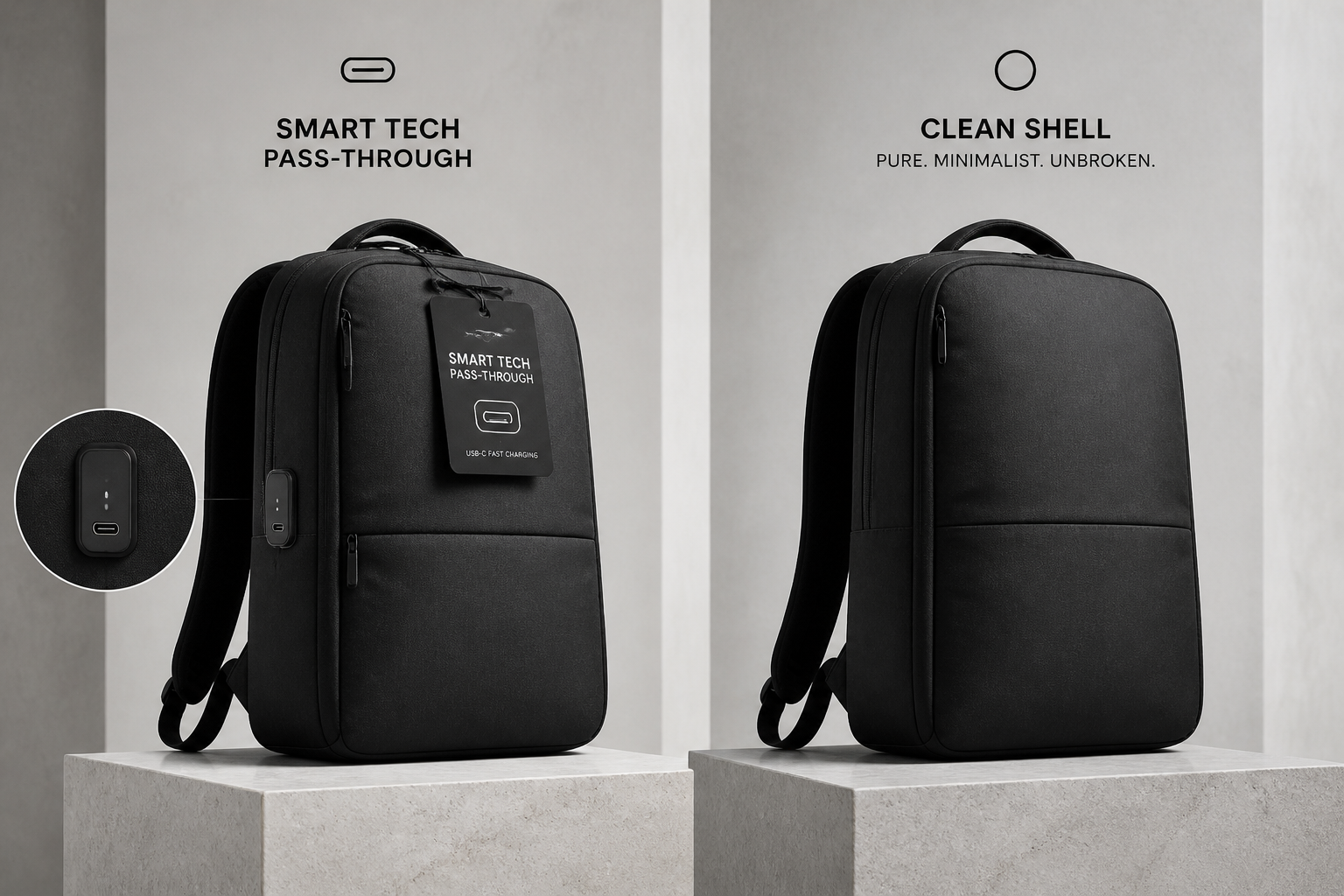
The port itself is cheap. An external USB-A female socket with a 30cm internal cable, a routing grommet, and a small Velcro-secured power bank pocket adds USD 0.60 to 1.40 per unit at 1,000 pieces. Add a second port, a USB-C output, or a hidden pass-through that reaches the laptop compartment, and the number rises to USD 1.90 to 2.80.
At Tianqin we treat the port as a hardware assembly rather than a single part, because the real cost sits in the routing. The internal cable has to survive repeated flexing where the bag folds, and every turning point needs either a reinforced channel or a strain relief. Skipping that step is the most common reason a port fails inside a warranty period.
There is a second cost line most buyers never model: the power bank is not part of the bag. If the listing implies a charger is included, the buyer owns that promise, and no factory quote can absorb it.
Volume changes the economics only mildly. At 300 units the port assembly costs about USD 0.25 more per unit than at 3,000, because the cable and socket are bought in smaller lots. The port is not a feature where volume creates a step change, so a small private-label launch pays almost the same per unit as a large program. That matters when a brand plans to test a USB variant with 500 pieces before committing to a container order.
The Retail Price Ceiling Question
A USD 1.00 feature can support a USD 10 price increase only if the customer already believes the bag is worth it. The port works as a price justification on a bag retailing above USD 49, where a USB port reads as part of a tech-forward spec set. On a USD 24 to 34 bag, buyers in the US and EU treat the port as expected rather than exceptional, and the feature does not move the ceiling at all.
That is the honest trade-off. Adding a port to a mid-price bag usually costs margin and adds service load without changing what the customer will pay. Adding it to a premium bag is a different calculation, especially in corporate gifting, where the port shows up in the program specification and helps justify a per-unit budget.
Our own position: we quote the port every time a buyer asks, and we also tell them when the price band does not support it. A buyer who prices the bag at USD 39 with a port usually ends up removing the feature on the second order, once the listing copy has to explain a power bank the customer does not own.
One more angle worth testing before you commit. If the bag already carries a dedicated power bank pocket with a cable pass-through and no external port, the customer keeps the charging function while the marketing claim becomes simpler and the failure point disappears. That configuration costs about USD 0.30 and has produced fewer support tickets than a full port assembly in the programs we supply.
Conversion Signals in Listing Data
Conversion data on this feature is mixed and easy to misread.
Listings with the port in the main image and in the title show the strongest lift, because the feature is discoverable without scrolling.
Listings that mention the port only in the bullet list show a small lift, often inside normal noise.
Listings where the port is present but the copy explains nothing about power banks see no lift and rising questions.
Travel and commuter channels respond better than campus channels.
Corporate gifting specifications respond best of all, because the port is written into the requirement document.
Across the programs we supply, the pattern is consistent: the port sells when the listing explains it, and it burdens the seller when it does not.
The Support Burden Nobody Quotes
The first question most buyers ask us is whether the port actually charges a device. It does not, unless a power bank is inside the bag, and the warranty terms say nothing about a power bank that is not ours.
Support load takes three predictable forms. Customers ask where the battery is. Customers report the port as broken when the cable is fine but the power bank is empty. Customers return the bag because the port does not charge their laptop, which no 5V port can do.
None of these are manufacturing defects, and all of them cost the seller money. A clear diagram on the hangtag or in the listing copy removes most of them. We now supply that artwork with every USB port program.
There is an asymmetry buyers should weigh honestly. The port is a low-cost part with a high explanation cost. In a marketplace channel where a customer reads one paragraph of copy, that ratio works against the seller. In a corporate gifting program, where the feature appears in a specification document and the recipient reads nothing, the explanation cost drops to zero and the port is a clean win.
USB Port Specification Checklist
Confirm the port output rating before printing any claim, our baseline is 5V at 2.1A
Controlla che il cavo interno sia classificato per la corrente, non solo per il connettore
Verifica il sistema di protezione contro le sollecitazioni in ogni punto di piega; sono necessari almeno due canali rinforzati
Conferma le dimensioni della tasca per power bank: il nostro modello standard misura 145 mm × 75 mm × 22 mm
Decidi se la tasca sarà chiusa con cerniera, elastica o aperta, e calcola il prezzo per ciascuna opzione
Chiedi il materiale dell’occhiello per la perforazione dello strato esterno: funzionano sia metallo che plastica
Assicurati che la porta non sia posizionata dove una cintura per i fianchi o una cinghia eserciti trazione su di essa
Richiedi l’illustrazione per l’etichetta appesa o per il foglietto esplicativo che descrive il requisito relativo al power bank
Conferma che il cablaggio della porta non annulli la garanzia della borsa qualora il cliente utilizzi un cavo più spesso
Verifica che l’insieme della porta superi il test di piegatura per 500 cicli prima dell’approvazione in serie
Chiedi la conferma della conformità agli standard USA ed UE per ogni componente elettronico
Include the port cost as a separate quote line so you can remove it in negotiation
Decide Before the Next Sample Round
Make the port decision with the price band on the table, not after the sample arrives. Bring us three numbers: your expected retail price, your target FOB, and the channel you are selling into. We will quote the build with and without the port assembly and tell you plainly whether the feature earns its place at that price.
If the channel is corporate gifting or premium tech retail, spec the port and invest in the explanation. If the channel is volume marketplace sales below USD 40, spend the same USD 1.00 on the laptop compartment foam instead, where every customer feels the result.
Send your target retail price and channel to [email protected], or review our OEM and ODM programs at www.tianqinbag.com . Sample turnaround is 7–15 business days from our Quanzhou factory, and we can build one USB sample and one without it from the same pattern so the decision is made on physical evidence.

 Nuntii Calidi