EN



A retailer asks for a two-year warranty on a USD 79 backpack and then asks what laboratory evidence supports it. That question is hard to answer with a photograph. Lab testing turns a claim into a number, and a number can be written into a warranty policy, a purchase order, or a packaging statement. Below is the test matrix we run on laptop backpacks, with the benchmark values we use to decide which material and which construction is allowed into a given price band.
Static Load Testing
Static load testing answers one question: does the bag hold its shape and its seams under sustained weight.
We load a finished 25 L backpack to 20 kg, hang it by both shoulder straps, and leave it for 24 hours in a controlled room at 23 degrees Celsius. Passing means under 5 mm of seam extension measured at the base corners and under 5 percent webbing elongation at the anchor. Anything beyond that shows up later as a sagging bag, which is the complaint that customers describe as cheap rather than broken.
The 20 kg figure is roughly 1.6 times the heaviest realistic load we expect in this category. A 15.6-inch laptop plus charger, documents, and a water bottle lands near 6 kg. The margin covers misuse, and buyers who test at the realistic load only are testing a scenario they have already survived.
One note on interpretation: static testing flatters good fabric and punishes bad sewing. We have seen 600D Oxford polyester hold 20 kg for 24 hours with a 2 mm seam extension when the seam was balanced, and fail at 8 mm when the same fabric was sewn with loose tension on a high-speed machine.
Dynamic Load and Drop Testing
Static tests are gentle compared with a commuter dropping a bag on a train platform.
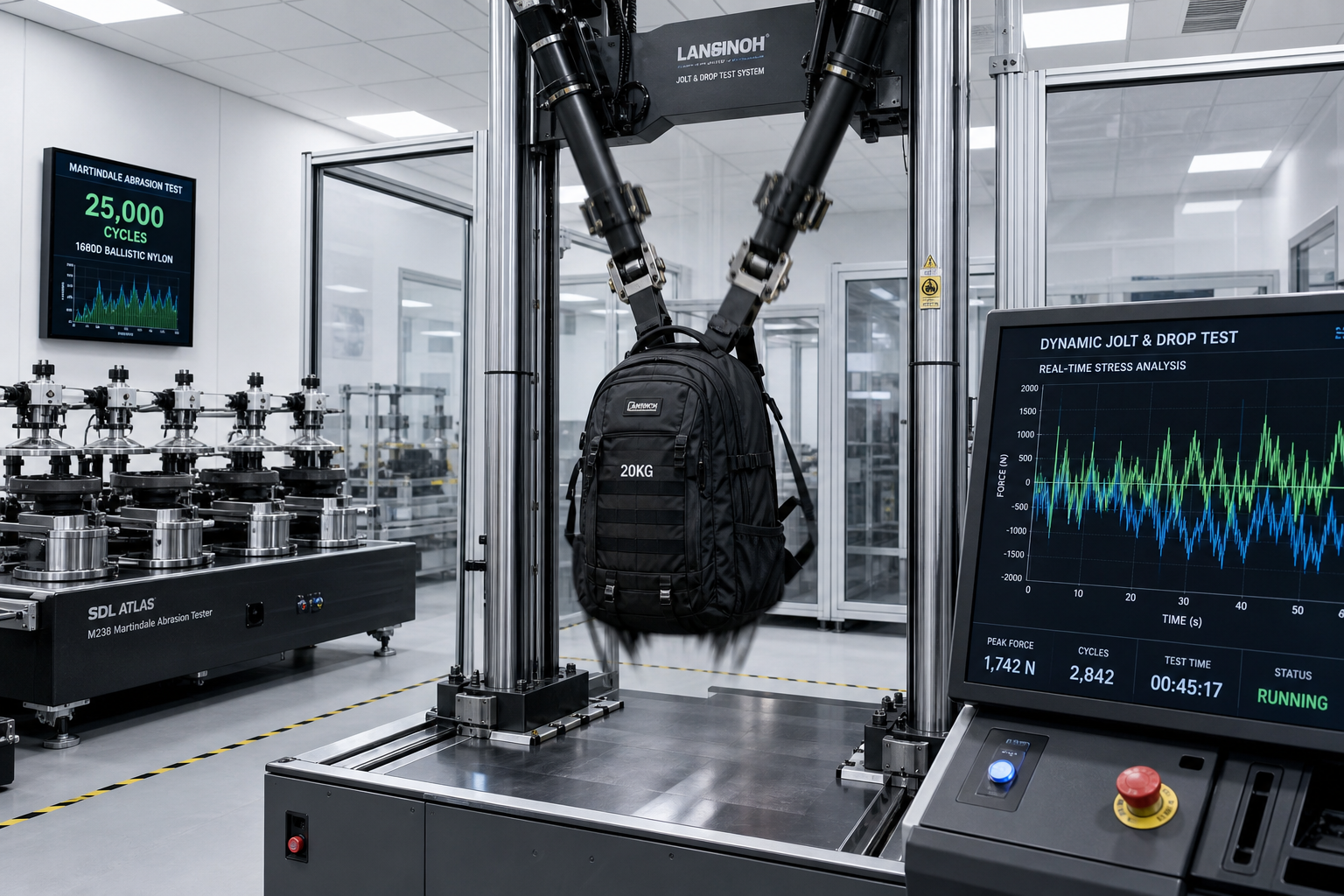
Our dynamic protocol: fill the bag to 15 kg, then drop it 500 mm onto a concrete floor, one drop on each of four faces and one on the base edge, eight drops total. A unit fails if a seam opens, a strap anchor pulls, the zipper splits open under the load, or the laptop compartment foam delaminates from the shell. The 500 mm height is higher than a table drop, which is deliberate. A bag that survives 500 mm on concrete will survive normal handling.
We also run a swing test for strap durability: 500 cycles of swinging the loaded bag in an arc, which loads the anchor at an angle rather than straight down. That angled load is what tears anchors in the field, and it is not covered by a vertical pull test.
There is a real trade-off here. Drop performance improves with heavier shell fabric, thicker foam, and additional bartacks, and every one of those adds grams. Going from a 600D polyester shell with 8 mm EPE to 1680D ballistic nylon with 10 mm EVA adds roughly 180 g to a 25 L bag and around USD 2.10 per unit at a 3,000-unit order. Performance rises measurably; so does shipping weight per carton and retail shelf feel.
Abrasion: Martindale and Taber
Abrasion testing tells you how the outer shell will look after two years of sliding on floors, car seats, and luggage carousels.
Martindale is the test we cite most often because it reproduces rubbing wear in a way that maps to real use. Following ASTM D4966 and ISO 12947-2 at 12 kPa with a standard abradant, our reference points are these:
600D Oxford polyester with PU backing: surface change between 12,000 and 15,000 rubs
900D polyester: surface change between 18,000 and 22,000 rubs
1680D ballistic nylon: above 25,000 rubs with no visible yarn break
Our engineers ran Martindale testing on three 600D polyester variants from two mills before we standardized on the current supplier. The cheapest of the three showed a visible surface change at 7,800 rubs, which would have failed a two-year warranty claim rate target of under 1 percent. The material cost difference was 6 cents per meter, which is nothing against the warranty exposure.
Taber abrasion, tested to ASTM D4060 with an H-18 wheel at 500 g load over 1,000 cycles, gives us a second data point on coated fabrics, mainly to catch coating loss on the base panel. It is a harsher test, so we use it comparatively rather than as a pass or fail gate.
A limitation that buyers should hear: both abrasion methods test a flat specimen. Real wear happens on curved panels, over seams, and at corners where the bag touches the ground. Lab abrasion data ranks materials and locks a supplier's quality, and it cannot predict the month a specific bag will wear through.
Seam Strength and Zipper Reciprocation
Seam strength testing to ASTM D1683 measures how much force a seam takes before the yarns begin to slip. Our internal acceptance for a load-bearing seam on a laptop backpack is 500 N, measured on a 100 mm wide specimen, with a grab test at 400 N minimum before fabric rupture.
Zipper reciprocation is the component test that produces the most useful warranty data. We run the main compartment zipper through 5,000 open and close cycles at 30 cycles per minute under a 1.5 kg load, and require no binding beyond 3 mm and no tape separation beyond 2 mm. Adjacent tests cover slider puller retention at 70 N and slider deformation under load.
The first question most buyers ask us is whether a lab report from a Chinese laboratory will be accepted by their retailer or their marketplace. In most cases the answer is yes, because the methods are the same ones used internationally. SGS and Intertek reports testing to ASTM, ISO, and EN methods are accepted by the majority of US and EU retail buyers, and we keep reports on file for every shell fabric and hardware item we buy.
The Lab Test Matrix
These are the values we work to for a 25 L laptop backpack. Adjust them to the price band you are selling into.
Static load: 20 kg for 24 hours on both straps, fail over 5 mm seam extension
Static webbing: 20 kg for 24 hours, fail over 5 percent elongation
Dynamic drop: 15 kg load, 500 mm onto concrete, 8 drops, no seam or anchor failure
Swing test: 500 cycles with 15 kg, no anchor tear or bartack failure
Martindale abrasion: ASTM D4966 at 12 kPa, 600D Oxford minimum 12,000 rubs
Martindale abrasion: 1680D ballistic nylon minimum 25,000 rubs
Taber abrasion: ASTM D4060, H-18 wheel, 500 g, 1,000 cycles, coating intact
Seam slippage: ASTM D1683, 500 N on load-bearing seams
Base panel grab test: 400 N minimum before fabric rupture
Zipper reciprocation: 5,000 cycles at 30 per minute, 1.5 kg load, no binding over 3 mm
Slider puller retention: 70 N for 30 seconds, no tab separation
Foam retention: no delamination of the laptop compartment foam after drop testing
What Each Result Means for Your Warranty
Match the test value to the warranty you intend to publish. A two-year warranty on a daily-use commuter bag needs a shell at 25,000 Martindale rubs, seams at 500 N, and a main zipper that clears 5,000 cycles. A one-year warranty on an entry price band can hold at 12,000 rubs with a 400 N seam, and the unit cost difference between those two builds is real money at scale.
Write the numbers into the purchase order, not just into the conversation. A specification that says the shell must be abrasion resistant is unenforceable. A specification that says the shell must reach 12,000 Martindale rubs at 12 kPa under ASTM D4966 with a report to prove it can be checked by any lab in any country.
At Tianqin, no new shell fabric enters bulk cutting until we hold a lab report for it, and we keep those files because buyers ask for them at the worst possible moment, usually two days before a shipment is due. Send your target warranty and retail price to [email protected] and we will map a test matrix and material set to it. Samples take 7 to 15 business days, and test reports from SGS are available on request. Product lines and factory details are on www.tianqinbag.com.

 Hot News