
 EN



A shipment of 4,500 laptop backpacks sat in Rotterdam for eleven days last spring because the fiber content printed on the hangtag did not match the lab report for the lining. The bags were fine. The paperwork was not. Almost all of that loss is decided before production starts, inside a spec sheet written without a standards map for the destination market. The first question most buyers ask us is which certificates we can send, and the honest answer is that the certificate is the last step, not the first.
Map the destination market before you write the spec sheet
US and EU rules overlap in intent and diverge in detail, so a single test pack rarely covers both markets without additions.
In the US, the binding layer for an adult laptop backpack is mostly state law, chiefly California Proposition 65, plus retailer restricted substance lists that are frequently stricter than the law itself. Where a bag is marketed for children or carries child appeal, CPSIA obligations and third-party testing come into scope.
In the EU, REACH Annex XVII governs restricted substances, the General Product Safety Regulation sets the general safety duty, and national textile labeling law controls what must be printed on the product and its packaging.
A backpack is not one material. It is shell textile, lining textile, webbing, foam, zipper tape, metal hardware and printed ink, and each of those pulls a different restriction list. This is why a single fabric test report cannot clear a whole product, and why buyers who assume otherwise end up re-testing after the sample is approved.
Build one master specification and two compliance annexes. The US annex lists heavy metals, phthalates and Prop 65 substances. The EU annex lists REACH entries, azo dye limits and labeling declarations, including the official language required per member state. Buyers who write one annex and ship to both markets usually pay for that shortcut at the port.
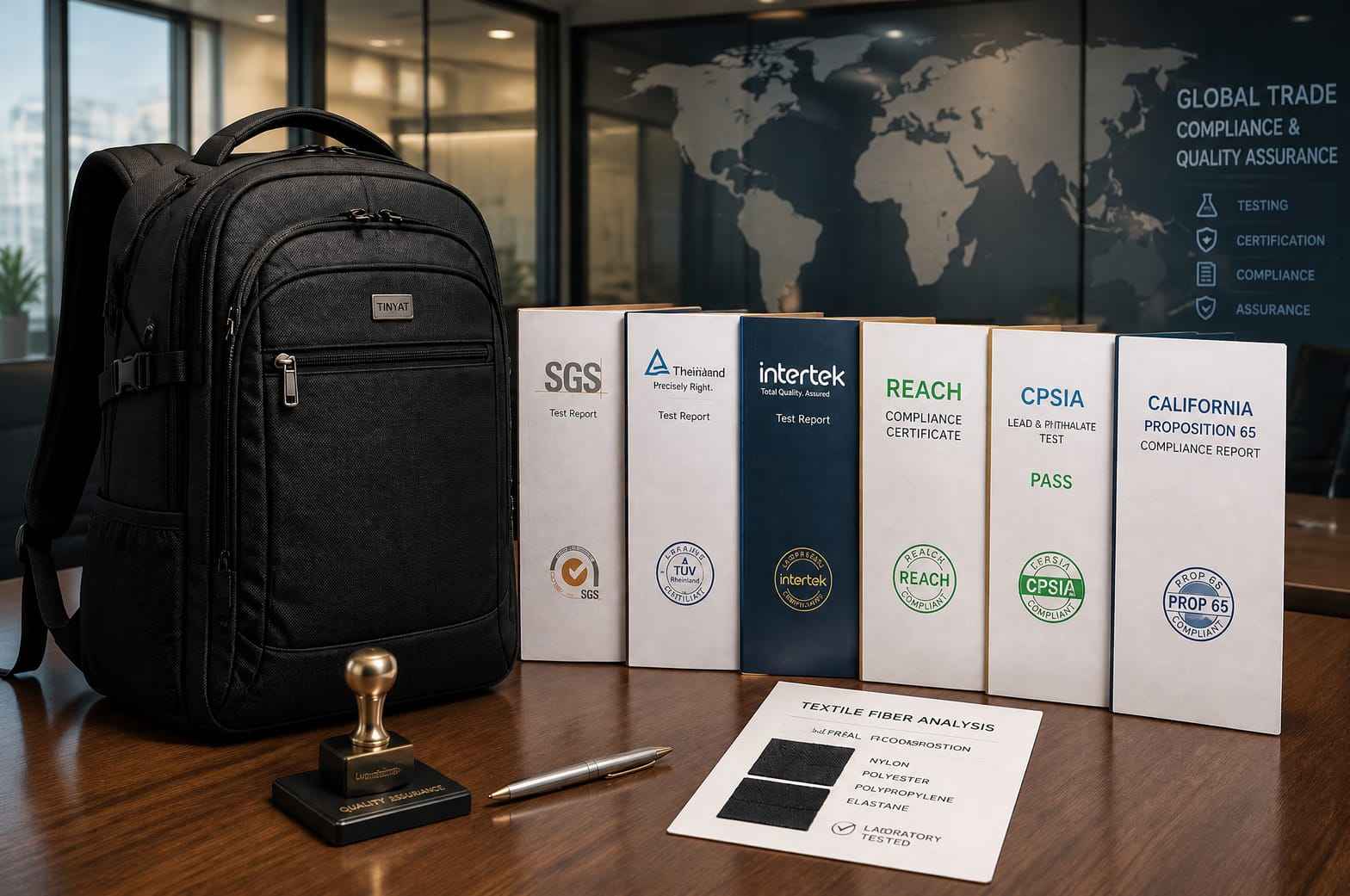
What US buyers must lock into the spec sheet
Write the substance limits into the purchase order, not only into the pre-order email. A limit that lives in email does not survive a supplier change or a staff change.
Four lines matter most for a laptop backpack sold in the US.
Total lead in accessible substrate, tested per component rather than per whole product
Phthalates DEHP, DBP and BBP in any flexible PVC, coated fabric or printed plastisol
Cadmium in metal hardware and zinc alloy pulls
Prop 65 warning decision, either a tested clear position or agreed warning text
That fourth line is the one buyers postpone, and it is the one that creates retail rejection later.
At Tianqin, hardware for our laptop backpack lines is specified as zinc alloy rather than a lead-containing zinc casting, and we keep the alloy mill certificate with the batch record. It costs roughly 3 to 5 percent more on hardware than the cheapest casting on the market. We accept that cost because a lead or cadmium finding in a 0.12 USD zipper pull can block a 38,000 USD order.
Timing matters just as much as content. A heavy metal screen or a Prop 65 panel runs 5 to 7 working days at SGS on standard turnaround. If your container booking is already released when the sample goes to the lab, you have built the delay into your own schedule and your supplier will get the blame for it.
What EU buyers must lock into the spec sheet
REACH is a substance regime, not a product certificate, and that distinction trips up a lot of importers.
The restriction groups that show up most often in backpack test failures are the ones to write into the spec.
Azo colorants that can release banned aromatic amines, most often found in dyed webbing and in black or navy shell fabric
Phthalates in flexible PVC trims, PU coated fabric and heat transfer prints
Heavy metals, particularly lead and cadmium in metal fittings and in printed ink
Organotin compounds, relevant when antibacterial finishes are applied to lining
A second EU layer catches buyers by surprise. Any textile component, and any material in prolonged skin contact, brings labeling duties on fiber content, care instructions and country of origin. We treat the care label and the fiber declaration as compliance items, not as print design, and we will not release a bulk order until the label artwork has been checked against the fiber test report.
Our standard lining for the business laptop backpack range is a 210D polyester with no antibacterial finish, chosen partly because it avoids the organotin question entirely. The trade-off is real. We cannot market that lining as antibacterial, and some buyers specifically ask for that claim on the hangtag. We show them what the claim costs in testing and in risk, then let them decide rather than quietly printing a claim we cannot support.
The spec sheet checklist we send to new buyers
Use this as a working document with your supplier before the first sample is cut.
Destination market and sales channel, because mass retail and marketplace listings apply different audit rules
Full bill of materials at component level, including zipper tape, pulls, webbing, foam and thread
Substance limit list per component, with the regulation cited next to each limit
Test standard per item, for example EN 71-3 for heavy metal migration or the applicable CPSIA method
Named lab, and confirmation that your retailer or marketplace accepts that lab's report format
Label artwork showing fiber content, care symbols, country of origin and required language
Written confirmation that the tested color and material match the production color and material
Owner and deadline for each document, dated before your booking cut-off, not after
That last row is the one buyers skip, and it is the one that decides whether a shipment moves on schedule.
Where buyers actually get caught
Three patterns account for most of the compliance delays we see on laptop backpack programs.
The report covers a different color. Black fabric and navy fabric may share the same construction, but they use different dyes, and a dye test on one does not automatically clear the other.
The report is old. Substance rules change, and a report issued three years ago may reference a limit value that has since been revised or replaced.
The report covers the sample, not the production batch. If the mill changed, or the trim supplier changed mid-order, the tested item and the shipped item are no longer the same thing, even though both carry the same product code.
Honest trade-off: full component-level testing on every color and every trim adds cost and calendar time, and for a 500-unit trial order it can be hard to justify against the margin. Our working rule is to test the components that touch skin and the components that fail most often, then run a production batch spot check instead of a full panel. It is a compromise, and we say so up front rather than promising a clean sheet that does not exist at that volume.
Build compliance into your first purchase order
Do not treat compliance as a document you collect at the end. Put the annex inside the purchase order, name the responsible party on both sides, and set the report deadline at least 10 working days before your booking cut-off so a failed item can still be fixed with a substitute trim.
Then verify once, properly. A single well-scoped test pack that matches the production material and the production color is worth more than five old reports that do not.
Send your destination market, target retail channel and bill of materials to [email protected]. Our sampling turnaround is 7 to 15 business days, and we can confirm which SGS reports already exist for your chosen materials before you commit to a specification. Capability details and current product lines are at www.tianqinbag.com.

 Hot News


