
 EN



Three sample rounds is a normal month in bag development. Each round costs freight, factory time, and two to three weeks of a season. After running 3D sampling on laptop backpack programs at Tianqin, our first-sample approval rate moved from the industry-typical pattern of 3 to 4 rounds down to 1 or 2. Here is what the render actually proves, what it cannot, and where a physical sample stays mandatory.
Why 3 to 4 rounds happen
Approval rounds multiply when the buyer and the factory are looking at different things. A flat technical drawing hides depth, pocket bulge, and hardware scale. Two people read "slim, professional profile" and picture different backpacks.
The typical failure sequence:
Round 1 reveals a proportion problem: the front panel reads bulky at 30L.
Round 2 reveals a detail problem: the zipper garages sit too close to the handle.
Round 3 reveals a trim problem: the puller looks oversized against the panel.
Round 4 is often the round where nothing structural changes, only confidence.
None of these require a sewing line. All of them require an image both sides can point at.
We track where rounds come from. Across first-time OEM laptop backpack projects, roughly half of all revision requests are about proportion and pocket layout, which a render settles in days. The other half concern fabric hand, weight distribution, and comfort, which only a physical unit answers. Splitting your own comment list into those two categories before you send it tells you which requests a render can close and which you should hold for the physical sample.
What a 3D render proves
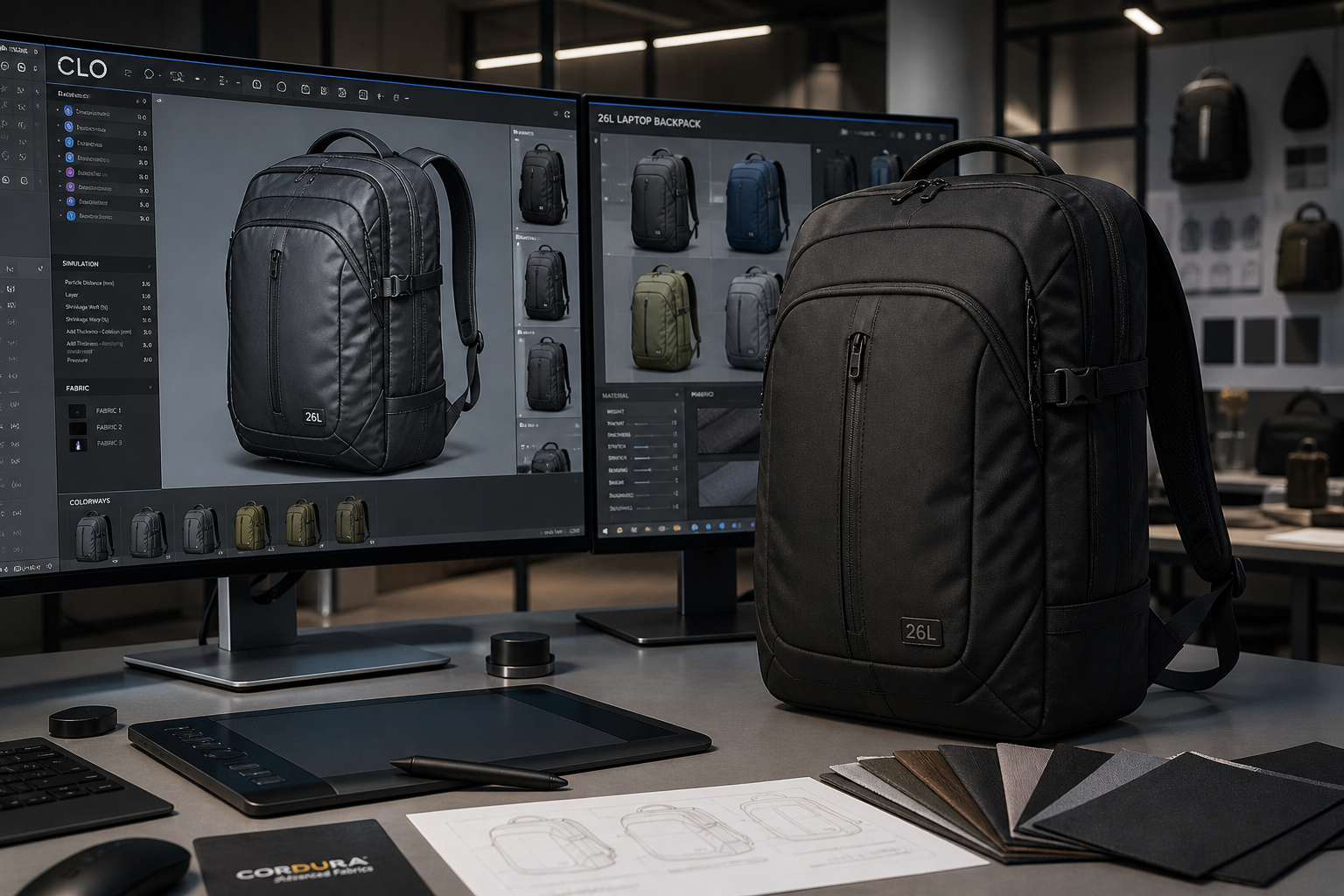
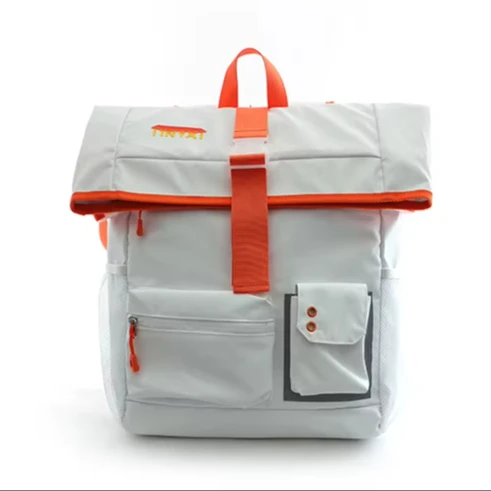
A 3D render proves geometry and proportion before fabric is cut. At Tianqin we build the model from pattern data, so the render dimensions trace back to the same numbers used on the cutting table.
What it settles reliably:
Overall proportion and volume at 20L, 25L, or 30L capacity.
Pocket placement and access angle, including whether a side pocket collides with the main zipper path.
Hardware scale relative to panel size.
Logo and label placement, including embroidery size on a curved front panel.
Colour blocking combinations across linings and trims.
Render turnaround is 2 to 4 business days from an approved tech pack. A revision inside the same model runs 1 to 2 days, because we are adjusting parameters, not rebuilding a sample.
That speed is the point. A buyer can review six colourways and three pocket layouts in one week instead of booking six physical samples across six weeks.
A render also gives your sales team something to test with a retail buyer before tooling is committed. When a US distributor needs internal sign-off on a new laptop backpack shape, the render can go into a deck the same week the tech pack is signed rather than three weeks later. Buyers who run an approval committee tend to value this more than the sample saving, because the render unblocks a decision that otherwise waits on a physical unit sitting in another country.
What a 3D render cannot prove
Drop a render and it stays pixel-perfect. Real backpacks do not.
A render cannot tell you:
How 1680D ballistic nylon drapes over a foam edge, or whether the panel shows a wrinkle at the seam.
Whether a 10 mm EPE foam back panel feels right against the spine after 30 minutes of wear.
Whether the seam allowance is sufficient for a bar-tack at the strap junction.
Whether the zipper runs smoothly around a 90 mm corner radius in the actual fabric.
Whether stitching density reads as premium at a 3 mm spacing versus 4 mm.
At Tianqin we tested this on a 25L business laptop backpack. The render showed a clean seam between the front panel and the bottom; the physical sample showed a pucker that needed a 3 mm pattern adjustment and a change in seam direction.
So 3D is a filter, not a replacement. It removes the rounds that were never about hand feel, and it leaves the rounds that genuinely need a physical unit.
The boundary sits exactly where touch, tension, and weight begin. Nothing in the render data tells you whether the strap edge digs in at 8 kg load, whether the back panel ventilates on a warm commute, or whether a customer picks up the pack and believes it is worth the shelf price. Those are product truth questions, and they belong to the sample, not the screen.
How we run a 3D round
Our sequence on a new OEM program:
Tech pack and gap list first, returned in one pass.
3D model built from pattern data, 2 to 4 business days.
Two camera angles minimum, plus a detail view of the laptop sleeve opening.
Buyer comments consolidated into one revision request, not a rolling stream.
Revision render in 1 to 2 days, with up to two revisions included in the development stage.
Physical sample built only after the render is signed off as geometry-approved.
This order matters. When buyers treat 3D as a preview before the sample, first physical samples land closer to approval. When they treat 3D as a formality after the sample, nothing changes and the rounds continue.
One process rule we hold to: comments go in one batch. A rolling stream of single-line emails, each triggering its own revision render, can consume a week that a consolidated revision request would have used in 2 days. On one recent program a buyer sent comments across five emails in four days; when we merged them into one request, the revision came back in 36 hours.
The first question most buyers ask us is whether 3D replaces the physical sample. It does not, and we say so in writing before a project starts, because a supplier that promises otherwise is selling a shortcut you will pay for at the bulk stage.
Render review checklist
Use this list when you open a 3D file from any supplier.
Ask for the model dimensions, not only images, and compare the laptop sleeve opening against your device size plus padding.
Confirm the camera angle list: front, side, three-quarter, back, and one interior view of the main compartment.
Check pocket access angles for a 15.6-inch or 16-inch device, not a drawing-sized placeholder.
Verify hardware scale against a known reference, such as a stated 20 mm webbing width.
Confirm trim colours against Pantone codes rather than screen appearance.
Ask which pattern revision the model is built from, and whether the render matches the current tech pack.
Request two colourways minimum if you plan a range, so trim contrast is visible.
Ask explicitly what the render does not show, and put those items on the physical sample comment sheet.
When a physical sample is still required
Always, before bulk. The question is only whether you pay for one sample round or three. Physical sampling stays mandatory for structure, comfort, and hand feel, and for any construction change to the back panel or strap geometry.
A physical sample on a new laptop backpack typically costs 150 to 400 USD depending on hardware and logo work, plus 40 to 80 USD in express freight. Two fewer rounds saves 300 to 800 USD per design and 3 to 6 weeks of calendar time, and the calendar saving is usually the larger number.
If your program has a fixed retail window and three physical rounds would consume it, start with the render and use the saved weeks as buffer. If your design changes the back panel or the load-bearing strap geometry, plan for a physical unit regardless, and treat the render as preparation for it rather than a substitute.
Send your tech pack to [email protected], or see our development process at www.tianqinbag.com. We return a 3D view in 2 to 4 business days and build physical samples in 7-15 business days, and we will tell you plainly which parts of your design the render cannot settle.


 Hot News


