
 EN



An EU distributor asked us to cut 200 grams off a 25L laptop backpack while keeping the same two-year warranty terms. We did it, but not where they expected. Half the savings came from a lining change the customer never sees, and the other half came from hardware that had been over-specified for a bag that would almost never be loaded past 6kg. Weight reduction is easy to claim and hard to place correctly. This is where the grams should come from, and where they should never be cut.
Where the Grams Actually Come From
A typical 25L laptop backpack with 1680D ballistic nylon shell and padded 15.6 inch laptop compartment lands between 780g and 1,050g. Break that down and the picture gets useful.
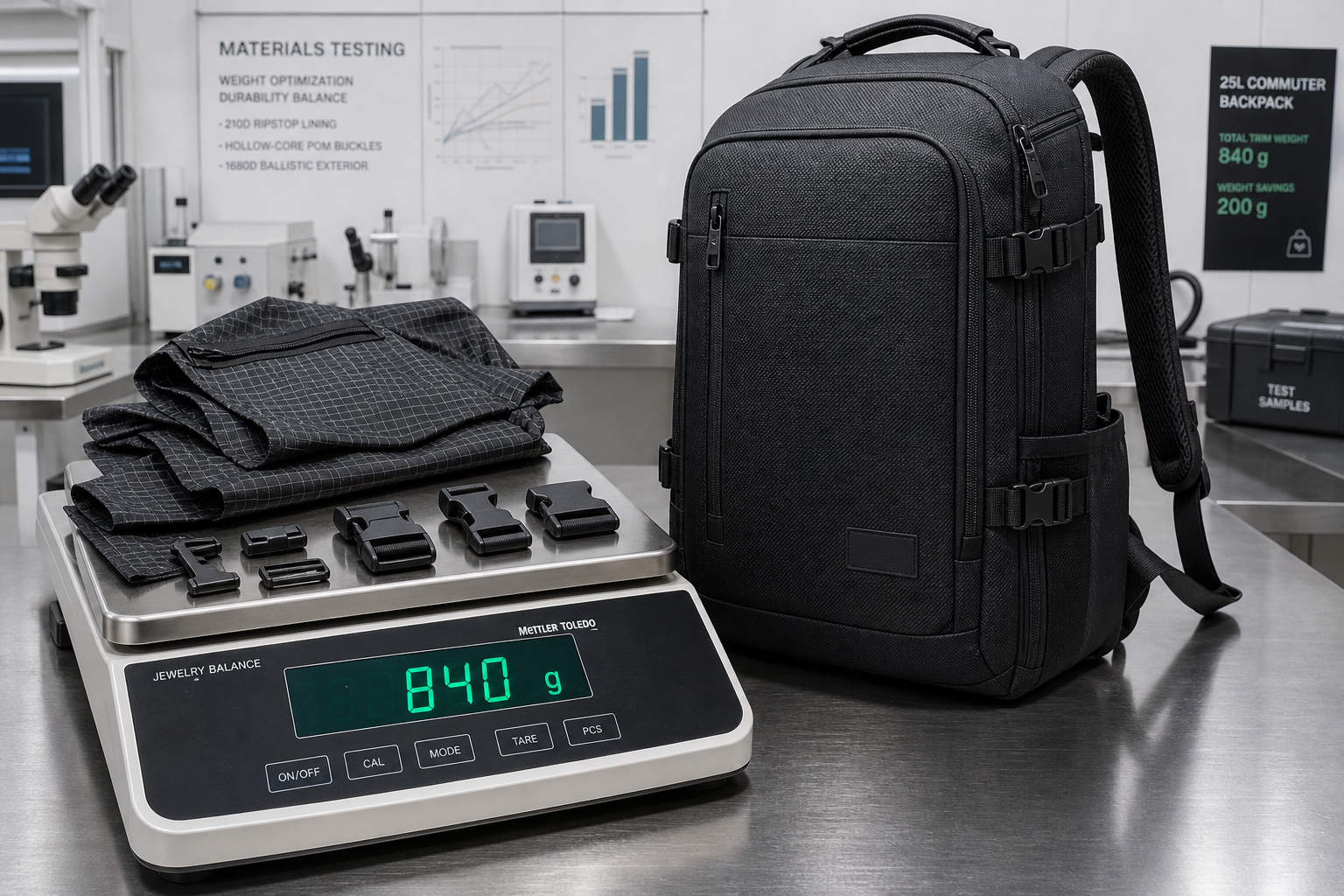
Shell fabric and lining account for roughly 300 to 420g. Foam across the back panel, shoulder straps and laptop compartment contributes 180 to 300g. Webbing, edge binding and zipper tape add 80 to 130g. Hardware, meaning buckles, sliders, adjusters and the padded handle, adds 90 to 160g. The remaining 100 to 150g sits in stitching thread, labels, zipper teeth and the small parts nobody counts.
At Tianqin we weigh every component family during sampling and log it on the specification sheet. Once a buyer sees that 300g of a 900g bag is foam, the conversation changes from "make it lighter" to "which foam".
The Four Components Worth Paying Up For
Some weight is load-bearing, and removing it costs more than it saves.
Foam is the first. Moving from 8mm EPE at 25kg per cubic meter to a lighter foam dimple pattern saves 40 to 70g across a full back panel, but the panel stops holding its shape after a season. We recommend keeping density and reducing coverage area instead, so the lumbar zone stays dense and the upper panel goes thinner.
Hardware is the second. Zinc alloy adjusters on the shoulder straps cost USD 0.18 to 0.30 per set more than acetal, and add roughly 35g per bag. On a bag rated for 10kg or more, that is the right trade: acetal adjusters creep and slip under sustained tension.
Zipper grade is the third. A 10# YKK zipper on the main compartment costs more and weighs more than an 8#, but a main zipper carries the full load of the bag. We keep 10# main and accept 8# on secondary pockets.
Shell denier is the fourth. Moving from 600D Oxford to 1680D ballistic nylon adds around 90 to 140g and USD 1.10 to 1.80 per unit at 1,000 pieces. Below 20L the upgrade rarely pays. At 25L and above, abrasion resistance and shape retention change the bag's perceived value on the shelf.
Shoulder strap construction is the fifth component, and it is the one buyers undervalue most. A 12mm closed-cell foam strap with a 210D lining and edge binding weighs more than a flat 8mm strap, but it distributes a 6kg load across a wider band. Our stock spec uses 12mm foam in the strap body and tapers to 10mm near the sternum strap, which trims 20 to 30g per pair while keeping the load-bearing top section intact.
Where Weight Cuts Are Safe
Several reductions cost nothing in durability.
Lining weight is the easiest place. Dropping from 210D to 190D taffeta lining saves 25 to 45g and USD 0.08 to 0.15 per unit, and no end user has ever inspected lining denier. We keep the lining on the laptop compartment face unchanged, because friction against a laptop edge matters there.
Over-specified webbing is the second place. Many briefs ask for 25mm PP webbing on compression straps where 20mm nylon does the same job at 15g less per strap pair.
Pocket count is the third. Each mesh pocket with binding adds 12 to 20g. A 25L bag with seven internal pockets is heavier than the same bag with five, and retail surveys rarely show the extra two driving purchase.
Thread and binding weight is the fourth and most overlooked. Switching from a heavier bonded thread to a standard 40/3 poly thread across the whole bag saves 15 to 25g and changes nothing structural, provided stitch density stays at 8 to 10 stitches per inch. Cutting stitch density to save thread is where this turns into a real risk.
Carton and packaging is the fifth, though it is not part of the bag weight. Polybag thickness, hangtag stock and the master carton label count against freight, not against the durability story.
A Budget Allocation View for a 25L Program
Take a target FOB of USD 11.50 for a 25L laptop backpack at 2,000 units. Here is how we would allocate the build cost if the brief says "durable first, light second".
Shell and lining: about 34 percent of unit cost, spent on 1680D ballistic nylon on the high-wear faces and 420D on the side panels.
Foam and padding: about 16 percent, weighted toward the laptop compartment and lumbar area rather than spread evenly.
Hardware and zippers: about 19 percent, with YKK on all openings and zinc alloy on the two shoulder adjusters only.
Labor and construction: about 22 percent, including the doubled stitching we use on strap anchor points.
Labels, packaging and overhead: the remaining 9 percent.
The honest trade-off: this allocation produces a bag that is heavier than a fast-fashion competitor by roughly 120g, and a lighter-looking spec sheet loses some marketplace comparisons where weight is listed as a search filter. We take that position because warranty claims on strap anchors are far more expensive than a 120g gap, and we tell buyers so before they commit.
The first question most buyers ask us is how light the bag can be without losing the warranty position, and there is no single number that answers it.
One buyer lesson from 17 years of quoting this category: the weight number that matters is the shipping weight, not the marketing weight. A bag listed at 900g on a website that ships at 1,050g with polybag and hangtag creates a support conversation before the customer has even opened the box.
Weight and Durability Checklist for the Next Purchase Order
Weigh the approved sample by component family, not only as a total
Confirm shell denier and test report before approving FOB
Check foam density in kg per cubic meter, not only thickness in mm
Verify YKK branding on main and secondary openings
Confirm zinc alloy on load-bearing adjusters, acetal is acceptable elsewhere
Ask for strap anchor stitch count and the reinforcement construction
Test a 10kg loaded bag on a shoulder-strap cycle rig before bulk
Compare lining denier against the laptop compartment face spec
Count pockets against actual channel demand, not a competitor teardown
Record unit weight in grams on the packing list for freight planning
Recheck drop test after any weight reduction, never before
Document which grams were removed and what warranty risk each removal carries
Decide the Weight Target Before Tooling
Set the weight number and the durability floor at the same meeting. If the brief only states a weight, a factory will remove the cheapest grams available, and those are usually foam and hardware, which is where the durability lives.
Bring us a reference bag, your target unit weight in grams, your channel and your warranty terms. We will send a component-level weight breakdown with the sample so your team can see exactly what each gram costs. Sampling runs 7-15 business days from our Quanzhou facility.
Contact [email protected] or visit www.tianqinbag.com to start an OEM or ODM laptop backpack project. Sample turnaround is 7-15 business days, and we can produce two weight variants of the same pattern so the decision is made on a physical bag rather than a spreadsheet.

 Hot News


