
 EN



Fourteen hundred cartons of laptop backpacks cleared production on schedule last autumn and then sat for nine days at the port of loading because the cartons carried a shipping mark that did not match the commercial invoice. The factory had done nothing wrong. The buyer's own forwarder had issued a mark change after packing. Nothing about that delay was a manufacturing problem, and the whole cost fell on the buyer. Most shipment delays we see are paperwork and packaging events, not production events.
Where shipments actually stop
Four points break a laptop backpack shipment, and they are worth separating because the fix at each point is different.
The first is customs, where classification, valuation and missing declarations create holds. The second is packaging material rules, which buyers rarely review and which a surprising number of ports enforce strictly. The third is carrier refusal, usually triggered by marking, labeling or dangerous goods questions. The fourth is the buyer's own document pack arriving incomplete after the container is already booked.
Only the fourth is fully within the buyer's control, and it is the most common cause of the delays we are asked about.
Customs holds: classification, valuation and declarations
Classification
A laptop backpack is normally classified under a heading for travel goods, sporting bags or similar articles with an outer surface of textile materials. Slight wording differences in the product description can move a shipment into a different statistical line and a different duty or inspection profile.
The fix is simple and almost never done: put the exact HS code on the commercial invoice and on the packing list, in the same words on both documents, and keep it consistent across repeat orders. A description that changes between shipments invites a review.
Valuation
Under-declared value remains the fastest route to a hold, and it is the mistake with the worst consequences because it can trigger penalties as well as delays. Declare the transaction value on the invoice, including the per-unit price, the quantity, the trade term and the currency.
Where the goods are samples rather than a sale, mark them as samples with a nominal value and keep the invoice and the packing list consistent.
Missing declarations
The declarations that most often go missing on a backpack order are the ones nobody thinks of as product documents.
Country of origin statement, matching the wording on the product label
Azo dye and substance declaration, where the destination authority requires a supplier statement
Wood packaging declaration, where pallets or dunnage are used, with ISPM 15 treatment evidence
Textile labelling declaration, confirming that fibre content and care information is present
Both the commercial invoice and the packing list, with matching weights and carton counts
We send a scanned declaration set with the pre-shipment documentation on every order, so the buyer's broker has the origin and substance statements in hand before the container is loaded rather than after.
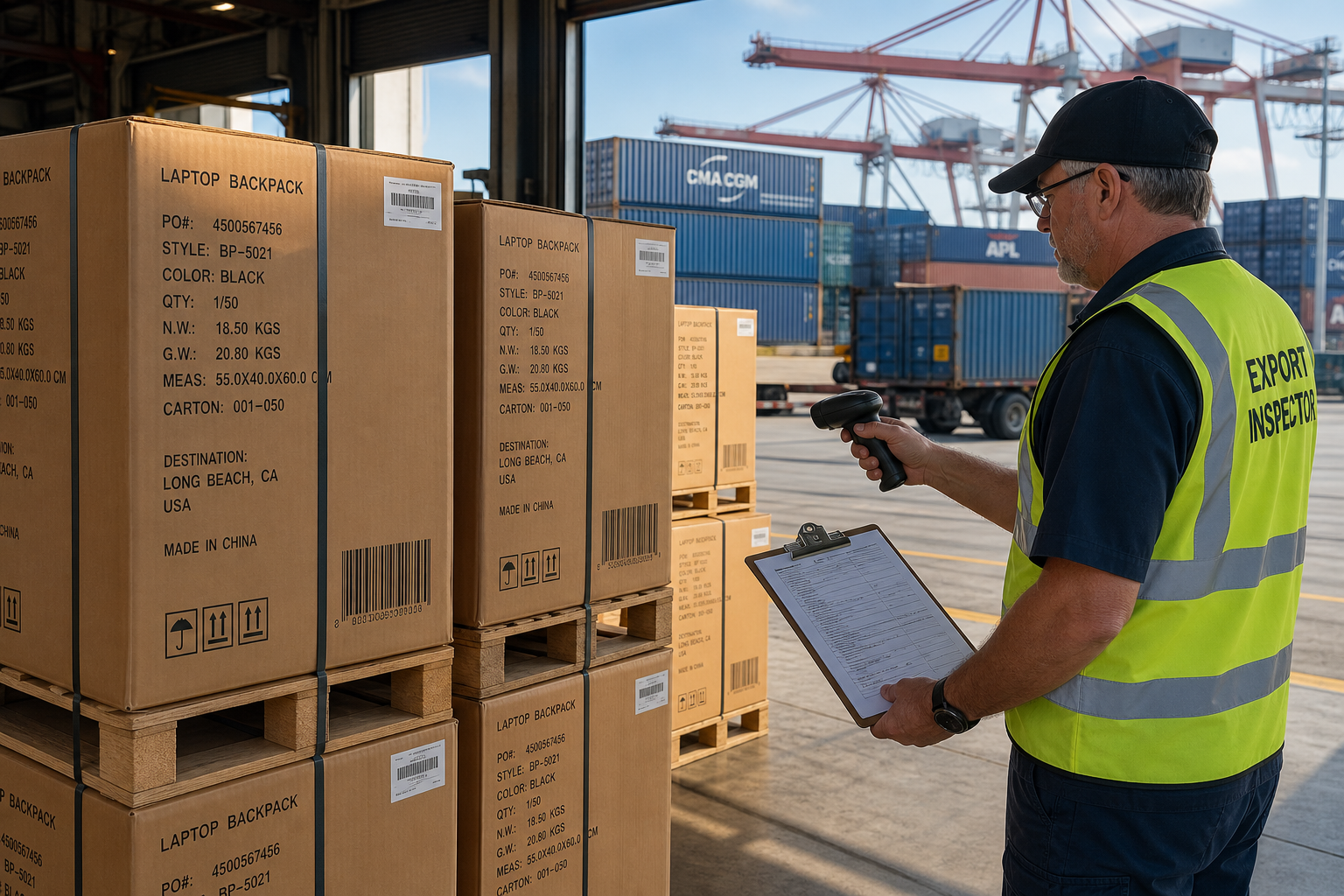
Packaging material violations nobody checks
Buyers spend weeks on the bag and no time on the box around it.
Heavy metal limits apply to packaging and to printed packaging ink in a number of jurisdictions. A recycled carton board with lead-containing print ink can fail a packaging substance screen even when the backpack inside passes every test.
Wood packaging is the harder rule. Untreated solid wood pallets and dunnage are rejected at the border in many countries, and the requirement is heat treatment or fumigation with the ISPM 15 mark applied to the actual wood. We ship laptop backpack orders on heat-treated pallets with the ISPM mark applied, and we hold the treatment certificate with the shipping file.
Polybag warnings for suffocation risk are required in some markets on any bag large enough to be a hazard. Carton drop and compression performance matters too. A carton rated for 12 bags that is packed with 18 will show crushed corners on arrival, and crushed corners are the first thing a retail distribution centre photographs.
One number worth tracking: our standard export carton for the 20L business laptop backpack takes 12 units and stays under 15 kg gross. Going to 18 units per carton reduces freight cost slightly and raises damage claims more than it saves, so we keep the count lower and tell buyers why.
Carrier refusals and marking problems
Carriers refuse shipments for reasons that have nothing to do with the goods being unsafe.
A lithium battery inside a bag with a built-in power bank is a regulated item, and a USB charging backpack that contains a battery must be declared as such with the correct documentation. A backpack with a removable empty power bank housing is not, and the difference in paperwork is significant. This is the single most common carrier question on charging backpack orders, and the answer has to be settled before booking.
Marking is the other frequent refusal. Shipping marks must match the commercial invoice. Carton numbering must run in sequence with no gaps. The port of discharge and the destination country should be legible on two adjacent sides of the carton. Where a customer supplies their own mark file, we require it at least 10 working days before packing, because a mark change after packing is a repacking job.
Labels on the outside of the carton must not cover the marking, and no old labels from a previous order should be left underneath. Customs officers look for that.
The pre-shipment document pack
This is the list we assemble on every order and send to the buyer before the container is loaded. Ask your supplier for the same set.
Commercial invoice with HS code, unit price, quantity, trade term and currency
Packing list with carton count, carton numbers, net weight and gross weight per carton
Country of origin statement matching the product label and the carton mark
SGS test reports covering the shipped material, colour and components, within validity
Substance and azo dye declaration signed by the factory
Textile fibre and care label artwork, in the approved version
ISPM 15 heat treatment or fumigation certificate for wood packaging
Battery declaration or battery exclusion statement for any USB charging model
Pre-shipment inspection report, where an AQL inspection was booked
Shipping mark file, approved by the buyer in writing, dated
Two rules keep this pack useful. Every document must show the purchase order number, so a broker can match them without asking. And the pack must be complete before booking, not before departure.
Build the document pack into the production calendar
Work backwards from the departure date, not forwards from the order date. Book an AQL pre-shipment inspection to finish at least 5 days before the container is scheduled. Confirm the shipping mark at least 10 working days before packing. Have the test reports in hand before bulk cutting starts, which is why we schedule sampling and substance testing in parallel.
The first question most buyers ask us is how early they need to send their marking and label files. Ten working days before packing is workable for a standard mark. A custom printed carton with a colour match needs 15.
Honest limitation: none of this removes the risk of a customs authority applying its own interpretation, and we cannot guarantee clearance. What we can do is make sure that no document we control is missing or inconsistent when the container is examined, because that is the type of hold that gets resolved in a day instead of a week.
Get the document pack before you book
Ask for the full pre-shipment document pack at purchase order confirmation, review it once, and fix the gaps while the goods are still on the production floor. A mark change found in week two costs an email. The same mark change found after packing costs a repack, a delay and a freight rebooking.
Send your destination country, channel and model list to [email protected]. We will send the declaration set we hold for those models and flag anything that needs new testing or a new label version. Sampling turnaround is 7 to 15 business days, and our full manufacturing capability is described at www.tianqinbag.com.
 Hot News


