
 EN



A US retailer asked us in January for a shell with 50 percent recycled content and a certificate to prove it, then asked why the quote ran 14 percent above the same bag in virgin polyester. That conversation repeats almost weekly now. Recycled material has become a standard line item in new briefs, so the practical questions are which recycled options exist, what certification actually proves, and which buyers are genuinely paying for it.
What Buyers Are Actually Asking For
Recycled content now appears in about 20 percent of our new laptop backpack briefs, up from under 5 percent in 2023. The requests cluster in three ways: a percentage claim, usually 50 percent or 100 percent rPET; a certification claim, with GRS the most requested; and a documentation request, meaning a transaction certificate, a test report, or both.
The first question most buyers ask us is whether recycled fabric performs as well as virgin. For the fabrics used in laptop backpacks the answer is broadly yes, with limits, and those limits matter more than the marketing language.
EU buyers lead on documentation. They ask earlier and they want the paperwork trail before sampling begins. US buyers lead on speed and often ask for the claim without the paperwork, which creates a problem later when the retail listing needs proof.
Retail timing matters as well. Claim review inside a large retailer often takes longer than the fabric lead time, so a buyer who raises the recycled content question after artwork approval usually loses the season. Raising it at brief stage costs nothing and changes how the quote is structured.
rPET and Recycled Nylon Options
rPET 600D Oxford
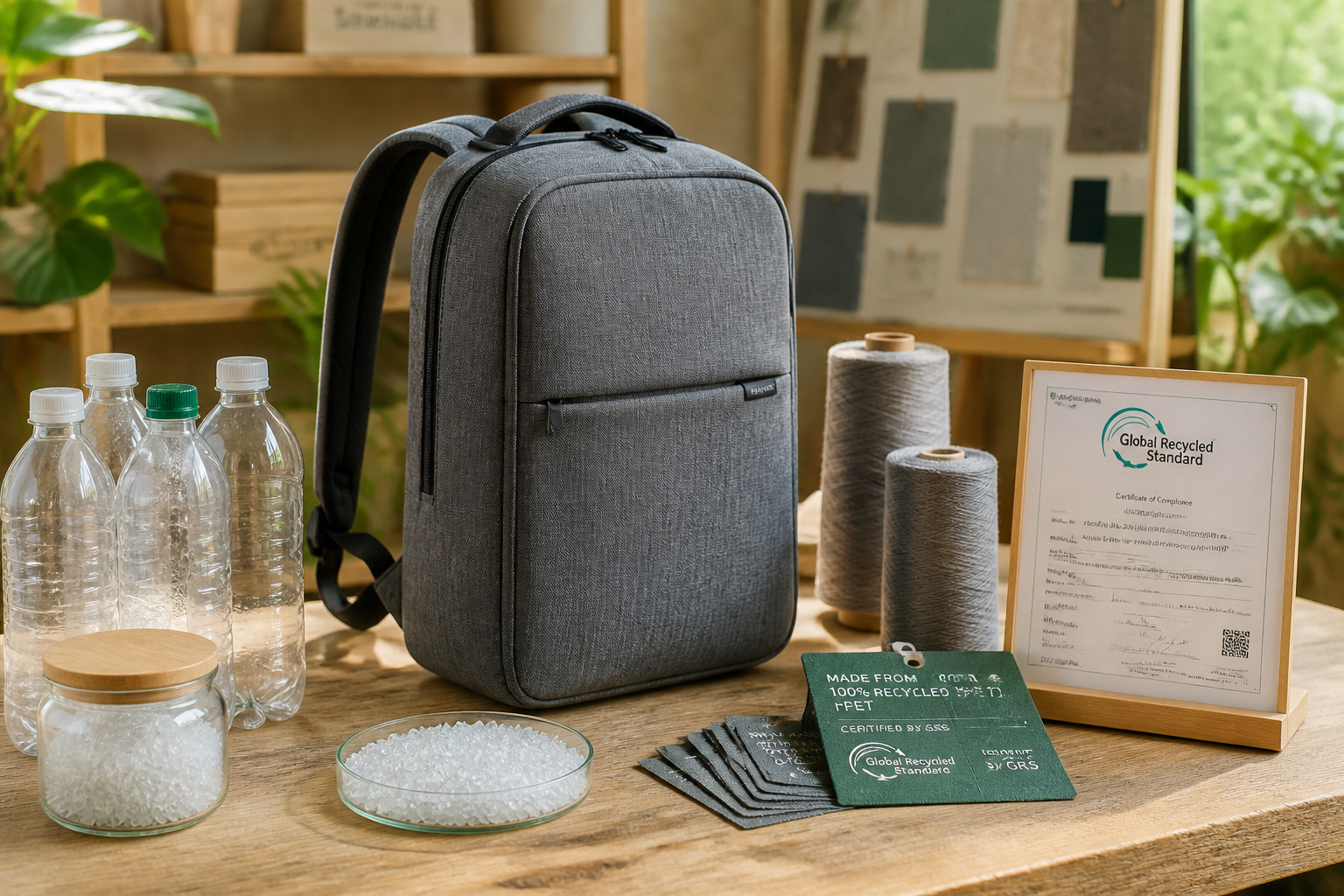
This is the workhorse of the category. Post-consumer PET bottles are chipped, melted and extruded into yarn, then woven to the same 600D construction and PU coated on the reverse. Hand feel and abrasion behavior sit close to virgin 600D Oxford. Color matching is the real constraint: recycled yarn lots shift slightly, so we recommend approving a color tolerance range rather than a single lab dip.
We also keep a substitute approval on file. If the recycled 600D lot runs short, a recycled 300D ripstop can move to a liner or a low-wear panel without changing the retail claim, and that single decision has kept two programs from slipping a schedule.
Recycled Nylon
Recycled nylon, usually from pre-consumer waste, appears in premium programs because it dyes more deeply and feels softer. It costs more than rPET and the supply base is narrower. Availability of specific deniers fluctuates, so we normally keep a substitute approval on file before production starts.
Linings and Webbing
The liner is the cheapest place to add recycled content and the easiest place to document, since it is largely out of sight and does not affect structure. We often propose moving the recycled claim to the 210D liner and the webbing first, which keeps the shell stable and reduces the cost impact.
Certification Implications
GRS is the certification most retail programs accept. It runs on a chain-of-custody model, which means the claim must be traced from the recycling source through yarn, fabric and finished bag. In practice we need the mill to issue a transaction certificate covering your specific order, not a general statement of capability.
Other marks exist. RCS covers recycled content only. OEKO-TEX covers chemical safety rather than recycled content. Buyers sometimes conflate them. A GRS claim does not by itself prove REACH or Prop 65 compliance, and a chemical test report does not prove recycled content. A full EU retail submission usually needs both.
One documentation detail catches buyers more often than any other. The transaction certificate covers the fabric volume purchased, not the number of bags. Fabric yield means a 1,000-unit order consumes roughly 1,400 meters of shell, and the certificate has to match the meters bought rather than the units shipped. Mismatched figures are a common reason a claim fails a retail audit six months after delivery.
One limitation we state plainly: certification adds administrative time, not only cost. Getting a transaction certificate issued for a specific order can add 5 to 10 working days to the documentation cycle, and it has to be requested when the order is placed rather than when the goods are ready to ship.
The Cost Delta and Who Is Paying
The premium depends on where the recycled content sits, and buyers should price each option before deciding how far to go.
Recycled liner only: about 3 to 5 percent above a virgin equivalent.
Recycled webbing and trim: about 5 to 8 percent, low risk and easy to document.
Recycled shell in 600D rPET Oxford: about 10 to 14 percent.
Full recycled build with GRS documentation: 15 to 20 percent.
Recycled nylon shell for premium programs: 20 percent or more, with limited availability.
At retail the premium is often absorbed rather than passed on. A backpack built on recycled 600D that would carry a USD 49.90 ticket usually retails at USD 54.90 to 59.90 with no measurable resistance from the target customer. The buyers who absorb the cost fastest are those selling into EU markets with published sustainability targets, and outdoor or commute brands with a stated environmental position. Buyers chasing pure opening price points rarely convert, and asking them to pay 14 percent more for a claim their customer does not ask for usually ends the conversation.
Where the premium lands matters as much as its size. A 14 percent material increase on a USD 9.00 FOB unit is roughly USD 1.26, while on a USD 18.00 FOB unit it is about USD 2.52. Premium programs absorb that without discussion. Entry programs usually cannot.
Documentation cannot be fixed retroactively either. A missing transaction certificate discovered after shipment needs a new order to resolve, which is why we ask buyers to confirm the certificate requirement in writing at the purchase order stage rather than at the loading date.
A Material Comparison Checklist
Bring this list to your next material review or supplier meeting.
Decide whether the claim is needed for retail marketing, for compliance, or for both.
Choose the percentage: 50 percent recycled is normally easier and cheaper to source than 100 percent.
Choose where the recycled content sits: liner and webbing first, shell second.
Confirm which certification standard your retail customer accepts, and whether it is GRS or RCS.
Ask the factory to confirm the transaction certificate timeline before you commit to an order date.
Confirm that a chemical test report covers REACH, CPSIA and Prop 65 as applicable to your market.
Approve a color tolerance range for recycled yarn rather than a single lab dip.
Ask for the abrasion cycle count on the recycled shell so it can be compared with virgin.
Confirm the care label and fiber content wording matches the actual recycled content.
Reconfirm pricing at order, because recycled yarn prices move more than virgin yarn prices.
How to Specify Recycled Content Without Losing Margin
Decide the purpose before you choose the material. If the claim is for retail storytelling, put recycled content in the liner and webbing, keep the shell on standard 600D, and you can usually hold your price point. If the claim is driven by a regulatory or corporate target, move to a full recycled shell and price the bag accordingly from the start instead of absorbing it late.
At Tianqin we keep an approved mill list for rPET 600D Oxford with documented GRS chain of custody, so a buyer can move from brief to sample without waiting for a new fabric to be developed. Our engineers also run abrasion and seam tests on recycled shells before we approve them for a program, because recycled yarn lots vary more than virgin lots and a single failed swatch can stall a whole order.
Email [email protected] or go to www.tianqinbag.com to request recycled material swatches, GRS documentation samples and a factory quote. Sampling takes 7-15 business days.

 Hot News


