
 EN



The first question most buyers ask us is how thick the laptop padding should be, and the answer starts with a different number. Thickness alone tells you very little, because a 10 mm layer of soft 20 kg per cubic meter foam absorbs less energy than a 6 mm layer of dense EVA. Density, thickness, and firmness are three separate specifications, and a spec sheet that lists only one of them cannot be quoted accurately. This guide explains how we specify laptop compartment padding and how the wrong foam fails a 15.6 inch laptop.
Density, Thickness, and Firmness Are Three Different Numbers
Density is mass per unit volume, usually written in kilograms per cubic meter. It tells you how much material is inside a given volume and is the strongest single predictor of how the foam behaves over thousands of compression cycles. Low density foam takes a set, which means it stays flattened after the bag carries a laptop for a few months.
Thickness is the distance between the laptop and the outside world. It sets how much travel the laptop has before it meets the ground, and it costs internal volume and grams.
Firmness describes how the foam resists compression at a given load, and it does not follow density in a straight line. Two foams at the same density can differ in firmness because of cell structure and the resin used. For a spec sheet, list all three. A request for 8 mm padding with no density and no firmness target is not a specification, and two factories will quote two different bags against it.
EPE, EVA, and PE Foam Compared
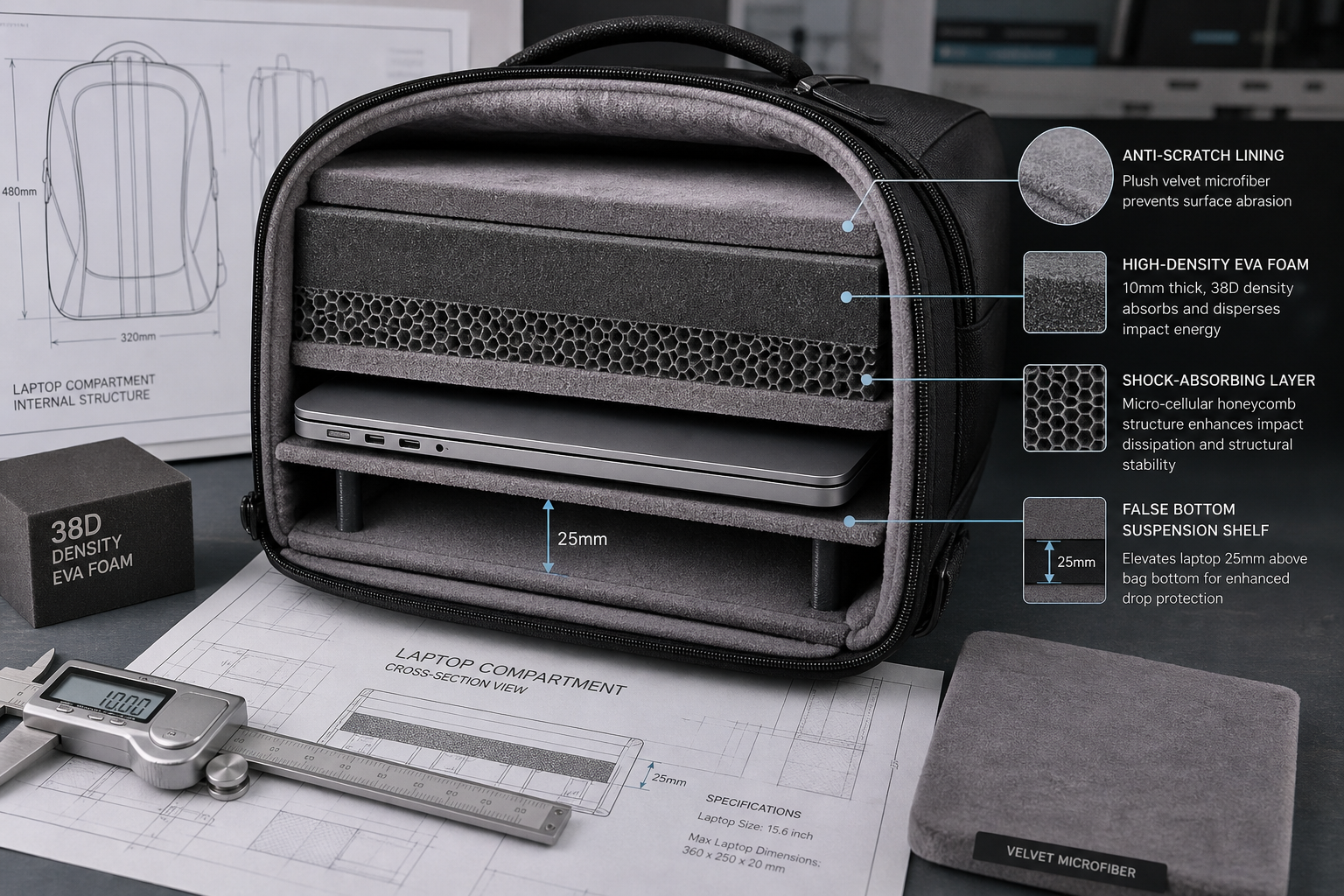
EPE, expanded polyethylene, is the lightest and cheapest of the three. It has a closed cell structure and good resilience for light loads, and it is the default in mid-range backpacks. It works well between 25 and 35 kg per cubic meter at 6 to 8 mm thickness.
EVA, ethylene vinyl acetate, is denser and firmer. It resists compression set better, feels smoother, and holds a molded shape, which matters when the padding has to wrap a laptop edge and stay there. It costs more per kilogram and adds weight.
PE foam, plain polyethylene sheet, is the cheapest option and the weakest in repeated impact. It protects well against cosmetic scuffing and poorly against a drop. We see it most often in promotional bags where protection is a marketing line rather than a requirement.
For a 15.6 inch laptop compartment we most often recommend EVA at 30 to 38 kg per cubic meter on the back panel at 8 to 10 mm, and EPE at 28 to 32 kg per cubic meter at 5 to 6 mm on the front face of the sleeve.
What Happens in a Drop Test
We drop test loaded bags from 76 cm, the standard table height, onto concrete tile with the bag in three orientations: base down, back panel down, and corner down. A 15.6 inch laptop with a spinning disk drive fails at lower energy than a solid state machine, and a corner drop is harder on the machine than a flat drop.
A bag with 8 mm of EVA at 35 kg per cubic meter and a suspended sleeve passes all three orientations with no internal damage across 20 drops. A bag with 6 mm of low density PE foam shows g-force spikes at the corner drop that would damage a mechanical drive at a much lower drop height. We log the peak reading for each orientation and keep the report with the sample, because a buyer cannot see padding difference in a product photo.
We also test with the compartment deliberately overfilled by about 10 percent, because that is how a real commuter packs. A sleeve that passes a clean fit test can still transmit more force to the laptop once it is compressed by a charging brick in the same compartment. The overfilled test reveals whether the foam or the zipper is doing the protecting, and it is the test that most often sends us back to the pattern table.
How the Wrong Foam Fails a 15.6 Inch Laptop
Three failure modes come up again and again. The first is compression set. A 20 kg per cubic meter foam under a 2.2 kg laptop flattens within a few months, and the sleeve loses the clearance that made it protective in the first place. The bag still looks fine, which is why this failure generates complaints rather than returns.
The second is edge exposure. Padding on the flat faces with no wrap at the bottom corners leaves the most vulnerable part of the laptop exposed. We add a 4 mm EVA bottom bumper on any sleeve that carries a 15.6 inch machine.
The third is overstuffing. A thick, firm sleeve that cannot accommodate the laptop plus a case pushes the user to force the bag closed, and the zipper and seam then take the load instead of the foam. The trade off is real: more padding means better drop performance and less usable interior volume, and there is no configuration that maximizes both.
Padding Spec Checklist
State density in kilograms per cubic meter, thickness in millimeters, and firmness, not just one of the three.
Specify material by name: EPE, EVA, or PE, with the density for each layer.
Require a wrap or bumper at the bottom corners, not only on the flat faces.
Confirm the sleeve fits the intended laptop plus a slim case without forcing the zipper.
Ask for the drop test method, drop height, orientations, and the loaded weight used.
Request a compression set figure after repeated loading, not only the new foam number.
Check that the padding is bonded, not just inserted loose, so it stays in place after washing.
Gram Weight, Interior Volume, and the Cost of Protection
Protection has a weight and a volume cost that buyers rarely price at the start. A full wrap sleeve built from 8 mm EVA at 35 kg per cubic meter adds roughly 120 to 170 grams to a finished 18 liter backpack, and the same sleeve in EPE at 28 kg per cubic meter adds 70 to 100 grams. On a bag sold online where shipping is charged by weight, that difference shows up in the landed cost per order.
Volume is the harder trade. A thick sleeve reduces the usable main compartment, and buyers sometimes discover at the sample stage that a 15.6 inch laptop plus a charger and a notebook no longer fit comfortably. We measure the interior clearing space in millimeters and confirm the fit with the actual laptop size before the sample is approved, because a compartment that is 5 mm too tight generates more complaints than one that is 5 mm too loose.
Cost follows density almost linearly. EPE at 28 kg per cubic meter costs less per kilogram than EVA at 35 kg per cubic meter, and the labor to cut and bond the layers is similar for both. The saving from switching the back panel from EVA to EPE is usually 0.15 to 0.35 USD per unit, which is real money on a promotional program and a poor trade on a bag sold with a three-year warranty.
Next Steps for Your Next Production Run
Send us the laptop size, the target retail band, and the interior volume you need to keep. We will propose two padding builds with named materials, densities, and thicknesses, plus a drop test result for each. Sampling runs 7 to 15 business days, and the sample ships with the foam specification and the test log attached.
Tianqin builds laptop backpacks for overseas brands and cuts foam to a signed specification rather than to a verbal request, because padding conversations get vague fast. Contact [email protected] or visit www.tianqinbag.com to review your compartment spec.


 Hot News


