EN



The first question most buyers ask us is whether the zipper upgrade is worth real money or just a logo on the pull tab. On a laptop backpack the main compartment zipper is the most handled part on the bag, opening and closing several times a day for years. Moving from a generic zipper to YKK costs a small amount per unit. The question is what that money saves inside a two-year warranty window. This article runs the math with the same figures we put in our own quotes.
What the Zipper Cost Delta Actually Is
For a number 8 or number 10 nylon coil zipper used on a laptop compartment, the delta between a qualified YKK zipper and a generic equivalent typically lands between 0.18 and 0.45 USD per unit at order volumes of 1,000 to 3,000 pieces. A smaller number 5 zipper on a front pocket shows a tighter delta, usually 0.06 to 0.15 USD. A backpack with four zipper applications, one on the laptop compartment and three on pockets, adds roughly 0.40 to 0.90 USD per unit when all of them move to YKK.
That figure looks small against a 40 USD retail bag. It also looks small against a 0.35 USD generic zipper, which is exactly why so many buyers cut it during cost reduction. The comparison only becomes useful when the zipper is treated as a warranty component rather than a trim item.
We quote the zipper tier as a separate line on every bill of materials for this reason. When a buyer asks us to hit a landed cost target, they can see immediately how much of the saving comes from the zipper, and they can decide whether that is where they want to carry the risk. Zipper and slider must also come from the same source, because a mismatched slider on a good coil tape creates the same failure we are trying to avoid.
Failure Rate Math Across a Two-Year Warranty
Field failure on a zipper is rarely a snapped tooth. It is a slider that loses alignment, a coil that separates under a stuffed load, or a tape that pulls away from the seam. We track claims from programs we produce and sort them by defect category and by batch, which is how we built the numbers below.
A generic coil zipper on a heavily loaded laptop compartment can run a field failure rate near 3 to 6 percent inside two years on a program shipping 10,000 units. A YKK coil zipper with a matched slider and tape on the same design runs near 0.5 to 1.2 percent. On 10,000 units that gap is 300 to 600 failures against 50 to 120 failures, which is roughly 250 to 480 additional zipper claims per program per warranty window.
If the buyer's fully loaded cost of processing one claim, including inspection, replacement unit, freight, and customer goodwill, is 12 to 20 USD, the extra claims cost 3,000 to 9,600 USD. The upgrade on 10,000 units costs 4,000 to 9,000 USD at the deltas above. The two figures sit close together. What tilts the decision is how expensive a claim really is for the brand, and how much a public review costs on top of the claim.
We also separate first-year claims from second-year claims when we review a program. Zipper defects cluster in the second year on generic hardware, once the slider has cycled a few thousand times, while design defects such as a short seam show up in the first month. A buyer watching only the first-year return rate sees a healthy number and then faces a claim wave in month fourteen, which is the pattern this cost test is meant to expose before the purchase order is signed.
The Return Cost Nobody Budgets For
The honest limitation is that the math is not always a win. On a low-cost promotional bag with no warranty program, where the end user simply discards a failed bag and never contacts anyone, a generic zipper can be the rational choice. The upgrade pays back through warranty claims and repeat purchase, and a bag with neither offers no payback at all.
The second limitation is design. A YKK zipper on a compartment that is overstuffed every day will still fail, because a coil zipper pushed past its load rating separates regardless of who made it. Zipper size has to match the packing habit of the target user. A single-compartment commuter bag used for a laptop, a charger, and a notebook does not need a number 10 zipper, and undersizing a zipper to save weight is a more common root cause than the brand on the slider.
A Side-by-Side Test on Your Own Samples
Build two identical samples from the same pattern, one with YKK and one with the generic zipper you are considering.
Load the laptop compartment with a 15.6 inch laptop and 1.5 kg of books before every cycle.
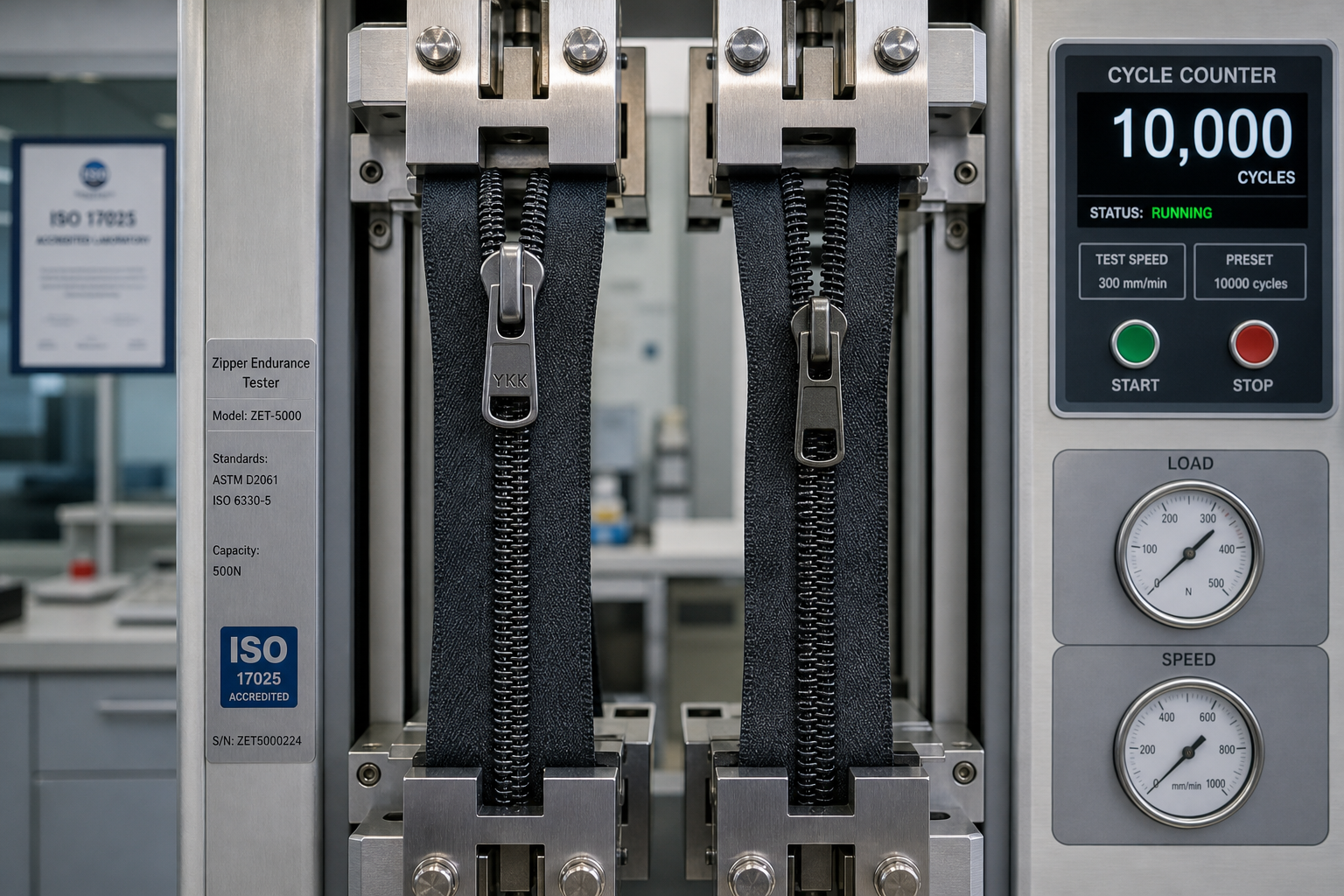
Run 5,000 open and close cycles, which matches roughly two years of heavy commuter use.
Record slider alignment, coil separation, and tape pull at 1,000, 2,500, and 5,000 cycles.
Inspect the seam where the zipper tape meets the shell, since that joint fails before the coil on many designs.
Check the slider for worn plating, which tells you more about the metal than the pull tab does.
Repeat the test on a cold sample if the bag ships to a market with winter temperatures below freezing.
Which Zipper Belongs on Which Program
Below 25 USD retail, a qualified generic zipper on the pocket applications and a mid-tier coil zipper on the laptop compartment is a defensible spec. Between 25 and 55 USD, move the laptop compartment to YKK and keep the pockets on a good generic coil. Above 55 USD, buyers expect YKK across every application, and usually a branded or metal slider on the main compartment. Programs sold with any warranty longer than twelve months should treat the laptop zipper as YKK by default, because the claim cost inside the window is what erases the saving.
What a Zipper Audit Looks Like in Our Factory
Before a new zipper source is approved, we pull ten zippers from the carton and inspect the coil pitch, the slider body, and the tape width against the drawing. Pitch variation is the first sign of a low grade coil, and a tape that measures narrow will not hold the seam allowance through a heavy load. We log the results against the lot number so a later claim can be traced to a batch rather than to a design.
We also test the mated pairs. A good coil with a mismatched slider separates under a lateral load, which is the failure mode most buyers describe as a broken zipper. On every new source we run 5,000 open and close cycles on a loaded compartment before the source enters production, and we keep one reference sample from each approved lot in a cabinet for two years.
The audit also covers the sewing line. Zipper tape sewn with the wrong needle size, or at a stitch density below 8 stitches per inch, pulls out of the seam before the coil fails. Roughly one in five zipper claims we investigate traces to the stitch rather than the hardware, which is why we quote the hardware and the construction together instead of treating the zipper as a purchased part.
Next Steps for Your Next Production Run
Pull your claim data for the last twelve months and sort zipper defects into their own category. If the rate is above 2 percent, the upgrade pays for itself in most programs. Send us your current bill of materials and your warranty terms, and we will return two zipper tiers with cost per unit and a tested failure estimate for each. Sampling runs 7 to 15 business days, and we include the zipper specification sheet with the sample.
Tianqin has produced laptop backpacks for overseas brands for more than a decade and runs cycle testing on every new zipper source before it enters production. Write to [email protected] or visit www.tianqinbag.com to start the cost test on your own program.
 Hot News