
 EN



The first question most buyers ask us is which of the three common shell fabrics will hold a price point without generating warranty claims. Oxford, nylon, and ballistic are not three competitors at the same level. One is a weave, one is a fiber, and one is a marketing shorthand that combines both. Sorting that out changes how you write a spec sheet, and it changes what you should expect to pay. This comparison maps denier and weave to retail price band, durability expectation, and target market.
What the Three Names Actually Describe
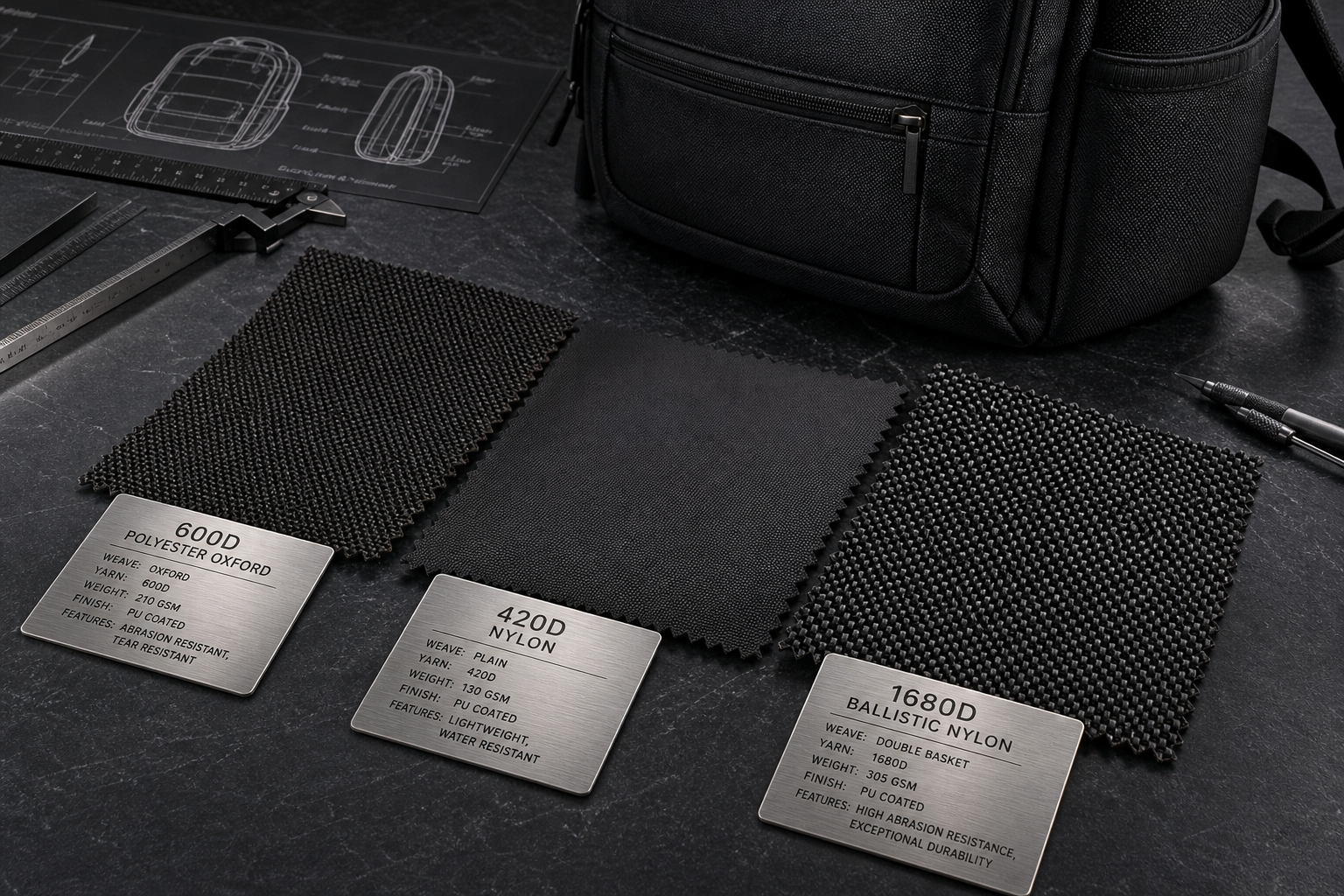
Oxford is a weave, not a fiber. A plain basket weave with two yarns crossing two yarns creates a textured, durable surface, and it can be woven from polyester or nylon. When a supplier quotes 600D Oxford, they usually mean a polyester basket weave with a PU coating on the back face. The weave gives it good tear resistance at a moderate cost.
Nylon is a fiber. It describes the polymer, most often nylon 6 or nylon 6.6, and it says nothing about how the yarn is woven or how heavy it is. A 210D nylon lining and a 1680D nylon shell share a fiber family and share almost nothing else in performance.
Ballistic is a weave and a fiber reputation in one word. The name comes from a tight, high-density weave built from heavy nylon yarns. In a backpack specification, ballistic almost always means nylon 6.6 in a tight weave at 840D, 1050D, or 1680D. Some mills sell a polyester version, and the performance numbers do not transfer.
How Weave Structure Changes the Outcome
Weave affects tear strength more than fiber choice does at a given weight. A tight weave with high yarn density resists a propagating tear because a broken yarn is pinned by its neighbors, which is the practical value behind the ballistic name. A loose weave of the same yarn weight tears further once a cut starts.
Coating sits on top of that. A PU coating on the back face adds hydrostatic resistance and some structural stiffness, and a heavier coating raises the water column number. At Tianqin we record the coating weight in grams per square meter for every shell lot, because two lots with the same denier and the same weave can differ by 40 to 60 percent in coating weight, and that difference decides whether a backpack beads water or wets out in a twenty minute walk.
Material Selection Matrix
Under 20 USD retail, promotional and corporate giveaway bags: 210D or 300D polyester Oxford, light PU coating, no ballistic base panel. Expect a one to two year useful life with light loads.
20 to 35 USD retail, campus and budget commuter programs: 600D polyester Oxford body, 600D reinforced base, standard PU coating. Expect good shape retention for two to three years of daily use.
35 to 55 USD retail, professional commuter and travel programs: 900D polyester or 840D nylon ballistic body, 1680D ballistic base panel, heavier PU coating. Expect three to five years of daily use.
55 USD retail and above, premium and specification-driven accounts: 1050D or 1680D nylon 6.6 ballistic across the shell, high coating weight, branded hardware, liner backed laptop pocket. Expect five years or more with normal care.
Lining in every band: 210D polyester is standard, 230T or ripstop lining reads as premium and costs little more.
Durability Expectations and Target Market
The material has to match how the bag will be treated, not how it will be photographed. A corporate giveaway bag that stays in an office most of its life does not need a ballistic base, and spending the budget there takes money away from the features that win the bid. A daily commuter bag in a rainy city is the opposite case. The base panel, the strap anchors, and the zipper tape take the abuse, and those are the places where a cheap shell becomes a claim.
We keep a simple internal rule for incoming programs. If the buyer's target customer carries the bag at least four days a week, we recommend a ballistic base panel regardless of the rest of the shell. If the bag is a seasonal or event item, we recommend keeping the shell modest and investing in stitch density at the anchor points and a stronger zipper instead.
We also track field feedback for two years after launch on programs where the buyer shares it. The pattern is consistent. Bags fail at the base panel and the strap anchor before they fail anywhere else, regardless of the shell grade used on the body. That is why our default recommendation is a strong base panel and a moderate body rather than the same fabric across the whole bag. It costs less than a full shell upgrade and removes most of the wear complaints we see in the second year of use.
Cost and Where Buyers Get It Wrong
The most common mistake is quoting 1680D ballistic nylon while paying 600D Oxford prices, then discovering the gap at the sample stage. Fabric cost per meter can vary by more than three times across these grades at the same order volume, so the shell choice alone can move unit cost by several dollars before any feature is added.
The second mistake is treating denier as the only quality signal. A 600D Oxford with a heavy PU coating, dense stitching at 8 to 10 stitches per inch, and quality zipper tape will outlast a poorly finished 900D bag in daily use. Denier sets the ceiling. Construction decides how close you get to it.
Common Spec Sheet Errors
The most expensive errors are small wording gaps. A spec sheet that lists 600D Oxford without naming the fiber can be quoted as polyester by one factory and nylon by another, and both quotes are technically correct. A sheet that says ballistic without a denier can be filled with 840D or 1680D, and the price gap between those two fabrics is wider than the gap between a generic zipper and a branded one.
Coating is the second gap. Two sheets can both read PU coated and differ by 40 percent in coating weight, which changes weather performance and adds cost the buyer never priced. We ask for coating weight in grams per square meter and the water column in millimeters before quoting, and we treat a missing number as an open question rather than a default assumption.
The third gap is weight tolerance. A shell specified without a weight range in grams per square meter leaves room for a lighter lot that passes a visual check and fails in abrasion testing. We measure the fabric weight on every incoming lot against the approved range and hold cutting when a roll falls outside it, which has delayed two production runs this year and saved both from a claim cycle.
Denier also interacts with print and logo application. A tight weave holds a screen print with sharper edges, and a heavier fabric tolerates a heat transfer with less risk of ghosting. Buyers planning a large logo across the front panel should settle the fabric before approving the artwork, because the two decisions are linked and reprinting a sample costs more than the fabric upgrade.
Next Steps for Your Next Production Run
Write down the retail price, the target customer, and the expected daily carry pattern before you choose fabric. Send those three items to us and we will return a material recommendation with denier, weave, coating weight, and a cost per unit range, plus the durability expectation behind it. Sampling runs 7 to 15 business days.
Tianqin builds laptop backpacks for overseas brands and reviews every incoming fabric lot against the approved spec before cutting. Mail [email protected] or visit www.tianqinbag.com to request a material matrix for your own price band.

 Hot News


