
 EN



The first question most buyers ask us is which fabric survives hard daily use without pushing unit cost past their retail band. That question usually narrows to two names: 1680D ballistic nylon and 600D polyester. They sit at opposite ends of the durability and price curve, and the wrong pick shows up as returns twelve months after launch. This guide compares abrasion behavior, weight, hand feel, and cost per unit, then maps each material to the retail price band where it belongs.
What Denier Actually Measures
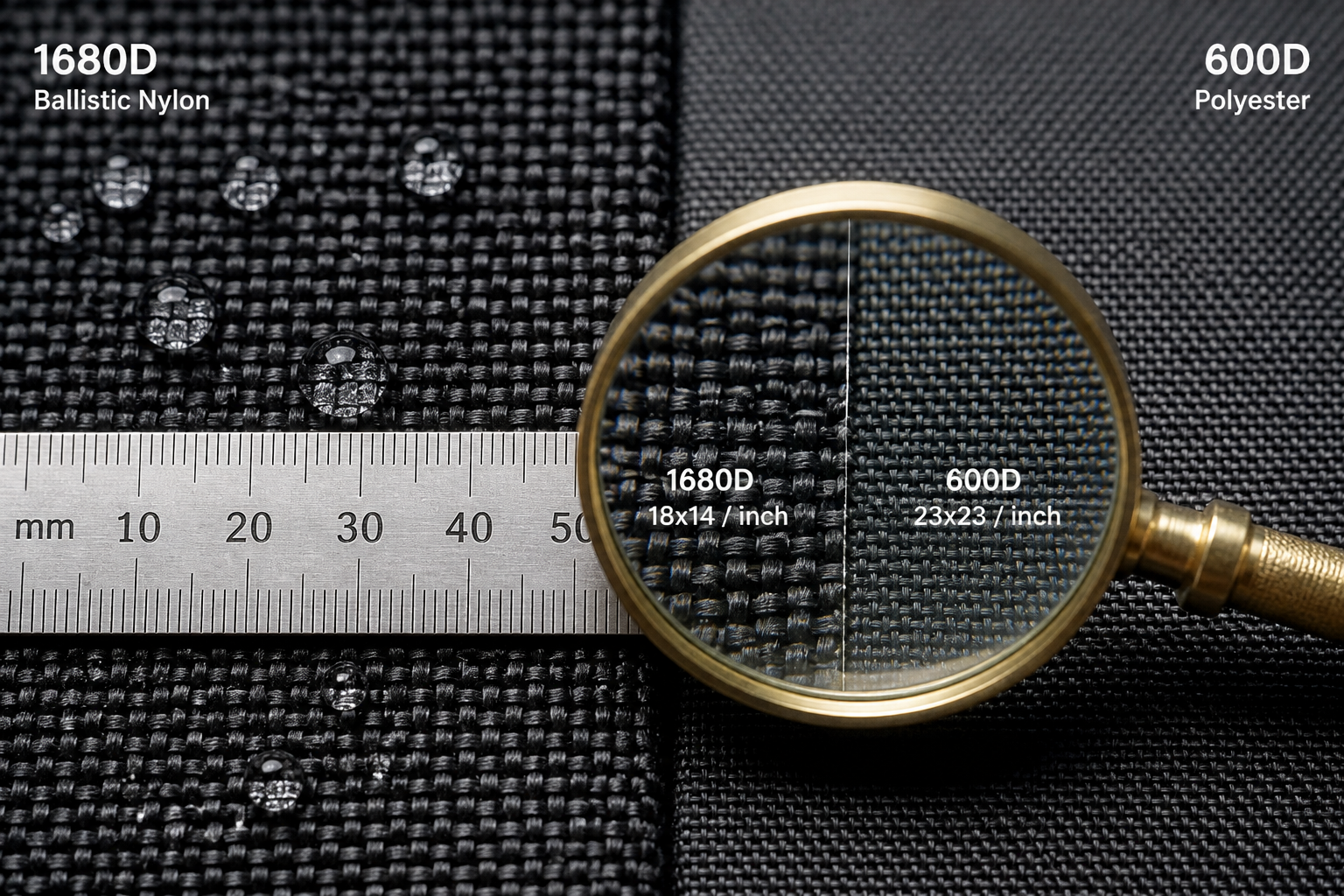
Denier describes the linear mass of the yarn, so 1680D yarn carries roughly 2.8 times the mass per unit length of 600D yarn at a comparable filament count. Heavier yarn woven into a tight plain or ripstop structure produces a denser surface that resists abrasion and puncture better than a lighter weave of the same fiber. It also makes the fabric stiffer and adds grams to every panel. On an 18 liter laptop backpack, moving the main body from 600D polyester to 1680D ballistic nylon adds roughly 90 to 140 grams, depending on coating weight and lining choice.
Fiber type matters as much as the number on the spec sheet. Nylon 6.6 has better abrasion resistance and better recovery than polyester at the same denier, which is part of why the word ballistic carries weight with buyers. A 1680D polyester exists on the market, but it does not behave like 1680D nylon, and the price difference at the mill is real. We require the fiber composition in writing from the mill before we approve any production lot, and we reject lots that describe the fabric only as ballistic without naming the polymer.
Abrasion Performance in Real Testing
We run Martindale abrasion on incoming fabric lots before a production run starts, using a 12 kPa load and a standard abradant. A common 600D polyester with a light PU coating develops visible wear between 8,000 and 12,000 rubs. A qualified 1680D ballistic nylon from a mill we audit holds past 25,000 rubs with only surface fuzzing and no yarn exposure.
Field wear concentrates in three places: the base panel, the shoulder strap anchors, and the top carry handle. Those are the points that meet car seats, airport floors, and concrete steps thousands of times a year. That is why we spec 1680D ballistic on the base panel and a lighter 600D or 900D on the body of many models instead of using one fabric everywhere. It gives the wear points a longer life and keeps the weight and cost of the large panels under control.
Weight and Hand Feel
Hand feel is where the comparison gets uncomfortable. A 600D polyester body feels smooth and pliable when a buyer picks up the bag in a store. A 1680D ballistic nylon body feels dense, slightly boardy, and noticeably crisper when new. It softens after several weeks of use, but it never becomes as soft as a light polyester weave.
The honest limitation is that heavy ballistic nylon is not automatically the better choice for every model. On a slim commuter bag aimed at a fashion-forward account, a 1680D shell can read as bulky and can push finished weight past what the buyer's end customer will carry daily. For those programs we often keep a 600D or 900D body and spend the budget on the laptop compartment and the hardware instead, where the buyer and the end user both notice the difference immediately.
Cost Per Unit and the Retail Price Band
Fabric price moves with order volume, mill, coating, and color, so treat these as working numbers rather than quotes. At order volumes of 1,000 to 3,000 pieces, a 600D polyester with a light PU coating lands near 0.55 to 0.75 USD per meter. A 1680D ballistic nylon with a 1500 mm PU coating lands near 1.60 to 2.40 USD per meter. A typical laptop backpack consumes 0.9 to 1.3 meters of main body fabric, so the swap adds roughly 1.20 to 2.60 USD per unit in material alone, before any change in zippers or hardware.
That delta decides the band. Below 25 USD retail, 600D polyester with a decent PU coating and reinforced base stitching is the practical answer. Between 25 and 45 USD, a 900D body upgrade with a heavier coating and a ballistic base panel buys meaningful durability without breaking the target cost. Above 45 USD, buyers expect 1680D ballistic nylon on the visible wear points, branded hardware, and a foam-lined laptop pocket to match. Pricing the fabric above the band creates a bag that looks expensive in a photo and disappoints in the returns report.
One more variable sits outside the fabric grade. Color and coating finish drive mill minimums, and a small color run can add 8 to 15 percent to the fabric price per meter. When a buyer needs a specific shade for a seasonal launch, we plan the fabric order before the pattern work finishes so that the mill minimum does not get absorbed by a single small production run. Buyers who can accept a stock color usually save more on fabric than they save by dropping a denier grade. We also quote fabric in the mill currency and convert at the contract rate, so a currency move between quote and purchase order does not quietly erase the buyer's margin.
Practical Selection Checklist
Confirm fiber type and denier in writing from the mill, not from a marketing sheet.
Ask for the coating type and the water column rating in millimeters.
Match fabric to wear points: base panel and handle in 1680D, body in 600D or 900D.
Request a Martindale abrasion report on the actual production lot, not a sample swatch from six months earlier.
Weigh the finished bag with the intended laptop size inside before approving the spec.
Set fabric grade against the retail price band, not against a competitor's product photo.
Moving Between Grades Without a Full Redesign
Most buyers do not start from a blank pattern. They have a bag in production and want more durability at the wear points without paying for a completely new shell. We handle that with a partial upgrade, which changes the base panel, the carry handle, and the strap anchors to 1680D ballistic nylon and leaves the body fabric alone. The cost lands near 0.30 to 0.60 USD per unit and the weight gain stays under 45 grams, because the upgraded panels are small.
The second option is switching the fiber rather than the denier. Moving from 600D polyester to 600D nylon keeps the panel weight and the pattern unchanged while improving abrasion resistance and recovery. The cost delta is smaller than a denier change and the hand feel shifts only slightly, which keeps an existing retail account comfortable with the update.
For buyers moving down a grade to hit a price point, we protect three things: stitch density at the anchor points, the zipper on the laptop compartment, and the base panel. A 600D Oxford body with a ballistic base and a quality zipper reads as a durable bag in the hand, and the saving stays in the panels the customer never inspects.
Some accounts ask whether the two fabrics can be mixed in one color. The answer is usually yes, but a 1680D nylon and a 600D polyester dyed to the same color target show a visible sheen difference under store lighting. We build a color standard panel from both fabrics and send it with the sample so the buyer approves the contrast before production starts rather than after the container arrives.
Next Steps for Your Next Production Run
Decide the retail band first, then work backward to fabric. If you already have a price point and a target market, send us the details and we will build two fabric options with real abrasion results and a cost per unit for each one. Sampling takes 7 to 15 business days, and each sample arrives with the fabric spec sheet and the abrasion report attached.
Our team at Tianqin has cut and sewn laptop backpacks for overseas brands for more than a decade, and we would rather tell you that a 1680D shell is wrong for your channel than ship a bag that comes back. Reach us at [email protected] or through www.tianqinbag.com to start a quote, and we will confirm fabric availability and a production window before you commit to a purchase order.


 Hot News


