
 EN



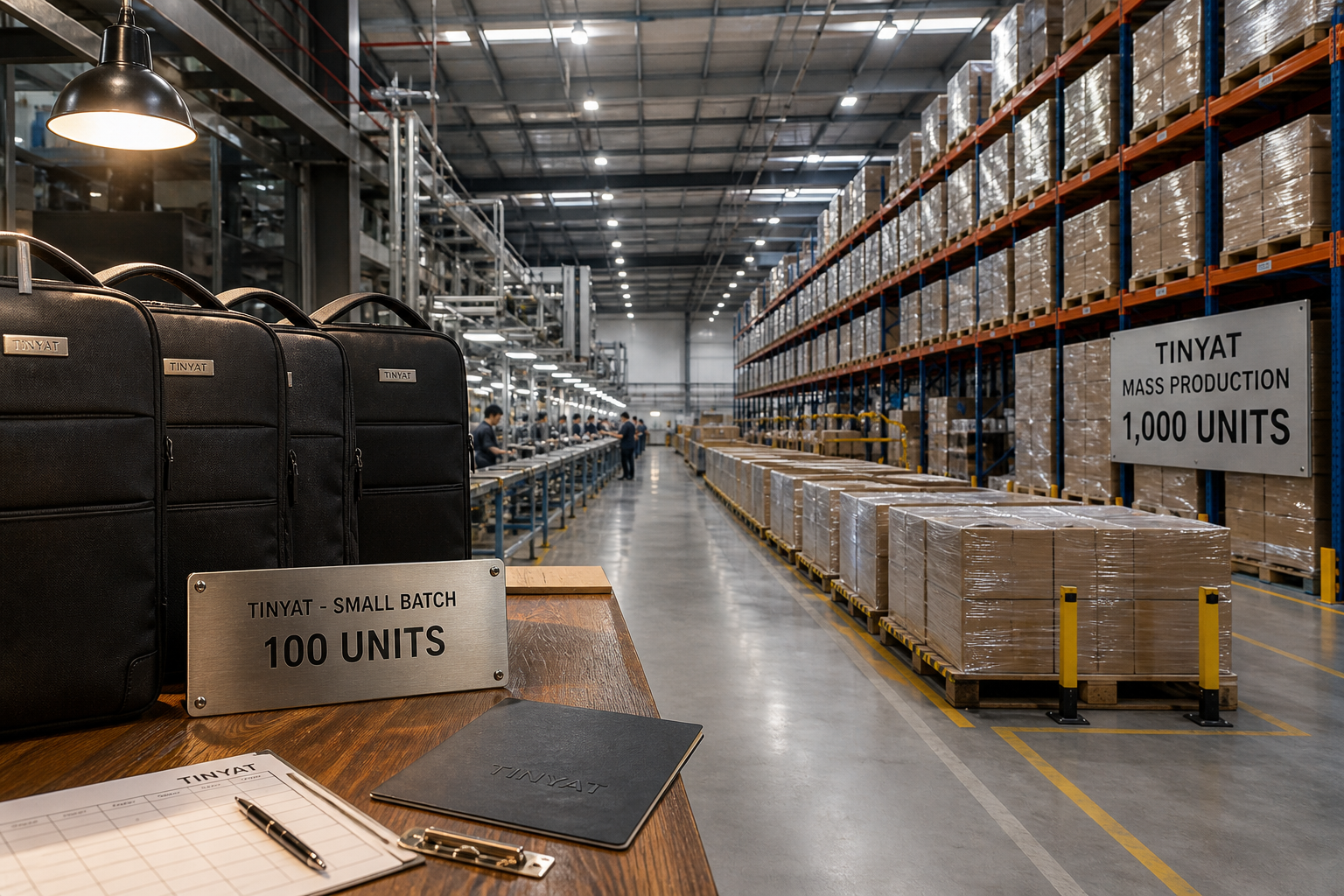
The first question most buyers ask us is whether 100 units is possible at all. It is. What they usually do not realize is that 100 units and 1,000 units are not the same product at two prices. They are two different products, built with different methods, because several customization options only exist above a certain volume. Here is what each order size actually delivers.
What 100 Units Gets You
At 100 units you are buying a stock pattern with your identity on it. That is still a real private label product, and for a market test it is often the right first step.
What is available: embroidered logo on the front panel, a custom woven or printed brand label, a printed hangtag, stock lining from our six colors, stock hardware finishes, and the standard EPE foam laptop sleeve. Embroidery is the only logo method with no tooling behind it, which is exactly why it dominates small orders.
What is not available at 100 units: custom-dyed lining, molded rubber patches, deboss tooling, custom-engraved metal pullers, or a new pattern. Each of these carries a mold or mill minimum that cannot shrink to 100 pieces.
The economics are also the hardest at this tier. For a 25L pack in 600D Oxford with a PU coating, unit price lands around 21.50 USD at 100 units. A 240 USD tooling line spread over 100 pieces is 2.40 USD per unit before the part itself costs anything.
Lead time behaves differently at this size too. A 100-unit run is cut after the bulk orders on the same fabric, which means we wait for a gap in the cutting schedule rather than open a dedicated line. The scheduling is workable but less flexible: if a 3,000-unit program is running on 1680D ballistic nylon, a 100-unit Oxford order waits its turn.
What 300 and 500 Units Change
300 units is the first real threshold. It is where silkscreen and heat transfer printing become sensible, because a 60 to 120 USD setup per color position finally spreads thin enough to be invisible in the unit price. Unit price drops to roughly 18.40 USD.
500 units changes three things at once. Deboss tooling at 180 to 400 USD becomes reasonable, light pattern modification such as a deeper front pocket becomes available, and hardware finishes move from limited stock to a free selection across the range. Unit price falls to about 16.90 USD.
Tooling dilution is the mechanism behind both jumps. A 300 USD mold is 3.00 USD per unit at 100 pieces, 1.00 USD at 300, and 0.60 USD at 500. The mold itself never changes. Only the denominator does, and that is why a factory can drop a unit price without changing a single material call.
There is a practical trick here. If you are planning 480 units, go to 500. The tier boundary is not a marketing device, it is where a setup cost gets divided by a number large enough to stop mattering. Buyers who plan around tier boundaries rather than round numbers save more than buyers who negotiate hard on the unit price.
What 1,000 Units Makes Possible
1,000 units is where the design stops being a relabeled stock bag.
Molded rubber patches become viable, because a 180 to 400 USD mold divides into 0.18 to 0.40 USD per unit. Custom-engraved metal pullers become viable at roughly 0.35 USD per unit plus tooling. Custom-dyed lining becomes possible, because the mill minimum of about 1,000 meters of fabric finally matches your order volume. Custom carton printing enters as well.
Unit price reaches about 15.60 USD, which is a 27 percent reduction against the 100-unit price for essentially the same labor and material content. The difference is almost entirely setup dilution.
At Tianqin we standardize on 1680D ballistic nylon as the default shell for 20L and larger laptop backpacks, but the material premium only makes sense at volume. At 100 units the ballistic shell pushes the price up sharply against a 39 USD retail band. At 1,000 units the premium is small enough that the durability argument usually wins.
Printing and Packaging by Order Size
Printing methods scale in steps, not smoothly.
At 100 units: embroidery only for the logo. Hangtag printed from our stock shapes. Packaging is a plain polybag.
At 300 units: heat transfer printing available with a 60 to 120 USD setup per color position. Custom hangtag text and layout.
At 500 units: silkscreen printing with better coverage per color, deboss tooling available, custom hangtag shape.
At 1,000 units: custom carton printing, custom polybag printing, molded or debossed components, fully custom hangtag.
Packaging is the most underrated line in this list. A printed polybag and a branded carton cost very little per unit at 1,000 pieces and change how a retail buyer receives the shipment. At 100 units they cost enough to be skipped, which is why small first orders often arrive looking generic even when the backpack itself is well made.
Unit Price Side by Side
These figures are for a 25L laptop backpack in 600D Oxford with a PU coating, YKK main zipper, and EPE foam sleeve, FOB Quanzhou. Use them as a shape rather than a quotation.
100 units, 21.50 USD per unit: embroidery logo, stock lining, printed hangtag, stock hardware.
300 units, 18.40 USD per unit: adds heat transfer printing option.
500 units, 16.90 USD per unit: adds deboss tooling, pattern modification, full hardware finish range.
1,000 units, 15.60 USD per unit: adds molded patches, custom pullers, custom-dyed lining, printed packaging.
Sampling sits outside these figures and is worth budgeting separately. Our sampling turnaround is 7 to 15 business days per round, and a design with two tooled components usually needs two rounds. Budget the sample cost and one revision round before you commit, and keep a contingency for a hardware color change, which is the request that triggers a third round more often than any other.
Converted to setup exposure, the difference between 100 and 1,000 units is roughly 5.90 USD per unit at the same specification depth. On a 1,000-unit order that is 5,900 USD, which is usually more than the entire first-order marketing budget of a new brand.
Pick Your Volume From Your Channel, Not Your Cash
There is a real trade-off at the bottom of the range, and buyers should hear it before they order. Small orders at our factory are slotted into gaps in the bulk production schedule rather than given a dedicated line. That can add 5 to 10 days to bulk lead time compared with a 1,000-unit run booked in advance. A 100-unit order is a genuine order, but it is not a scheduled one, and pretending otherwise would be dishonest.
The better question is not what the cheapest order you can place is. It is what your channel can actually sell in 90 days. If you sell through a marketplace with proven demand, 500 to 1,000 units is usually correct, because the margin works and the design freedom is real. If you are testing a new assortment or a new market, 100 to 300 units at a higher unit price is a cheap way to find out whether the product sells before you commit tooling.
Send us your channel, your target retail price, and the quantity you are considering, and we will tell you what that volume actually buys and what to postpone to the reorder. Contact [email protected] or visit www.tianqinbag.com to request samples, get a factory quote, or start an OEM or ODM project. Sample turnaround is 7 to 15 business days.


 Hot News


