
 EN



A private label buyer asked us for a 100-unit run with custom-dyed lining, a molded rubber logo, and a custom hangtag. Every one of those three requests had a minimum above 500 pieces. The quote that came back was not the quote they expected, and the reason was not price. It was volume. Private label terms are decided by how many units you can commit to, not by how good the design is.
What Private Label Means at a Bag Factory
Private label means the product carries your brand, not ours. Your logo, your labels, your hangtag, your packaging, and your name on the invoice. The factory does not appear anywhere in the retail chain.
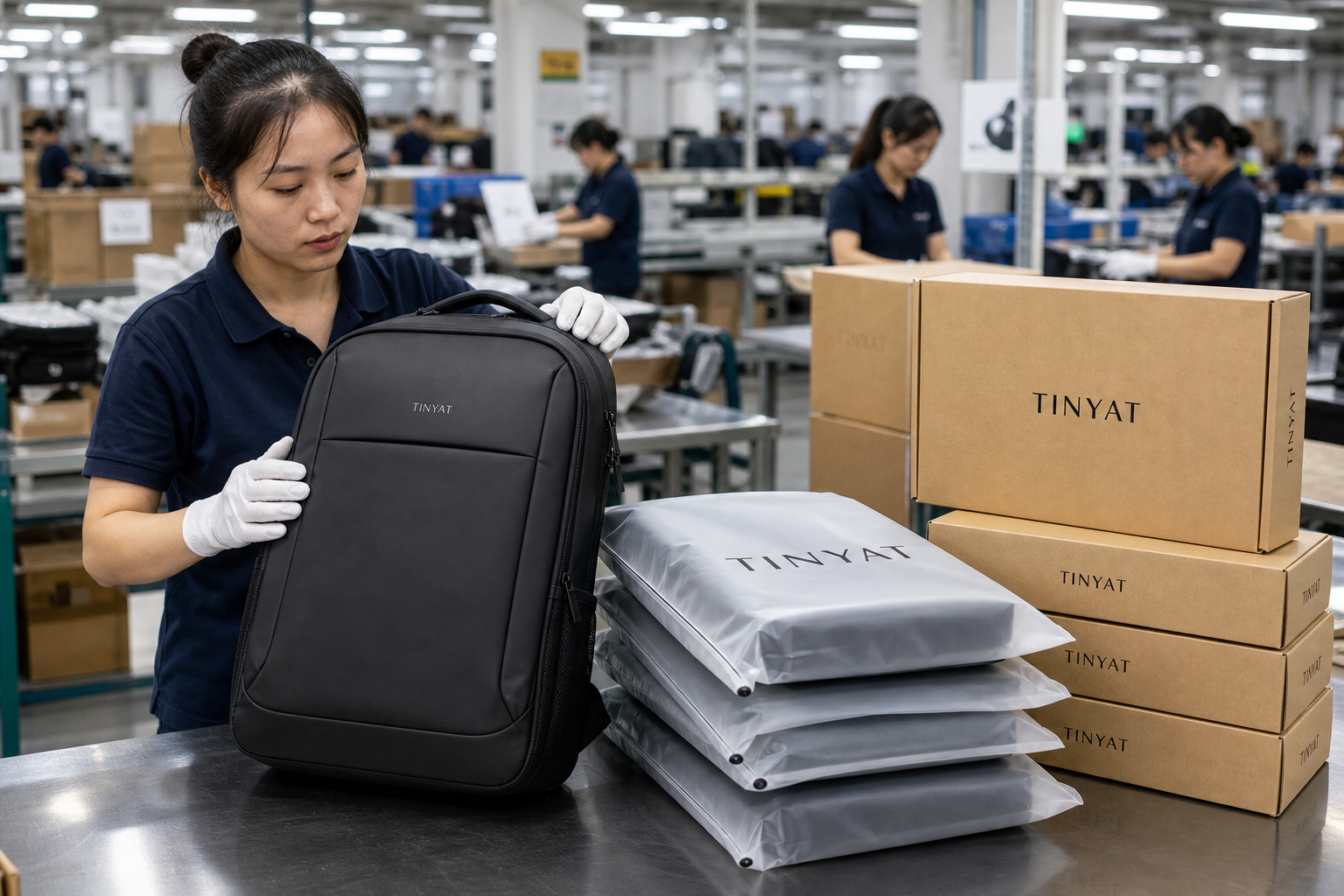
What varies is how deep the customization goes. A private label program at our factory can mean a stock 25L laptop backpack with your woven label and a printed hangtag, or it can mean a new pattern, custom hardware, dyed lining, and molded tooling built only for you.
Those two programs are in the same category to a marketer and in completely different categories to a factory, because they carry different minimum quantities, different setup costs, and different design freedom.
The MOQ Tiers and Their Unit Economics
Our pricing ladder follows a predictable shape. Material and labor are roughly linear with volume. Setup, tooling, and print costs are not, and they are what make small orders expensive.
For a 25L laptop backpack in 600D Oxford with a PU coating, YKK main zipper, and EPE foam laptop sleeve, our FOB ladder looks approximately like this:
100 to 300 Units
Unit price lands around 21.50 USD at 100 units and 18.40 USD at 300 units. At this tier, customization is limited to embroidery, a printed or woven brand label, a printed hangtag, and choice from stock lining colors. Setup costs are amortized across a small number, which is why the unit price is high.
300 to 500 Units
Unit price moves to roughly 16.90 USD at 500 units. Silkscreen or heat transfer printing enters the picture, because the 60 to 120 USD setup per color position can now be spread thinly enough. Stock hardware finishes, including matte black and gunmetal zinc alloy, become freely selectable.
500 to 1,000 Units
Unit price reaches about 15.60 USD at 1,000 units. Woven label patches, deboss tooling, a custom hangtag design, and semi-custom packaging all become practical. This is the tier where the product starts to look like a real brand line rather than a relabeled stock bag.
1,000 Units and Above
Molded rubber patches, custom-engraved metal pullers, custom-dyed lining, and custom carton printing all open up here. Tooling costs, which dominated the small tiers, become nearly irrelevant per unit. Beyond 1,000 units the price curve flattens, and the argument for a further increase is about margin protection rather than dramatic savings.
Our 500-cycle abrasion testing and the 1680D ballistic nylon shell we standardize on for larger volumes both make more sense at this tier, because the material premium is offset by the per-unit savings.
Container math adds a fourth consideration. A 40 foot high cube holds roughly 1,900 units of a 25L laptop backpack packed six to a carton. Buyers planning a container load are effectively designing for the 1,000-unit tier by default, and the freight saving per unit at that volume is often larger than any unit price concession a factory can offer. If your plan ends at 400 units, your product travels as LCL, and your landed cost per unit will reflect that.
Design Freedom at Each Tier
Design freedom is not a marketing phrase. It is a list of components you are allowed to change.
At 100 units you control the logo method (embroidery only), the brand label, the hangtag, and the lining color from stock. You do not control the shell fabric, the hardware design, or the pattern.
At 300 to 500 units you add print methods, hardware finish, puller style from stock options, and a light pattern modification such as a different front pocket depth.
At 500 to 1,000 units you add deboss tooling, woven patches, custom hangtag shapes, and semi-custom packaging.
At 1,000 units and above the pattern can be new, the lining can be dyed to your color, the logo can be molded, and the carton can carry your branding.
Here is the honest limitation we explain to every buyer at this point. Below 1,000 units we cannot offer custom-dyed lining, because the mill minimum is roughly 1,000 meters of fabric, about 900 backpacks. We offer six stock lining colors instead, and we tell buyers to design around those rather than promising a Pantone match we cannot deliver.
Where the Cost Curve Breaks
Three points break the curve.
The first is the tooling point. Any molded or debossed component needs a mold of 180 to 400 USD. At 100 units that is 1.80 to 4.00 USD per unit for one component. At 1,000 units it is 0.18 to 0.40 USD.
The second is the print setup point. A 60 to 120 USD setup per color position is painful at 100 units and negligible at 1,000.
The third is the fabric and lining point. Custom fabric and custom lining have mill minimums measured in meters, and those minimums do not scale down.
At Tianqin we show setup costs as a separate line in the quotation rather than burying them in the unit price. Buyers who see a 240 USD tooling line beside a 1,000-unit price usually make a different decision than buyers who only see a unit price.
One more cost deserves a mention because buyers rarely ask about it. Every tooling change carries a sample round, and a sample round costs both money and calendar time. A revised rubber patch or a new deboss mold usually means one additional sample at 7 to 15 business days. Two tooling changes in a single season can push an order into the next quarter, and a missed retail window costs more than the mold.
Match Quantity to Ambition: A Tier Comparison Tool
Use this to choose your tier before you brief a factory.
Ask what your channel can absorb in 90 days. If the answer is under 300, design within the 100-unit list and save tooling for the second order.
Ask which component is carrying most of your setup cost. If one molded part is over 30 percent of the setup total, either raise volume or switch the method.
Ask whether a stock option is close enough. Stock lining, stock pullers, and stock hardware finishes are the cheapest design freedom available.
Ask what changes at the next tier boundary. If you are at 480 units, the difference between 480 and 500 is often less than the difference between the two prices.
Ask what repeats. Setup costs paid once for a repeatable design are cheap. Setup paid once for a seasonal design is not.
Move Up a Tier Without Paying Twice
The first question most buyers ask us is what they can change at 100 units. The second is what they should wait for. The practical answer is to spend your first order on the components a shopper sees, keep the tooling-dependent parts for the reorder, and confirm the plan with the factory before the design is frozen.
At Tianqin we keep tooling and artwork on file for repeat orders, so a component you paid for once stays yours without a new setup. Send us your target quantity and your brand plan, and we will tell you which tier your design actually fits and what to delay. Contact [email protected] or visit www.tianqinbag.com to request samples, get a factory quote, or start an OEM or ODM project. Sample turnaround is 7 to 15 business days.


 Hot News


