EN



The first question most buyers ask us is what a water resistance claim actually means on a product page. Most claims are true and still useless, because they describe a lab number rather than a twenty minute walk in the rain. Coating type, seam treatment, and lining choice decide how a laptop backpack behaves in weather, and each one fails differently. This guide separates PU coating from DWR finish, explains what seam sealing does not cover, and shows how to test a sample instead of trusting the marketing line.
PU Coating and DWR Are Not the Same Claim
A PU coating is a solid polyurethane layer applied to the back face of the shell fabric. It creates true hydrostatic resistance, measured as the height of a water column the fabric holds before water passes through. A common laptop backpack shell sits between 800 mm and 1500 mm, and a heavier coating pushes higher.
A DWR finish is a surface treatment applied to the face of the fabric. It makes water bead and roll off, which keeps the fabric from wetting out and getting heavy. It does not stop water under pressure, and it wears off with abrasion and repeated washing.
The two work as a system. DWR keeps most rain off the surface, and the PU coating stops what gets through. A bag with DWR only looks impressive in a light shower and fails in sustained rain. A bag with PU coating only will hold water out but can feel clammy and heavy as the face fabric wets out. We specify both on any model sold into a rainy market, and we record the coating weight in grams per square meter for every production lot.
The coating is also a durability item rather than a permanent property. A 1500 mm shell that rubs against a shoulder strap can fall below 1000 mm in the worn area within a year, and that local number is what the user feels in a storm. We test both a new panel and an abraded panel when a program sells into a market with a long rainy season, and we report both figures rather than the better one.
Seam Sealing and What It Does Not Cover
Stitching punches thousands of holes through a coated fabric, and each needle hole is a path for water. Taped or sealed seams close those paths. On a backpack, the seams that matter most are the top opening, the base panel seam, and any seam that faces upward.
We specify seam sealing tape on the base panel and the top opening on water resistance programs, and we leave the cosmetic interior seams untaped. Taping every seam adds labor and cost, and it stiffens the panels in ways that hurt the shape of a slim commuter bag.
Water also enters through the zipper, not the seams, on most bags. A standard coil zipper is not water resistant. A reverse coil zipper with a coated tape reduces ingress, and a water resistant zipper with a storm flap removes most of it. The limits are practical: none of these options make a backpack submersible, and a zipper under a flap still leaks in driving rain on a long walk.
Lining Choices and Where Water Ends Up
Lining does not keep water out. It decides where water goes once it gets in, and that is why it matters for laptops. A 210D polyester lining wicks slowly, and water that reaches the inside face bead up and rolls to the bottom of the compartment. A smooth taffeta lining moves water faster, which can be worse if the laptop sits at the base of the sleeve.
The limitation we accept on every water resistance program is that a backpack is not a dry bag. Sealed, taped, and coated as it is, a bag in heavy rain for an hour will let moisture in along the zipper path and through the fabric itself under sustained pressure. Buyers who need guaranteed dry storage need an internal dry bag or a welded construction, not a better coating. Being explicit about that protects the brand from claims it cannot win.
We recommend a light-colored or bonded lining on the laptop sleeve, plus a raised foam base, so that any water that enters travels around the sleeve rather than through the bottom of it.
How to Read a Water Resistance Claim
A water column number in millimeters is a hydrostatic test result and describes the shell fabric, not the finished bag.
The word water resistant without a number usually means a DWR finish only.
The word waterproof on a sewn backpack is almost always overstated, because seams and zippers are not sealed to that standard.
A claim about the fabric says nothing about the zipper, the flap, or the base seam.
A spray rating describes surface beading and drops quickly after abrasion and cleaning.
Ask which seams are taped, which zipper is used, and whether the base panel is sealed or only coated.
Request the coating weight in grams per square meter, because two shells at the same coating name can differ by 40 percent.
Real Testing, Not Just a Lab Number
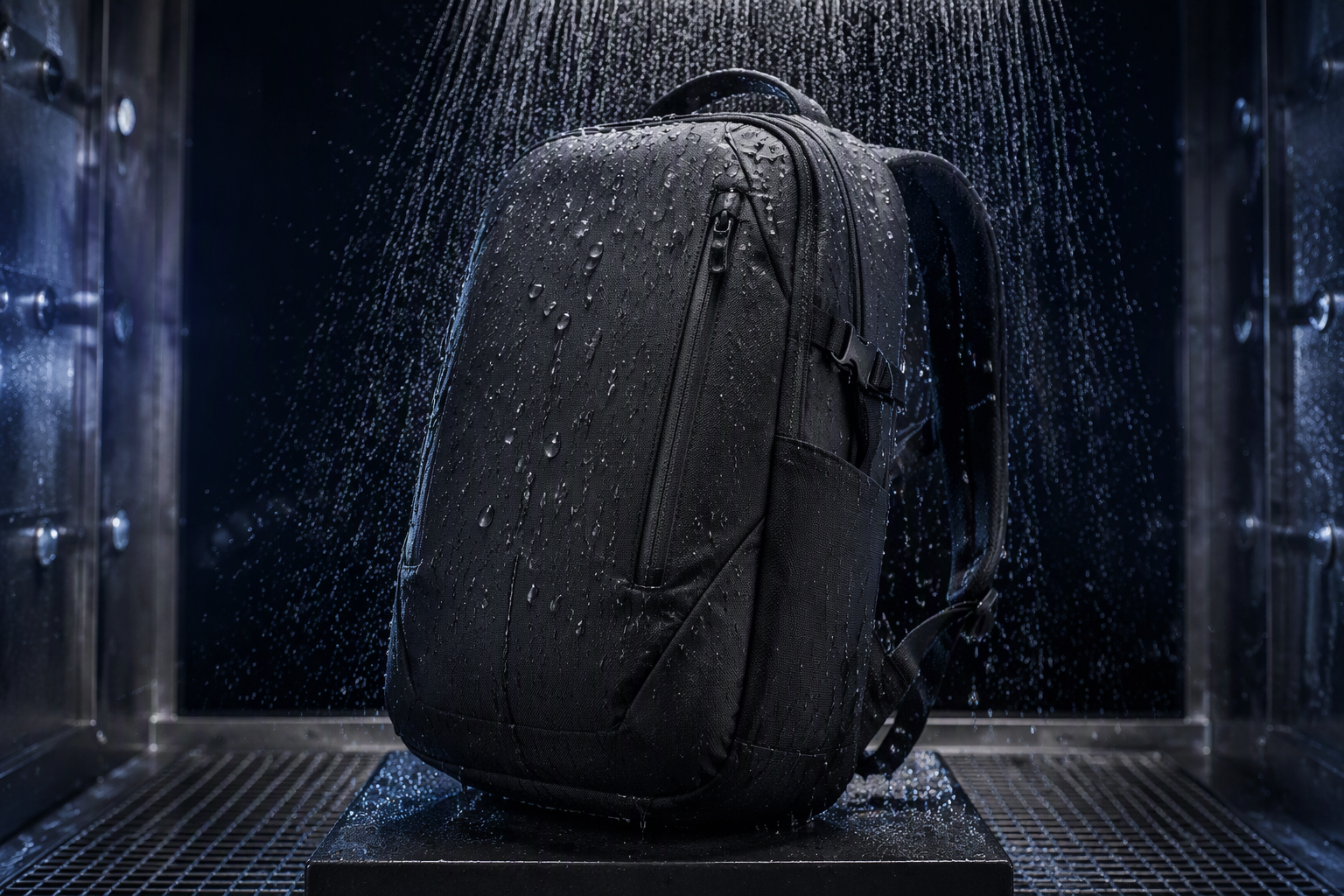
We run a spray test on incoming shells and a rain simulation on every finished sample. The rain test runs 20 minutes at a controlled flow with the bag packed to a realistic load, including a 15.6 inch laptop substitute, and we inspect for moisture at the sleeve face, the base seam, and the zipper ends. A sample that keeps the interior sleeve dry for 20 minutes in that test handles normal commuting weather. A sample that shows moisture at the base seam needs a design change, not a stronger coating.
What Happens After Washing and Abrasion
Water resistance degrades with use, and a product page photograph never shows that. A DWR finish loses effectiveness after roughly 10 to 20 wash cycles and after sustained abrasion at the shoulder straps and the base panel. The PU coating behind it holds much longer, so the bag keeps most of its resistance even after the surface stops beading.
Buyers who plan a care label should be specific. A soft wash at 30 degrees Celsius with a mild detergent preserves the coating better than a hot wash, and a tumble dry on low heat can reactivate a DWR finish on many fabrics. We test a washed sample against a new sample in the rain simulation and record the difference, so the conversation with the buyer starts from data rather than from a claim.
Abrasion at the base panel is the other weak point. A coated shell that rubs against concrete loses its surface treatment first, and the exposed area wets out faster than the rest of the bag. On programs sold into wet climates we reinforce the base panel with a second layer or a heavier coating weight, which costs 0.20 to 0.40 USD per unit and removes the most common moisture complaint we see.
Next Steps for Your Next Production Run
Tell us the climate the bag is sold into, the expected exposure time, and the price band. We will return two water resistance builds with coating weight, seam and zipper treatment, lining choice, and a rain test result for each. Sampling takes 7 to 15 business days, and each sample ships with the fabric coating report attached.
Tianqin has produced laptop backpacks for overseas brands for more than a decade and treats water resistance claims as a test result rather than a selling phrase. Email [email protected] or visit www.tianqinbag.com to start a spec review.
 Hot News