
 EN



A backpack that fails in month eight almost always fails in one of three places: the zipper slider, the shoulder strap anchor, or a structural seam. Everything else outlives the warranty period. When a buyer is building a 10,000-unit program and asks what evidence we can supply before the deposit, these are the three tests we run and the acceptance numbers we hand back. Each one is cheap to run and hard to argue with.
Zipper Cycle Testing
Cycle testing is the only reliable way to find a zipper that will bind after a season of use. Hand-pulling a sample ten times proves nothing.
Our internal standard for a 25 L laptop backpack: the main compartment zipper runs 5,000 open and close cycles at 30 cycles per minute, with a 1.5 kg load sitting in the compartment. The front pocket zipper runs 2,000 cycles under the same setup. A unit fails if the slider binds for more than 3 mm of travel, if teeth skip at the curve, or if the tape separates from the seam by more than 2 mm at either end.
Puller strength is a separate test. We hang 70 N from the pull tab for 30 seconds. The slider must not deform, and the puller must not tear out of the slider body. That number comes from field data rather than from a standard: pullers fail when a user yanks a corner-loaded bag, and 70 N covers a hard single-handed pull.
The first question most buyers ask us is whether the YKK upcharge buys anything measurable. On a three-zipper setup, YKK adds roughly USD 0.40 to 0.55 per bag at a 3,000-unit order. In our cycle data, the generic slider we approved in 2019 began binding between 1,200 and 1,800 cycles on the main zipper under load, while the YKK unit passed 5,000 with no measurable tape wear. You are buying a factor of three, and you are buying it on the part that generates the most returns.
Strap Anchor Pull Force
The strap anchor is the highest-load joint on the bag, and it is the first place a warranty claim lands. We test it destructively.
A 25 mm nylon webbing strap on our current business line is rated around 1,150 N breaking strength. The anchor seam that holds it to the body is the weak link, so that is what we measure: 500 N applied for 30 seconds, then inspect. Passing means no stitch failure, no fabric tear at the bar, and elongation under 5 percent. Failing at the bartack is the most common result, and it is always a bartack problem rather than a webbing problem.
At Tianqin, we spec a 42-stitch bartack at both anchor points and hold it as a fixed process parameter, not an operator choice. Before that rule, we had a batch of 800 units where the bartack ran 24 to 28 stitches because a machine was set for a different ticket. Nothing looked wrong on the table. Two of those bags came back from a retailer with the anchor pulled out after 14 months.
We also test the adjuster under load, because a slipping adjuster is a silent complaint that never generates a repair, only a bad review. We load the strap to 15 kg and hold it for 10 minutes. If the adjuster slides more than 5 mm, the buckle or the webbing weave is out of spec.
Seam Strength and Stitch Density
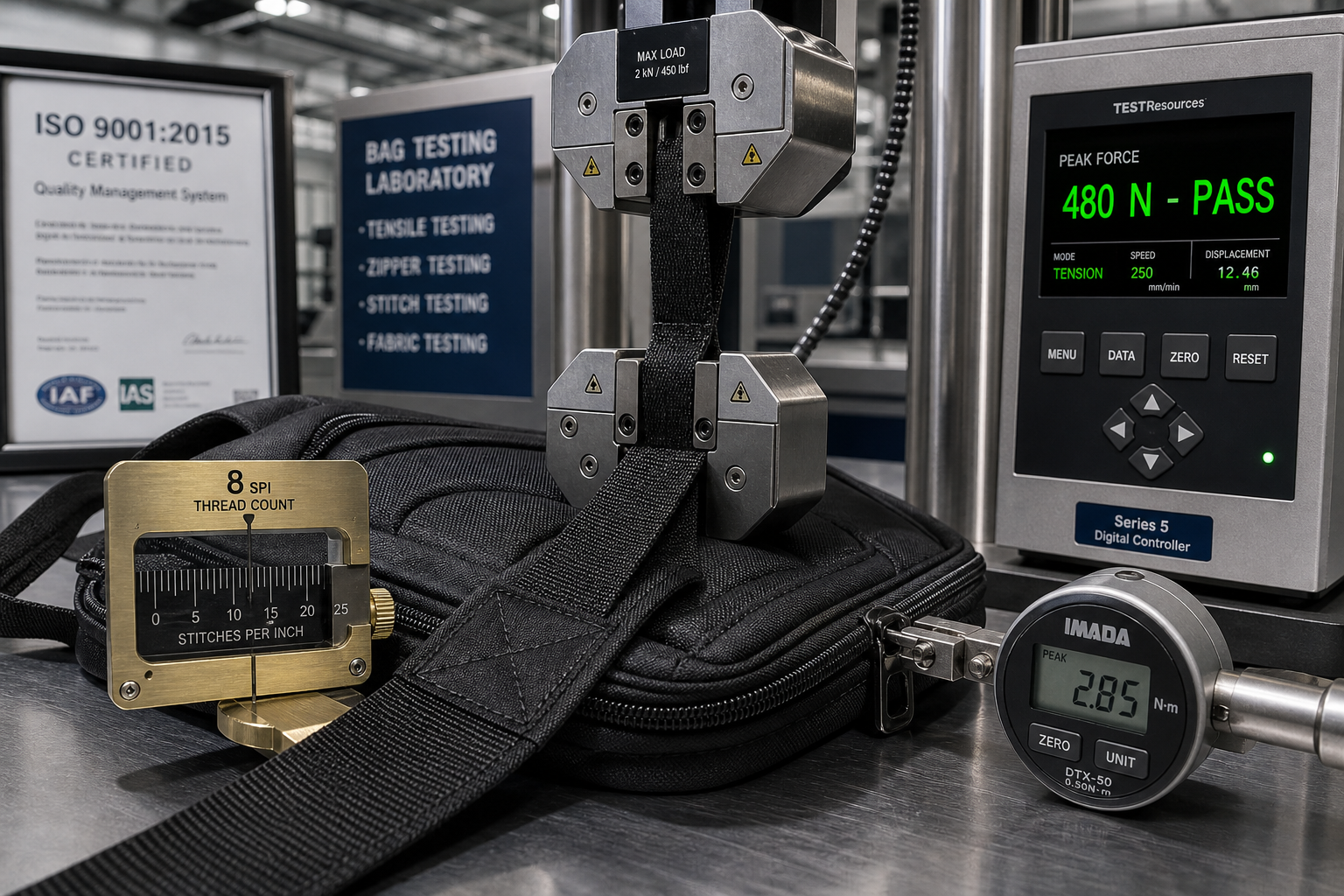
Seam strength starts with stitch density. We require 8 to 10 stitches per inch on structural seams and 10 to 12 on webbing attachments, which an inspector can count over 25 mm with a ruler in about 15 seconds.
Then check balance. Pull a seam apart by hand on both sides. On a balanced lockstitch, the needle and bobbin threads lock inside the fabric. If the bobbin thread is visible on the top surface as a line of dots, tension is off, and that seam will lose roughly 30 percent of its strength even though the stitch count looks correct.
For the base panel and the bottom corners, we run a grab test on a 100 mm wide specimen and require 400 N before the fabric ruptures. Anything lower usually points to a fusion or coating issue in the shell fabric rather than to the sewing.
Load and Drop Checks That Support the Three Tests
Component tests cover the parts. A loaded bag test covers the system.
We fill the bag to 15 kg, close every zipper, and drop it 300 mm onto each of four faces, one drop per face. Then the bag hangs full for 24 hours to check for seam creep. Passing means under 5 mm of seam extension measured at the base corners and no permanent panel distortion above 3 mm.
A limitation worth stating clearly: this test is destructive, so we can only run it on a sample. We pull 3 units per 1,000 from the sewing line for the full test set. A systematic fault affecting fewer than 0.3 percent of production can pass through that net. Cycle testing at 30 cycles per minute also accelerates wear in a way that no real user replicates, so the data ranks designs rather than predicting a lifespan in months.
What buyers should skip
Testing the logo, the hangtag, or the packaging under load wastes inspection time. Those are visual checks performed against the approved sample, and they belong on the packing line checklist instead.
Component Test Sheet With Pass and Fail Values
Use these as starting values and adjust them to your retail price band.
Main zipper: 5,000 cycles at 30 per minute with 1.5 kg load, fail on binding over 3 mm
Front pocket zipper: 2,000 cycles, same load, same binding limit
Slider puller: 70 N held 30 seconds, fail on tab separation or slider deformation
Zipper tape: no separation over 2 mm at either end after cycling
Shoulder anchor: 500 N held 30 seconds, fail on any stitch failure or fabric tear
Anchor bartack: 42 stitches minimum, verified visually on every sampled unit
Webbing: 25 mm nylon rated 1,150 N, fail if elongation exceeds 5 percent at 500 N
Strap adjuster: 15 kg held 10 minutes, fail if slippage exceeds 5 mm
Structural seams: 8 to 10 stitches per inch, fail outside the range
Stitch balance: no bobbin dots visible on the exterior surface
Base seam grab test: 400 N minimum before fabric rupture
Loaded drop: 15 kg, 300 mm, one drop per face, no seam separation
Static hang: 15 kg for 24 hours, fail if seam extension exceeds 5 mm
Sampling rate: 3 units per 1,000 pulled from the line for the full test set
Run the Tests Before Production, Not After
The cheapest moment to run these tests is on the pre-production sample and on the first 100 units off the line. A bartack problem caught in hour one costs a machine setting. The same problem caught after packing costs a container.
Buyers should also ask for the raw numbers, not a pass statement. Ask for the cycle count reached, the pull force at failure, and the stitch count per inch. A report that says passed tells you nothing about how close the batch came to the limit, and the margin is where the next batch will fail.
If you want the test sheet above applied to your own spec, send it to [email protected]. We can run the component tests on a sample and return the measured values with the sample itself in 7 to 15 business days. Individual test reports and SGS documentation are available on request, and product lines are listed on www.tianqinbag.com.
 Hot News


