EN



A buyer rejects 200 backpacks over a 4 mm logo offset. The factory answers that the bag functions perfectly and the logo was approved on a 3D render, not on a physical unit. Both sides are technically right, which is the problem. AQL works when major and minor defects are defined in writing before production starts, and it breaks when the standard is one line saying that no cosmetic defects are allowed. Here is how we set it with buyers.
Why the Standard AQL Table Needs Translation
ISO 2859-1 gives you sample sizes and accept numbers. It does not tell you whether a visible stitch run of 6 mm is major or minor. That judgement belongs to the buyer, and it has to be written down before the lot is produced.
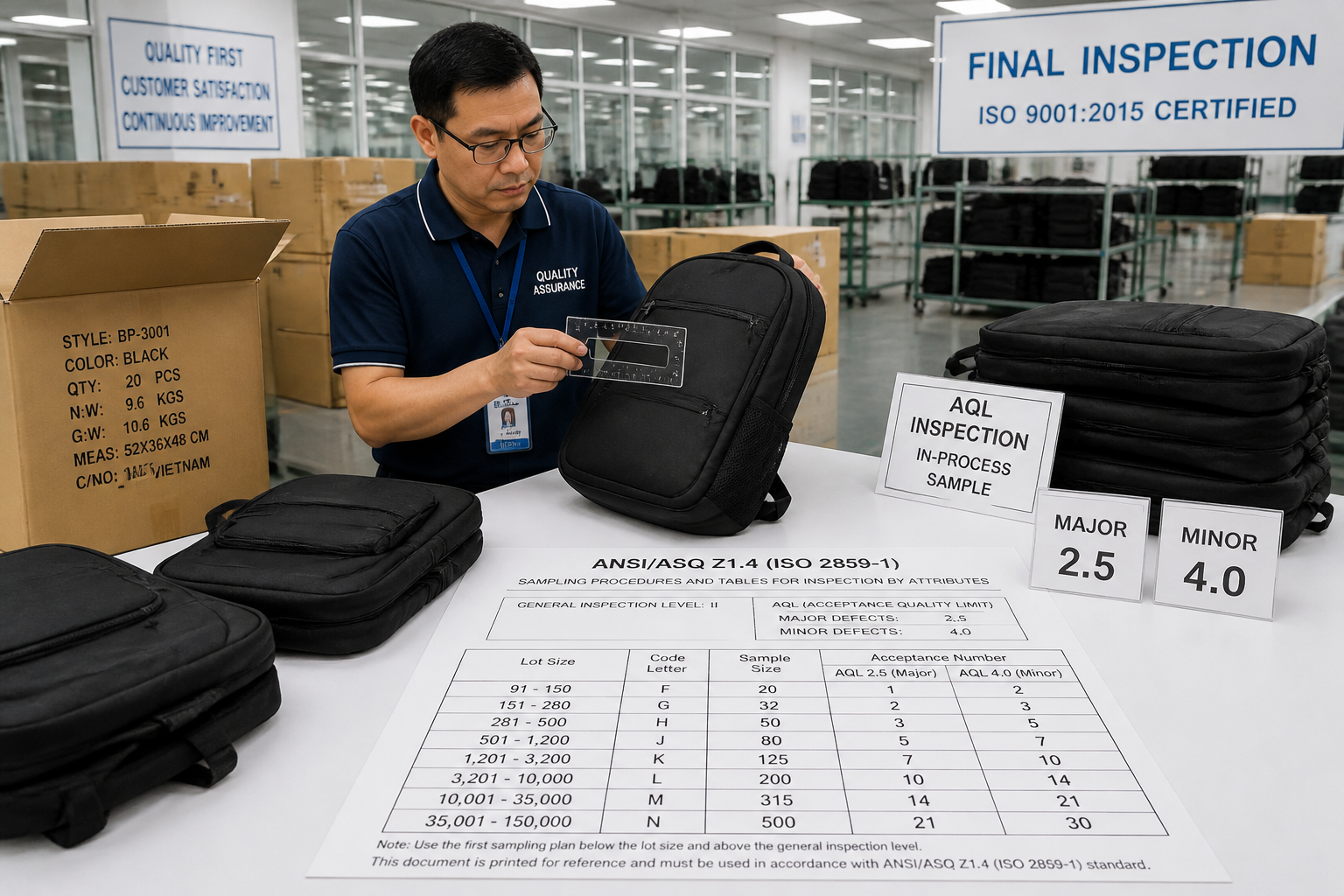
Third-party inspectors default to general inspection level II with AQL 2.5 for major defects and 4.0 for minor. For a 1,200-unit lot, that means a sample of 80 pieces, with 5 major defects accepted and 6 triggering rejection. For a 3,200-unit lot, the sample is 200 pieces, accepting 10 major defects and rejecting at 11. Those numbers are neutral. What matters is what you feed into them.
A working rule we use on the floor: if a defect affects function, load-bearing capacity, or safety, it is critical or major. If it affects appearance only, and a normal customer will not notice it in normal use, it is minor.
Defining Major and Minor Defects for Bags
Critical defects carry AQL 0, meaning one unit rejects the lot. Our critical list for laptop backpacks is short: exposed sharp metal edge, broken slider straight out of the polybag, missing or unstitched strap anchor, and any mildew or chemical odor.
Major defects cover the load path and the function. Skipped stitches on a shoulder or base seam, a seam that opens under a manual pull test, a zipper binding across more than 20 percent of its travel, foam below spec thickness by more than 2 mm, wrong hardware color against the approved sample, and thread tension set so loose that loops show on the exterior.
Minor defects cover appearance. Thread tails above 5 mm, shade difference inside the agreed tolerance, a light lining wrinkle that does not affect closure, logo position within 2 mm of target, and removable chalk or dust marks.
A 25 L business backpack typically carries 40 to 60 components across shell, lining, webbing, foam, and hardware. Across a 1,200-unit order you will see minor variation with near certainty. Setting minor at AQL 4.0 accepts that reality instead of arguing about it at the end.
The Cosmetic Trap That Causes Disputes
Buyers often push cosmetic criteria to zero. A line reading no visible stitch irregularity sounds strict and looks good in a purchase order. In practice it cannot be enforced, because the inspector has to decide what visible means at 30 cm or at one meter, under factory lighting or under daylight.
We watched a European retailer hold a 6,000-unit shipment over a 5 percent shade difference on the interior lining, a surface that no shopper sees once the bag is closed. The delay cost more than the lining was worth in material terms. When we traced it, two lining rolls from different dye lots had been loaded into the same cutting batch, which is a storage error rather than a sewing error. The fix was to rewrite the criterion around the exterior: main panels judged at one meter in daylight, lining excluded, and a written delta E tolerance of 1.0 for both.
Numbers beat adjectives in every AQL sheet. Replace good stitching with 8 to 10 stitches per inch on structural seams. Replace strong straps with a shoulder anchor that holds 400 N for 30 seconds without stitch failure. An inspector with a ruler and a pull gauge produces a repeatable result. An inspector asked to judge quality produces an opinion.
Sampling Rules Most Buyers Overlook
AQL assumes defects are randomly distributed. That assumption fails on certain problems. If a die was cut wrong, every panel from that die is short by the same 4 mm. If the lining was switched, all 1,200 units have the wrong lining. In those cases the sample tells you nothing useful, because the defect rate is 100 percent. AQL measures random variation, not systematic error, and a factory that does not run in-line checks will pass a broken lot.
We recommend in-line checks at three points for this reason: after cutting, at 50 percent assembly, and at packing. A 15-minute check at each point costs far less than a rejected container.
Sampling severity also moves. If a supplier receives two consecutive rejected lots, the plan should shift to tightened inspection, which raises sample sizes and lowers accept numbers. Most buyers write that into the purchase order once and never revisit it.
A sample size reference we share with buyers
For normal single sampling at general level II, a 1,200-unit lot samples 80 pieces and a 3,200-unit lot samples 200 pieces. Below 500 units, the sample drops to 50 pieces or fewer, and the statistical value of the inspection falls with it, which is why small orders need a different quality strategy.
A Working AQL Specification
Attach this to your purchase order and edit the lists, not the structure.
Critical AQL 0: one unit rejects the lot, no exceptions and no averaging
Major AQL 2.5: functional and load-bearing defects such as skipped stitches and zipper binding
Minor AQL 4.0: appearance defects that do not affect function
Inspection level general II as the default, general III for orders above 10,000 units
Single sampling, normal severity, switch to tightened after two rejected lots
Sample reference: 1,200 units samples 80 pieces, accept 5 major, reject at 6
Sample reference: 3,200 units samples 200 pieces, accept 10 major, reject at 11
Critical list: sharp metal edge, broken slider, missing strap anchor, mildew odor
Major list: open seam, zipper binding, foam below spec, hardware mismatch, loose tension
Minor list: thread tails over 5 mm, shade inside tolerance, logo shift up to 2 mm
Measurements per sampled unit: logo height, strap width, compartment depth, gross carton weight
Photo rule: every defect photographed with a scale and the unit ID tag in frame
Disposition rule: rework on site before packing, or remove the units from the carton count
Agree the Standard Before the Sample Is Signed
Write the AQL sheet into the purchase order and attach the approved physical sample to the same document. A sample without defect definitions is an argument waiting to happen, because a sewn bag always differs somewhere from the render.
Ask for the inspection report as a data file, not a screenshot. Unit-level defect tags let you separate random variation from a systematic problem. If 9 of the 10 major defects sit on the left shoulder anchor, the cause is one operator or one machine, and the factory can correct it in a single shift instead of reworking a container.
The first question most buyers ask us is whether a stricter AQL is worth the friction. Our honest answer is that AQL 2.5 major with a tight cosmetic definition has produced fewer disputes for our buyers than AQL 1.5 with a vague one, because an agreed standard prevents more arguments than a low number does.
At Tianqin, we run the same AQL sheet on internal pre-final inspection, 48 hours before a third-party inspector arrives, so that fixable defects are already out of the lot. It costs us a shift of QC time per order. We accept that cost because pulling units out during packing disrupts the line more than catching them early does.
Send your current AQL sheet to [email protected] and we will mark it up against what we see in production, including the defect lists we would tighten. Samples run 7 to 15 business days, and a bulk quote usually comes back with the same reply. Product details are on www.tianqinbag.com.
 Hot News