EN



Buyers keep asking the same question in slightly different words: is the built-in USB charging port still a selling feature, or is it now a liability with a hole in the shell? The honest answer sits in the middle, and it depends on where your bag is sold, how it is shipped, and whether you are willing to own the port's failure modes.
The Adoption Curve in Our Order Book
Growth has flattened but not reversed. In 2023, about 35 percent of our laptop backpack briefs specified a USB port. In 2024 that reached roughly 45 percent. In 2026 it is holding near 40 percent, with a clear split: online-first brands add it, while EU retail and airline-adjacent programs often remove it.
The pattern suggests the feature has settled into a segment rather than continuing to expand. It is strongest in the USD 39.90 to 69.90 online price band, where the port is visible in listing images and reads as value. It is weakest in premium business ranges with leather trim and in programs aimed at frequent flyers.
Regional behavior differs too. Buyers shipping into Germany and the Nordics ask about battery handling in the first email and often drop the port entirely. Buyers selling into the US online channel ask about the port first and about the battery almost never. Both reactions are rational inside their own channel. Airline rules also change more often than any textile standard does, so a design that depends on a specific battery model staying acceptable carries avoidable risk.
The first question most buyers ask us is whether the port charges a laptop. In most designs the answer is no, and that expectation gap sits behind a large share of returns.
What a Built-In Charging Port Actually Is
There are two very different products sold under the same name.
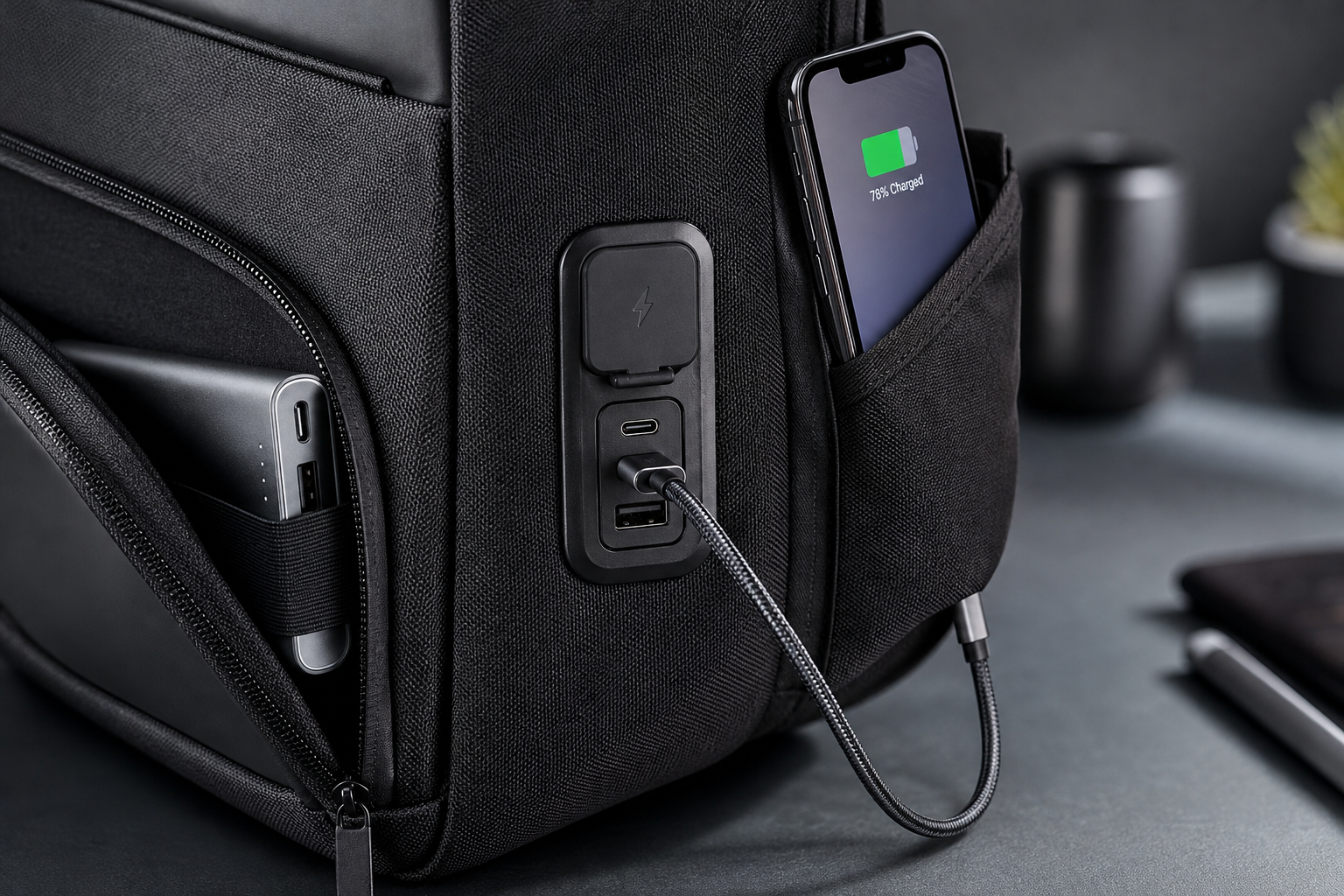
The common design is a pass-through port. A short USB-A or USB-C extension cable runs from an external port through the internal pocket, and the customer supplies their own power bank inside the bag. The bag itself contains no battery.
The less common design is an integrated battery pack, where the bag ships with its own cell. On our line, more than 90 percent of USB programs are pass-through, because the integrated version carries shipping, documentation and liability weight that most buyers decline once they see it on paper.
Pass-through construction cost is modest: roughly USD 1.20 to 2.60 per unit including the port housing, the cable, internal routing and labor.
The housing is where buyers under-specify. A standard 41 x 23 mm ABS housing with a 5 V 2.1 A output is the volume choice. A metal housing holds its screw points better and adds about USD 0.45, which is worth paying on a bag that will be set down on hard floors. A port that fails after sale costs far more than the port itself: one returned bag erases the margin on roughly eight to twelve units, depending on FOB and freight.
Spec and Safety Risks
The failure points are consistent and mostly mechanical rather than electronic.
Water ingress at the port. A port that is not covered lets rain into the shell. A rubber flap helps but gets lost or torn. Silicone covers survive longer and add about USD 0.20 per unit.
Cable fatigue. The internal cable bends every time the pocket opens. We specify a strain relief boot at both ends. Without it, we see conductor failure in field returns within roughly 6 to 12 months of daily use.
Current limit mismatch. A USB-A port rated at 2.1 A will not fast-charge a modern phone, and the customer blames the bag rather than the phone. Labeling the port output in the listing prevents most of these complaints.
Heat and pocket placement. The power bank sits inside a closed pocket with no airflow. That is acceptable for a 10,000 mAh bank, but it becomes a genuine issue with higher capacity packs, which is why we route the internal pocket away from the laptop sleeve.
Certification is the other practical risk. A pass-through bag normally needs no battery documentation, but the cable, housing and solder still fall under REACH and Prop 65 testing for plastics and metals, so include the port assembly in the test submission rather than testing the shell alone. Bench testing is not enough either. We run a 200-cycle open and close test on the internal cable routing, because the failure point sits in the pocket hinge and not in the connector.
Battery and Airline Rules That Shape the Spec
Here the feature stops being a design decision and becomes a compliance decision.
Power banks above 100 Wh are generally restricted or forbidden in cabin baggage on most international airlines. Most travel power banks run 10,000 to 20,000 mAh, roughly 37 to 74 Wh, so they usually qualify for carry-on but not for checked baggage in many jurisdictions.
If the bag itself contains a battery, the finished backpack is no longer only a textile product for transport purposes. Depending on capacity and configuration it may be treated as dangerous goods, which changes documentation and freight routing and can delay a shipment at the forwarder stage.
That is the strongest practical argument for pass-through design. The bag ships as a bag. The battery ships separately or the customer already owns one. The trade-off is less product differentiation, because the customer has to bring the power source, and some retail customers read that as a weaker offer.
A USB Port Decision Checklist
Work through this before adding a port to a 2026 program.
Decide pass-through or integrated, and note that integrated changes freight and documentation.
If integrated, state the battery capacity in Wh and confirm airline and carrier rules.
Confirm whether the port is USB-A, USB-C or both, with output ratings printed on the shell.
Specify a silicone or rubber cover and confirm it stays attached through testing.
Require strain relief boots at both ends of the internal cable.
Confirm the internal power bank pocket is separated from the laptop sleeve.
Verify the port housing does not sit where the bag is most likely to be set down.
Test the port housing for water ingress after 30 minutes of simulated rain.
Confirm the retail listing states honestly that the port does not charge a laptop.
Decide who carries warranty on the port, brand or factory, and write it into the terms.
How to Handle Charging Ports in Your Next Order
Add the port when the bag sells online to a young commuting audience and the listing can explain what the port does and does not do. Skip it when the bag is premium, aimed at business travel, or distributed inside the EU where battery handling adds friction at the border.
Decide before the artwork, not after. A port designed into the pattern keeps its cable channel, its cover recess and its pocket separation. A port added later gets surface-mounted, and the surface-mounted version is the one that leaks.
If you add it, treat the port as a component rather than a decoration. Specify the cover, the strain relief, the output rating and the internal pocket placement in the purchase order, and ask for the water ingress check inside your inspection plan.
At Tianqin we quote the pass-through and integrated versions separately so a buyer can see the full cost difference before deciding, and our standard pass-through assembly uses a covered port with strain relief at both cable ends. We have also talked buyers out of the feature when their retail price did not leave room to build it properly, because a cheap port generates more returns than it generates sales.
Email [email protected] or visit www.tianqinbag.com to discuss a charging port spec, request samples or get a factory quote. Sampling runs 7-15 business days.


 Hot News