
 EN



A first-time FBA seller sent us a 25L laptop backpack specification in March with one instruction at the bottom of the email: make the carton as small as possible. The bags were perfect. The first shipment arrived at a US fulfillment center with 4 percent of units flagged as unscannable and an inbound placement fee that erased the margin on 90 units. The problem was never the sewing line. Nobody had planned the packaging for Amazon's system.
Sourcing laptop backpacks for FBA private label is two projects running at once. One is the bag. The other is a set of physical constraints Amazon enforces with fees, rejections and delayed check-in.
Start With the Carton, Not the Bag
Most buyers open a sourcing conversation with fabric and padding. That order works for a retail chain and fails for FBA. Carton geometry decides your inbound placement fee, your freight cost per unit, and how many units survive the conveyor.
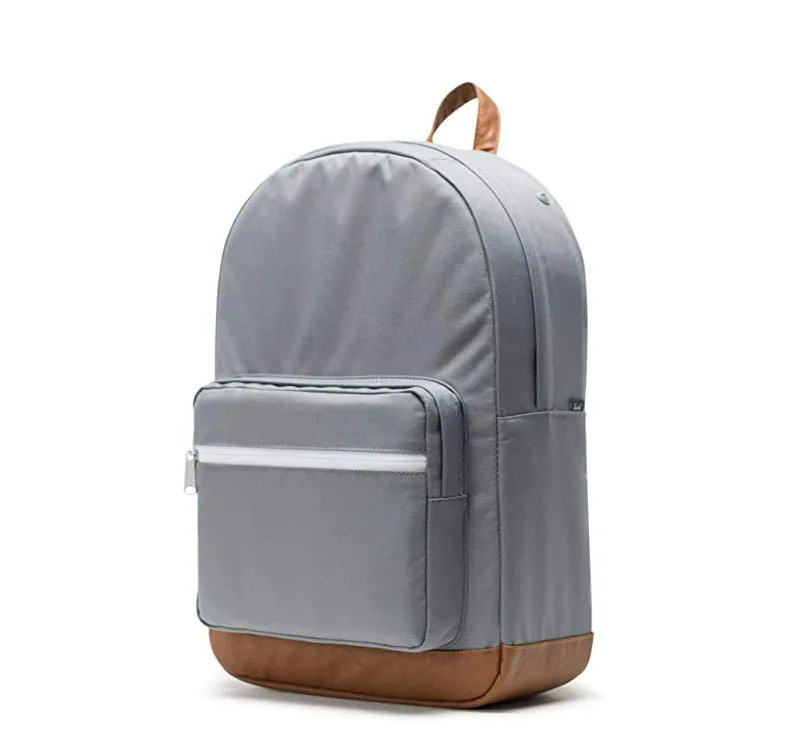
A 20L laptop backpack with a finished weight of 1.1 kg fits 10 pieces in a 60 x 40 x 40 cm carton, with a gross weight of approx. 12.6 kg and a volume of 0.096 cbm. That configuration is comfortable. It stays well under Amazon’s 22.7 kg (50 lb) per-carton limit for standard boxes, and no side exceeds 63.5 cm (25 in).
Push to 14 pieces in the same box and you gain freight efficiency but lose handling safety. The carton becomes unbalanced—heavy on one end—the corrugated walls bulge, and the bottom layer bears the full load of all layers stacked above it in the trailer.
Dimension and Weight Limits That Determine Your Carton Spec
Three numbers drive most decisions:
22.7 kg (50 lb) gross weight per carton for standard-size boxes
63.5 cm (25 in) maximum length on the longest side before a carton is classified as oversize
0.096 cbm to 0.13 cbm per carton—the range where freight cost per bag remains predictable
The trade-off nobody quotes for
Minor cartons reduce dimensional weight charges but increase the number of cartons per 500-unit order. More cartons means more labels, more receiving scans, and more chances for a box to be mis-sorted. Larger cartons cut freight per unit but push you toward the weight ceiling and slower check-in.
Buyers ask us constantly whether the carton can be shrunk to shave the inbound placement fee. Sometimes it can. Moving a 500-unit order from 0.13 cbm per carton to 0.096 cbm removes roughly a fifth of the shipped volume and the fee follows. Sometimes the saving is illusory, because a tighter pack compresses the shoulder straps into the back panel and units arrive with creased foam that photographs badly on a listing.
At Tianqin, we build the FBA carton specification before the first bulk order, not after. Our packing engineers produce a carton drawing with inner divider layout, then load a test carton and photograph the top layer before sealing. Buyers approve the drawing, not a verbal promise.
FNSKU Etiketë, Saccë Poli, dhe Kartë Inserti
Kërkesat në nivel të njësisë janë ku shitësit e parë herë humbasin më shumë para, sepse një gabim etiketimi në 2.000 saccë bëhet një faturë ripunimi, jo thjesht një varg email-esh.
Etiketimi FNSKU bëhet për çdo njësi dhe duhet të mbulojë plotësisht barkodin origjinal UPC. Ne vendosim etiketat FNSKU në linjën e paketimit vetëm pasi blerësi konfirmon hartimin ASIN-to-SKU në një dokument të nënshkruar. Hartimi me gojë shkakton gabime dublikimi kur dy variacione ngjyrash kanë kode të ngjashme.
Saccët poli kërkojnë një paralajmërim sufokimi kur hapja është 12,7 cm (5 in) ose më e madhe, i shtypur qartë në vetë saccën. Ne shtypim paralajmërimin direkt në filmin e saccës, jo me etiketë, sepse etiketat ndahen në qendrat e plotesimit të ftohta dhe saccja atëherë nuk plotëson kushtet.
Insert cards are allowed with limits. You cannot offer compensation in exchange for a review, and you cannot direct buyers to an off-Amazon channel with a lower price. We print inserts as part of the packaging order and hold them to the same artwork approval as hangtags.
Replenishment Cycles Reshape Your MOQ Math
The mistake we see most often is a buyer calculating MOQ against the launch order instead of the reorder cycle.
Sea freight from Xiamen to a US West Coast warehouse runs roughly 30 to 35 days port to port, plus 10 to 14 days for booking, trucking and Amazon check-in. Producing 1,000 laptop backpacks takes 30 to 35 days in our Quanzhou facility. Add a sampling round at the start, and the first cycle reaches about 90 days.
Your MOQ therefore has to cover demand across the whole cycle plus a buffer. Forecast 150 units a month and a 500-unit order gives roughly three months of cover, which is thin when one shipment sits in receiving for two weeks. A 1,000-unit order gives six months and a lower unit price, but ties up cash and risks a colorway going stale.
Buyers usually ask the question in reverse: can we start at 300 units and scale. Yes, at a higher unit cost. Below 300 units on a custom colorway, fabric minimums per color and dye lot charges push the unit price up by 12 to 18 percent in our quotes, and a second color doubles that effect.
Packaging That Survives Amazon Handling
A bag that leaves the factory intact can still arrive crushed. Amazon's conveyors, mixed pallets and automated sortation punish thin packaging.
We standardize on 5-ply corrugated export cartons for FBA-bound orders, with the top and bottom face printed so a box that splits on a conveyor can still be identified and traced to a shipment. Every new carton configuration goes through a 10-drop sequence at 76 cm on corners, edges and faces before we release it for bulk. When a German client reported 3 percent crush damage across a 17-inch backpack program, we traced it to a 3-ply carton swapped in to save USD 0.22 per box. The program moved back to 5-ply and the claim rate fell below 0.5 percent on the next 4,000 units.
We also keep a carton library of every configuration we have run for a client, with board grade, internal dimensions and the drop test record attached. A reorder six months later uses the same drawing, which matters when the warehouse receiving team has already learned how your boxes stack.
Our honest limitation: we do not control what happens after the pallet leaves our dock. What we control is board grade, compression strength, and how tightly the units are packed inside the carton.
The FBA packaging check before you approve bulk
Carton drawing approved with internal dimensions in mm
Gross weight per carton confirmed against the 22.7 kg ceiling
Longest side confirmed at or under 63.5 cm
FNSKU label placement agreed with a sample photo
Poly bag film at 0.05 mm minimum with printed warning
Insert card copy reviewed against Amazon's review policy
Drop test result shared for the exact carton configuration
Carton label format matched to the buyer's box content file
Construe brevem FBA-Ready, deinde ordina exemplaria
Si vis citationem quae veritatem refert, mitte fabricae simul quattuor res: specificationem sacculi, destinatam configurationem cartonis FBA, structuram ASIN et FNSKU, ac tuum praefatum mensalem. Citatio constructa super 500 unitatibus absque specificata configuratione cartonis erit falsa utrinque, et correctio saepe venit ut ordo mutationis.
Quanzhou Tianqin Bags Co., Ltd fabricat sacculos iam annos 17 et mittit programmate OEM et ODM pro sacculis pro computatris portatilibus in plus quam 50 nationes. Nos producimus exemplaria 3D ante instrumentationem, tenemus relationes examinis SGS pro materiis ad petitionem, et utimur sectione automatica et systemate convectore pendente ut reordinatio cum pristina copia congruat.
Mittite vestram brevem FBA ad [email protected] aut recensete lineas productorum apud www.tianqinbag.com . Respondebimus cum schemate cartonis, pretio unitario ad vestrum MOQ, et programma exemplarium intra 7 ad 15 dies operativos, ut vestra dies inaugurationis fundetur in vero tempore.

 Nuntii Calidi


