
 EN



Packaging is the last item on most private label briefs and the first item that causes a shipment to be reworked. A buyer approves a sample, confirms a carton, and then discovers the hangtag barcode does not scan at the retailer's distribution center. We have held finished backpacks on the floor for exactly this reason. Deciding packaging in the same approval round as the product removes that risk entirely.
Why Packaging Specs Slip
The product gets signed off in the sampling round. Packaging is treated as a detail and confirmed later by email, often by a different person on the brand side. By then the fabric has been cut and the cartons are on order.
At Tianqin we ask for the packaging spec at the same time as the tech pack, not after sample approval. If a buyer does not have one yet, we issue a standard export spec and let them overwrite it later. That default has saved more than one launch date, because a change to a hangtag is a print run rather than a production line stop.
Retail packaging also carries a compliance dimension that product design does not. A polybag without a suffocation warning cannot ship to a US retailer. A hangtag missing a country of origin statement creates friction in EU customs. These are not design preferences. They are blocking conditions.
A packaging change after bulk production starts is the most expensive change in a private label program. If hangtag artwork moves after the tags are printed, the run is repeated and the old tags are scrapped. If carton dimensions change, the pallet configuration changes with them and the forwarder recalculates the container loading plan. One approval meeting prevents both.
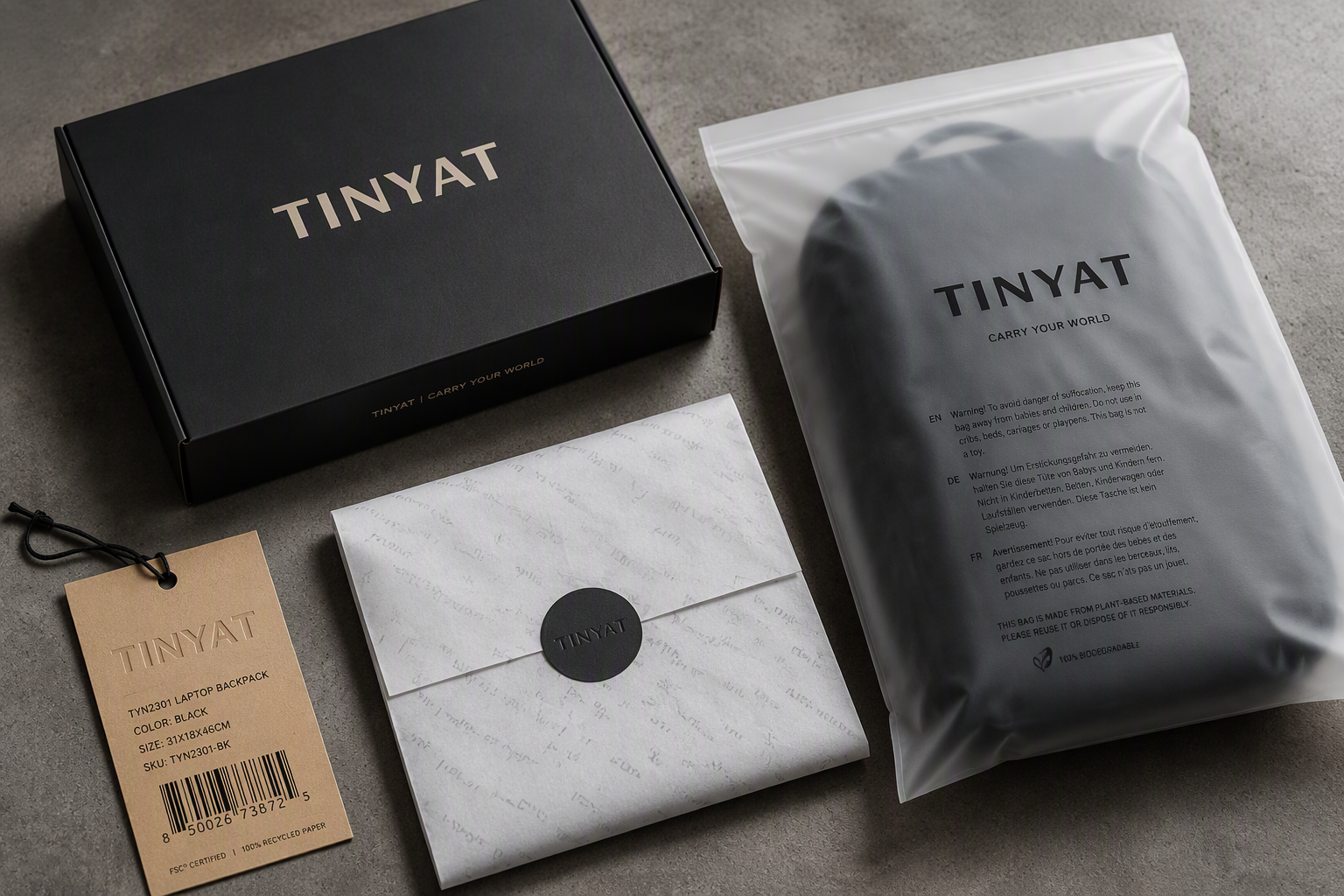
Polybag Specs That Pass Retail and Compliance Checks
A backpack in a retail-ready polybag is not the same product as a backpack in a protective bag. Decide which one you are buying before you request a quote.
Material: LDPE at 0.04 mm to 0.06 mm thickness. Under 0.04 mm it tears at the shoulder strap contact points.
Size: 25 x 35 cm fits a 25L backpack laid flat. A tight bag distorts the strap shape in transit.
Ventilation: 2 to 4 punched holes of at least 5 mm, required by many US retail vendor manuals.
Warning text: suffocation warning printed at no less than 8 pt on the bag face for US shipments.
Recycling mark: LDPE 4 symbol for EU shipments, plus any retailer-specific label applied on the outside.
Closure: self-adhesive flap tape beats a twist tie for retail handling speed.
Optional: euroslot or header card cut if the retailer hangs product on pegboard.
Polybag thickness also affects packer speed. A 0.06 mm bag holds its shape and opens faster on a packing line, while a 0.04 mm bag needs more handling time and is more likely to split at the strap corner. Across a 1,000-unit order the material difference is small and the labor difference is visible.
One limitation worth knowing: printed polybags are usually quoted at a 5,000-piece minimum. A first order of 600 units gets stock bags with an adhesive brand label. It is the practical answer, but it is a slightly less polished unboxing for a DTC brand, and buyers who want printed bags at low volume should expect to pay a plate fee that adds roughly USD 0.08 per unit at 600 pieces.
Master Carton Specs and Unit Counts
Carton geometry drives freight more than any other packaging decision.
Carton for a 25L backpack, 10 units: 60 x 45 x 40 cm, 5-ply corrugated, gross weight about 14 kg.
Carton for a 25L backpack, 8 units with deeper pocket protection: 62 x 48 x 42 cm, gross weight about 12 kg.
Carton for a 30L backpack, 8 units: 65 x 50 x 45 cm, gross weight about 15 kg.
Maximum gross weight: keep under 20 kg unless the destination 3PL has confirmed it handles heavier cartons.
Burst strength: 5-ply AB flute for ocean freight. 3-ply is acceptable for air freight only.
Markings: shipping mark, carton number, gross and net weight, country of origin, and the side-loading arrow.
Freight impact is measurable. A 40HQ holds about 1,900 25L backpacks packed 10 per carton and about 1,750 packed 8 per carton. That difference is roughly USD 0.15 per unit at typical ocean rates, which is minor on a 300-unit test order and meaningful on a 3,000-unit program.
Carton strength is set by the flute grade, not by the print. We keep 5-ply AB flute as the default for ocean freight because a crushed carton transfers compression to the backpack inside, and a distorted silhouette is a retail reject even when the fabric and stitching are perfect.
Hangtags, Inserts, and Barcode Requirements
Hangtags carry the data the retailer scans and the customer reads. Both jobs need to work.
Hangtag size: 40 x 60 mm to 50 x 80 mm, 350 gsm coated card with matte lamination for handling durability.
Barcode: EAN-13 for the EU, UPC-A for the US and Canada. Print at 100 percent magnification, black on white.
Placement: barcode on the reverse face, with a quiet zone of at least 5 mm on both sides.
Variable data: color and size codes must differ. Retailers reject duplicate GTINs across a size run.
Country of origin: Made in China printed on the hangtag for US retail. EU rules require origin marking on the product or its packaging.
Care and content: fiber content and care instructions if the retailer applies textile labeling rules.
Inserts: a warranty card or brand card adds perceived value. Keep inserts under 1 g to avoid postage tier changes for DTC parcels.
Higher price bands: a security thread or hologram on the tag is worth quoting above roughly USD 79.00 retail.
At Tianqin we print a barcode proof and scan-test it in our sample room before the tag goes to press. A quiet zone error of 5 mm is invisible on a design proof and fatal at a distribution center.
Artwork handover causes its own delays. We need the barcode as a vector file with the correct quiet zone, the logo in vector format, and Pantone references rather than screen colors. A JPEG logo pulled from a website will not print cleanly at 40 mm wide, and the reprint carries a full plate fee.
Packaging Specification Checklist
Send this completed document with your purchase order, not after it.
Polybag material, thickness in mm, and size in cm
Ventilation hole count and diameter
Suffocation warning text and font size
Barcode type, GTIN, and the per-color or per-size breakdown
Hangtag dimensions, card weight, finish, and artwork file
Insert content, dimensions, and weight
Carton dimensions, ply, units per carton, and gross weight
Carton markings and shipping marks
Pallet configuration and cartons per pallet
Destination 3PL or retailer routing requirement
Approved sample of the final packaging
Lock the Packaging Spec Before Bulk Production
Packaging is cheap to change in the sample room and expensive to change in the packing hall. Book the review early.
The first question most buyers ask us is how much custom packaging adds to the unit cost. On a 25L laptop backpack, a printed polybag, custom hangtag, and branded carton add roughly USD 0.35 to USD 0.65 per unit at 1,000 units, and closer to USD 0.25 per unit at 5,000 units.
For packaging development, a quote request, or an OEM/ODM packaging project, contact [email protected] or visit www.tianqinbag.com. Samples that include final packaging ship in 7-15 business days, and we scan-test your barcode before the bulk run starts.

 Hot News


