
 EN



A 2,000-unit laptop backpack order does not begin on the sewing floor. It begins as a brief, a tech pack, and a costing sheet. Between that email and the loading date sit roughly nine approval gates, and each one either releases the next stage or sends the order backward. Buyers who know where those gates sit lose fewer weeks. Here is the route an order takes through our Quanzhou facility, stage by stage, and what you sign off at each stop.
Stage 1: Brief, tech pack, and costing
The tech pack is the only document that matters at this point. If it specifies capacity in litres, shell fabric, padding density, zipper brand, and a dimensioned drawing, we can quote in 2 to 3 business days. If it says "a 15.6-inch laptop backpack, good quality," we cannot.
The first question most buyers ask us is how fast we can start. The honest answer is that our start date depends more on their document quality than on our floor space. A complete tech pack with a reference sample moves to pattern making in 48 hours. An incomplete one can sit in email for two weeks.
At Tianqin we now issue a written gap list within one business day of receiving a brief. It lists every missing measurement, and the buyer fills it in during one pass. That single change cut our average pre-production email cycle from nine days to three on first-time OEM programs.
Costing follows the tech pack, not the other way round. Fabric choice moves unit cost more than labor does. Swapping a 600D Oxford polyester shell for 1680D ballistic nylon adds roughly 0.9 to 1.4 USD per unit at our volume, which is why we ask buyers to settle the fabric tier before we quote MOQ.
We also confirm the MOQ tier at this stage, because it changes how the mill sells to us. At 300 units we buy from stock or from short rolls. At 3,000 units we can commit a full roll lot and hold the color consistent across the entire run. A buyer planning a 300-unit first order and a 3,000-unit reorder should say so early, since we can reserve dye lot continuity for the follow-up order.
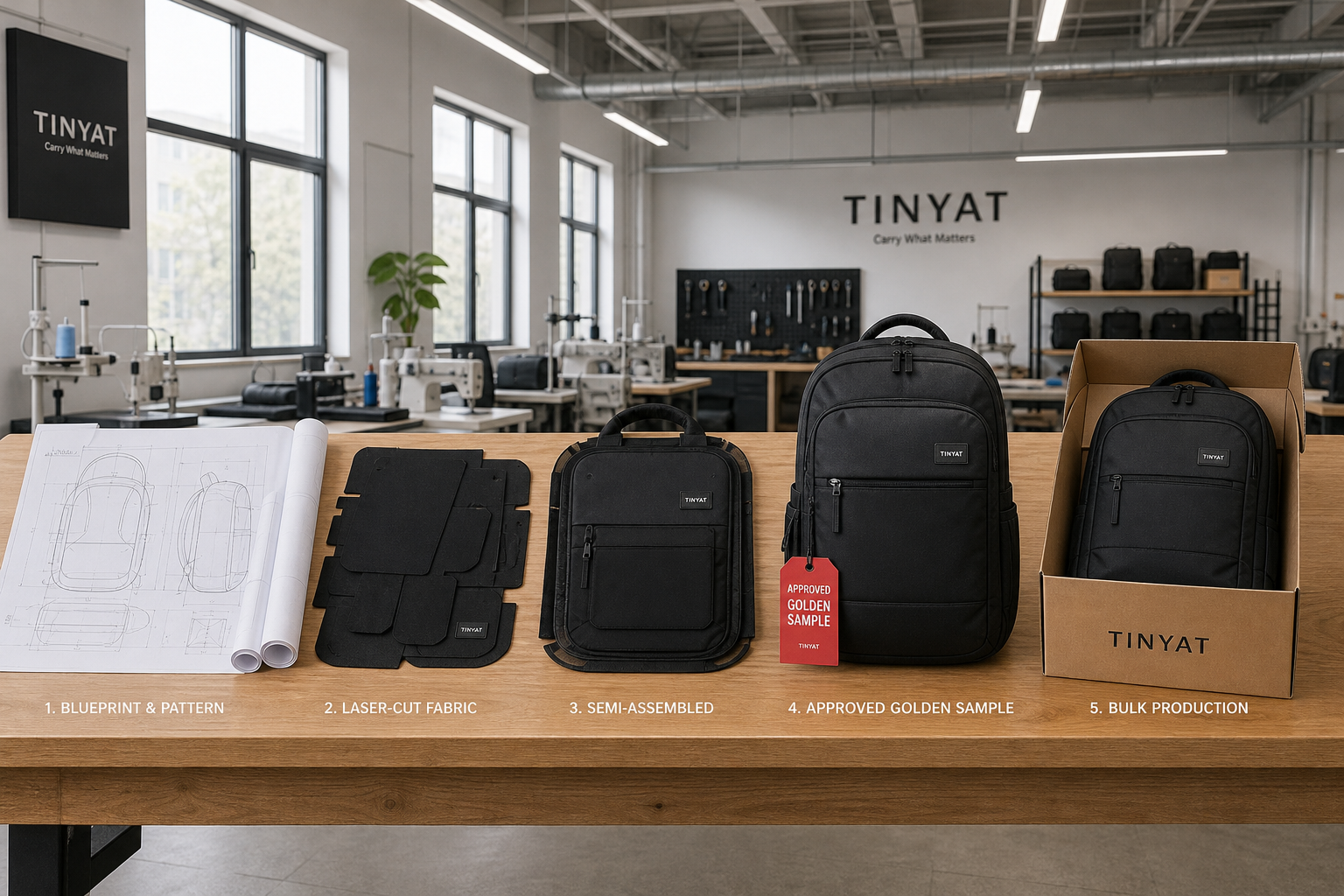
Stage 2: Pattern making and trial cut
Pattern making converts the drawing into cutting data, seam allowances, and a marker layout. On a 20L to 25L laptop backpack, a full pattern set runs 60 to 90 pieces including linings, foam panels, webbing loops, and pocket stiffeners.
Then we run a trial cut. We cut one unit by hand or on a short-run die to test geometry before committing fabric to the automated cutter. The trial cut is where we find the problems a drawing hides: a laptop sleeve that measures 265 mm wide inside but only 250 mm at the seam, or a side pocket that collides with the main zipper pull.
Trial cut turnaround is 2 to 3 business days. We do it before sampling, not after, because a sample built on unverified geometry simply moves the error one stage later.
Fabric choice affects the trial cut more than software does. A 1680D ballistic nylon with a PU backing holds a tight radius without fraying, while a looser 600D Oxford can pull at a 15 mm curve. The same pattern behaves differently in two shells, so we always trial cut in the confirmed fabric rather than a stand-in.
One limitation is worth stating. A trial cut cannot validate soft-goods behavior over time. A foam panel that feels correct at cut stage may compress after two weeks under load, so a single trial unit confirms geometry, not durability.
Stage 3: Sample approval
This is the gate buyers control most directly. The sample is the physical contract. Once approved, the approved sample is sealed in our sample room and every bulk unit is measured against it.
We build samples in 7 to 15 business days, depending on material availability and how much new tooling is required. Logo embroidery, a custom lining print, or a new zinc alloy puller can add 3 to 5 days.
The sample gate carries three decisions: fit and proportion, workmanship, and specification match. Approve all three together, or reject with a written defect list. Approving with verbal comments such as "looks good, just tighten the stitching" is how disputes start six weeks later.
At Tianqin we photograph every approved sample from nine angles and store the images alongside the tech pack revision number. When a bulk discrepancy appears, both sides check the same file instead of describing a backpack from memory. On one EU program, that photo set resolved a strap-length question in 20 minutes instead of the three days a re-sent sample would have cost.
Stage 4: Bulk fabric, cutting, sewing, and assembly
Bulk starts when the deposit clears and the approved sample is sealed.
Fabric procurement is the longest single input. 1680D ballistic nylon, 600D Oxford, YKK zippers, and zinc alloy hardware typically take 12 to 20 days to arrive in-house if we are not holding stock in the color required.
Cutting runs on automated CNC cutters. On a mid-size laptop backpack, one automated cutting line processes 800 to 1,200 units per shift with waste near 1 to 3 percent on a well-nested marker. Manual cutting is slower and less consistent, but it stays useful for small runs and for shapes the nesting software handles badly.
Sewing is organized into sub-assembly cells: front panel, laptop sleeve, padded back panel, and strap sets, each built separately, then joined. A hanging conveyor then moves joined bodies through final assembly so no operator waits for a stack of work.
Assembly handles the parts machines cannot place: zipper insertion on curves, webbing bar-tacks, and hardware riveting. This stage remains roughly 70 percent manual on a laptop backpack, and it is where most visible defects originate.
Packing follows the buyer's retail requirements, and those requirements have to be fixed before cutting. Polybag gauge, hangtag placement, carton configuration, and inner pack quantity are settled at the release meeting, not after sewing. A late packaging change can move a shipping date by several days even when every backpack is finished and hanging on a cart.
The approval gates: a checklist for buyers
Use this list to keep an order moving. Each item is a gate, not a suggestion.
Tech pack: capacity in litres, internal laptop sleeve dimensions in mm, shell fabric and denier, lining spec, zipper brand, hardware material, and a dimensioned drawing.
Reference sample: one competitor or previous-season unit to settle fit and pocket layout before pattern making.
Gap list: return it in one pass, not across six emails.
Costing approval: confirm fabric and hardware tier before MOQ negotiation, because the fabric decision drives unit cost more than order quantity does.
Trial cut feedback: approve geometry before sampling to avoid paying twice for one error.
Sample approval: written comments only, with photos of any defect and a clear accept or reject.
Size set: for multi-size programs, approve the size set before bulk cutting starts.
Sealed sample: confirm that the approved sample is physically sealed in the factory sample room.
Pre-production record: one page naming the construction points that bulk must match.
In-line inspection window: agree the percentage inspected and the stage, typically after 30 percent of the run is sewn.
Pre-shipment inspection: AQL sampling against the approved sample, not against memory.
Before you release the deposit
Move the technical decisions forward, not the money. Confirm the fabric, seal the sample, and lock the packing specification, then release the deposit. Orders that slip by two weeks usually slip at the sample gate, not on the sewing floor.
A buyer who arrives with a complete tech pack, a sealed sample decision, and a fixed packaging spec can usually compress the whole cycle by 10 to 15 days against the same order with open questions. That difference is not factory speed. It is decision speed before the factory starts.
Send your tech pack, reference photos, or a target retail price to [email protected], or review our OEM and ODM capability at www.tianqinbag.com. We build samples in 7-15 business days and export to more than 50 countries from our factory in Quanzhou, Fujian. If you want a realistic monthly output figure for your specific construction before you commit, ask for it in the same email.



 Hot News


