EN



A buyer places a USD 120,000 order for 6,000 laptop backpacks on a 30/70 split, with the balance due against a copy of the bill of lading. The goods ship. The inspection report arrives three days later and shows a zipper size deviation on 1,800 units. At that moment the buyer has paid in full and holds no leverage beyond a warranty conversation. The payment schedule was the risk, not the factory.
The standard structure and why it exists
Most Chinese bag factories quote 30 percent T/T deposit with the balance against a copy of the B/L, or 30/70 in short form. The structure exists because materials must be bought before anyone sews. On a USD 4.10 FOB backpack, materials are roughly USD 2.25, labor about USD 0.95, overhead and packing around USD 0.65, with the remainder as factory margin.
A 30 percent deposit on that unit is USD 1.23 against a material outlay of USD 2.25. The deposit does not cover the material purchase, which is why a factory holding a custom 1680D nylon order and a custom lining color is taking real exposure on your behalf. That does not make the schedule ideal for the buyer. It explains why the supplier will resist a 10 percent deposit, and why arguing about it usually costs time rather than money.
Deposit sizing: what 30 percent really covers
Deposit size reflects material specificity and order history far more than order value. We apply this in our own quotations, and buyers can use the same logic to predict what a supplier will accept.
Stock colors and stock hardware, second order onward: 20 to 30 percent is normal
Custom dyed fabric or custom lining, first order: 30 to 50 percent, because the mill wants payment before running your lot
Custom tooling such as a molded logo plate or a specific buckle: 50 percent, or tooling invoiced separately
Sample and mold charges: billed upfront, credited against bulk on conversion
A deposit above 50 percent on a first order with stock materials deserves a question, not a refusal. Ask which specific purchase it funds, and ask for the fabric mill's own proforma as evidence.
Balance against inspection, written so it works
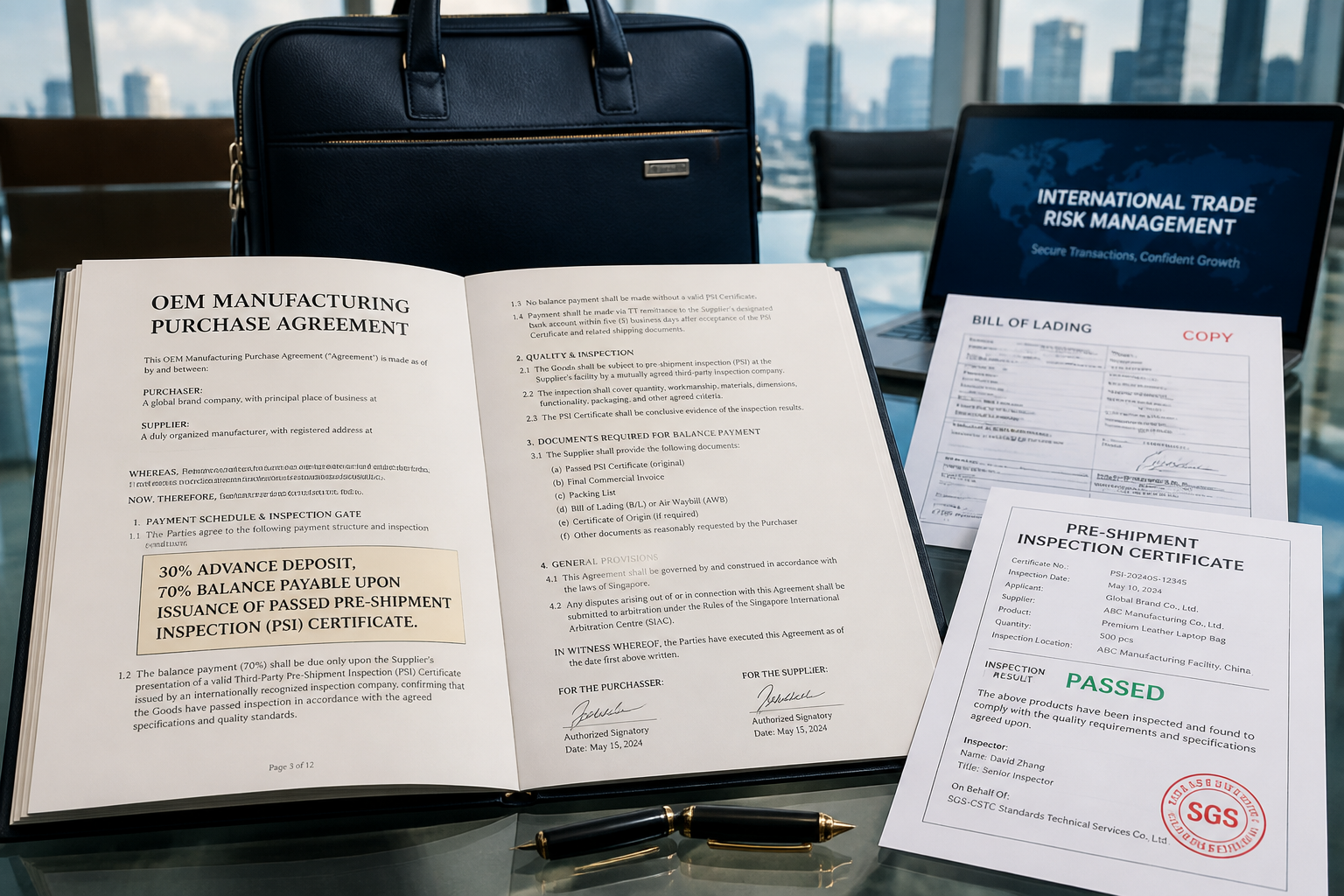
The phrase that appears in most contracts, 70 percent against a copy of the B/L, gives the buyer nothing at the moment it matters, because inspection then happens after the container leaves. Rewrite the schedule to put money behind quality. A workable three-stage split for a first large order:
30 percent deposit on order confirmation, against a signed golden sample
50 percent after a passed pre-shipment inspection, before loading
20 percent against the B/L copy or a shipping advice with container and seal numbers
The contract must define what passed means. Specify the AQL table rather than a default, and name it: AQL 2.5 for major defects and 4.0 for minor, with a general inspection level of II. Name who inspects: the buyer's nominated third party, at a cost the buyer pays unless the lot fails. State an allowed re-inspection, once at the supplier's cost when the first inspection fails, and a cure period of 7 working days for the supplier to sort, rework, and re-present the lot. Without those three lines, the word passed is a negotiation, not a standard.
Letters of credit: useful, but read clause by clause
An L/C at sight makes sense on a first order above roughly USD 150,000, or whenever the parties have no shipment history and the buyer wants bank discipline instead of trust. It is not cheap and it is not automatic. Expect an issuing fee, a confirming fee if you add one, and discrepancy charges of USD 50 to USD 75 per set each time documents fail to match.
Discrepancies are the part buyers underestimate. First presentations on bag orders frequently fail on details: the invoice showing a different model code from the L/C, the packing list omitting carton dimensions, a test report attached that was not listed as a required document, or a shipment date one day past the latest allowed date. Every one of those becomes a fee and a delay.
Two clauses to read closely. First, avoid an inspection certificate that must be signed to the buyer's satisfaction without a stated response deadline, because silence can either block payment or be treated as acceptance depending on wording. Second, confirm whether partial shipment and transshipment are allowed. On a 6,000 unit order split across two containers, a partial shipment prohibition turns a normal schedule into a compliance problem.
Clauses worth adding on a first large order
These sit outside the payment schedule but they are what actually secures it. Add them at quotation stage, before prices are fixed.
Quantity tolerance of plus or minus 5 percent, with the price applied to actual shipped quantity
Late delivery penalty of 0.3 percent of order value per day, capped at 5 percent, with force majeure defined
Inspection standard stated as AQL 2.5 major and 4.0 minor, with the inspector nominated by the buyer
Cure period of 7 working days on a failed inspection, before any penalty applies
Golden sample signed and dated by both parties, retained by each side, treated as the reference for claims
Zero-cost replacement for defects confirmed within 12 months, capped at 2 percent of shipped quantity
Tooling and logo plate ownership stated in writing, with return or transfer on request
Fabric lot consistency commitment, so a reorder matches the approved shade rather than approximately matching it
At Tianqin we hold the golden sample in our QC room and photograph it from four angles on approval. On the third consecutive order with a buyer we move a first-order schedule of 30/50/20 to 30/60/10, because inspection history replaces deposit as security. Our limitation runs the other way on small runs: below 500 units we ask for full payment before production, since a single sample run does not carry the same material exposure and the administrative cost of staged payments exceeds the margin.
How to negotiate terms without losing the price
Payment terms trade against price, lead time, and capacity priority, and buyers who negotiate all three at once get none of them. Choose one.
Offer a higher deposit for a price concession. Moving from 30 to 50 percent is worth roughly 1.5 to 2 percent on FOB with many suppliers, because it removes material financing cost.
Accept a wider delivery window. A 45 to 60 day window instead of 35 days lets the factory slot your run into a gap and typically buys a better rate than any deposit conversation.
Commit volume across a year. A 12 month forecast of 18,000 units moves the price more than any single-order term.
Give up something cosmetic instead. Dropping a custom packaging box is worth more than a month of arguing about the balance trigger.
Put every agreed term in the proforma invoice, not just the contract, because the proforma is what the finance department on both sides will actually read.
The first question most buyers ask us is whether we will release goods before the balance clears. The answer is no, and we state that before the quotation is sent, because a supplier who agrees to it and then ships anyway is telling you how the next dispute will go.
Send your target order volume, destination, and preferred payment structure to [email protected] or visit www.tianqinbag.com. We will return a quotation with a staged payment schedule, an inspection standard, and a sample in 7-15 business days.
 Hot News