
 EN



A buyer sent us a REACH report for a laptop backpack last month and asked whether it covered CPSIA as well. It did not, and it could not. The report tested four components against one European restriction list. CPSIA obligations, where they apply, run on different limits, different methods and a different lab accreditation. The buyer had spent 480 USD on a test that answered a question nobody at their retailer had asked. Reading which regulation applies to which component is the whole job.
Three regimes, three different questions
REACH asks what substances are restricted inside a product placed on the EU market. It is a substance list applied to materials, and it is enforced on the imported goods and on the technical documentation behind them.
CPSIA asks whether a product intended primarily for children meets US federal limits, and it comes with mandatory third-party testing by a CPSC-accepted lab. An adult laptop backpack sold to office users usually sits outside that mandatory testing, but a backpack with a cartoon print, a child-sized shoulder strap or a school channel listing can be pulled into scope by a retailer's own policy even when the law does not require it.
Prop 65 asks a different question again. It is a California warning statute, so the practical obligation is either to know that your product is below the safe harbor level for a listed substance or to carry a warning. It is not a pass or fail certificate in the way most buyers assume.
One backpack can therefore need three separate evidence files, and the paper you need depends on the sales channel as much as on the country.
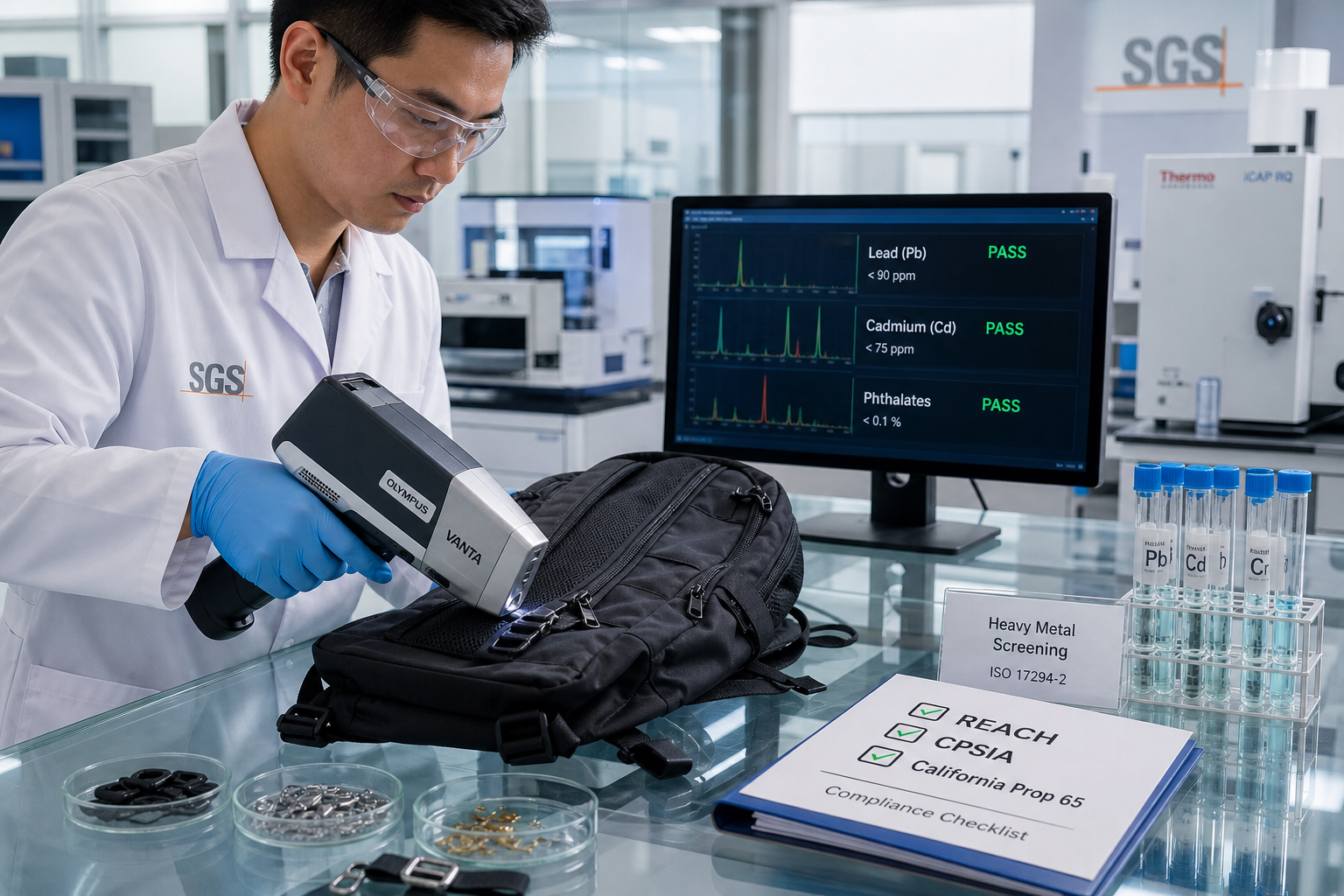
Test items by regulation: the working checklist
This is the item list we hand to buyers when they are building a compliance annex. Treat it as a starting document and delete rows that your channel does not require.
REACH azo colorants, tested on each dyed material: shell fabric, lining, webbing, binding tape and thread
REACH phthalates, tested on flexible PVC, PU coated fabric, heat transfer print and any soft trim
REACH heavy metals, tested on metal hardware, zipper pulls, eyelets, buckles and printed ink
REACH organotin compounds, tested where an antibacterial or antimicrobial finish is claimed
REACH SVHC screening at 0.1 percent by weight on the finished article where your retailer requires it
CPSIA total lead in accessible substrate, 100 ppm limit, tested per accessible component and not per whole bag
CPSIA phthalates, 0.1 percent limit on plasticized components, where the product is in scope
CPSIA tracking label and permanent marking review, where the product is in scope
Prop 65 lead and listed substances screen, with a documented decision to warn or not to warn
Color and material identity confirmation, stating that the tested swatch matches production
The last row is not a test. It is the single most common reason a valid report is rejected by a retailer's compliance desk.
Which components to test first, and why
Not every component carries the same risk, and spreading a small budget evenly across a bill of materials is a poor use of money.
Shell fabric in black or navy is the highest-risk dyed material for azo colorants because deep shades need more dye. Webbing and binding tape follow closely, and they are often forgotten because they are cheap.
Zipper pulls, sliders and buckles are the highest-risk metal parts for lead and cadmium. Printed logo ink on the front panel is the highest-risk ink area, especially where the ink sits on a coated fabric.
Foam padding is usually low risk, and testing it is often a waste of a test line unless the foam is recycled-content or treated with a flame retardant.
At Tianqin, we maintain a component risk matrix for every laptop backpack platform we run. On the current 1680D ballistic nylon business range, the matrix flags six items for full testing and marks the remaining eleven as low risk. That keeps a standard compliance pack at 9 to 11 test lines instead of 25, and keeps the lab spend on the parts that actually fail.
How the numbers land in a real program
A buyer launching a two-color laptop backpack line into the EU and the US should budget four separate test areas rather than one.
Azo and heavy metal screening on four dyed materials for two colorways typically runs 6 to 9 test lines. Phthalates add 2 to 3 lines. Hardware heavy metals add 2 lines. Prop 65 decision support adds a small screening set or an internal documented review.
Timing matters as much as cost. Standard turnaround at SGS for textile substance testing runs 5 to 7 working days, and longer if a limit is exceeded and the lab needs to re-run or if a component needs to be re-sampled. If your bulk production is already sewn when the results arrive, a failed lining means either a re-test on a substitute material or a delayed booking.
We build the lab window into the production plan. Sampling runs 7 to 15 business days, and we schedule substance testing in parallel with sample approval rather than after it, so the reports are usually in the buyer's hands before bulk cutting starts.
What CPSIA actually changes for a backpack program
For most adult laptop backpacks, the answer is nothing, and buyers should be told that plainly.
The moment a backpack is positioned for children, three things change at once. First, mandatory third-party testing by a CPSC-accepted lab applies, which is a different accreditation from the general lab panel. Second, small parts, cords, drawstrings and straps come under separate safety rules, and a shoulder strap on a child's backpack can be a hazard item in its own right. Third, a permanent tracking label becomes a requirement, which means the label has to be sewn into the bag and not applied as a hangtag.
The first question most buyers ask us is whether a single test pack can cover both a US kids SKU and an adult SKU. It cannot, and it is not close. Designing for both means two bills of materials and two evidence files, and the adult version should not be saddled with children's restrictions unless the channel demands it.
Where the checklist breaks down in practice
Three failure modes repeat across programs, and all three are documentation problems rather than factory problems.
The tested material and the shipped material are different. A report on a 600D Oxford shell does not clear a 1680D ballistic shell, even if both are black. A report on a standard lining does not clear a swap to a brushed tricot lining made by a different mill.
The tested color and the shipped color are different. Dye chemistry follows the color, not the construction, so a black shell report does not clear the same fabric in charcoal or navy.
The report has expired against the current rule text. Limit values and the listed substance inventory are revised, so a report tied to an older version of a restriction list can be rejected even though the product did not change.
Honest limitation: a compliance pack built this way still cannot guarantee that a customs authority or a retailer's auditor will accept every line. Different retailers apply different internal lists, and some add substances that neither REACH nor Prop 65 restricts. Our position is to be accurate about what we can evidence and to flag the rows we cannot answer, rather than to fill a document with claims the lab did not actually make.
Turn the checklist into a purchase order annex
Take the rows above, delete what your channel does not require, and attach the remaining list to the purchase order with a named owner and a dated deadline. Require that every test report names the material, the color and the component it covers, in writing, and that it names the lab and the standard used.
Set the report deadline at least 10 working days before your booking cut-off. That window is what lets a failed lining be replaced with an approved substitute instead of becoming a port story.
Send your destination market, channel and bill of materials to [email protected]. We will return the component risk matrix for your model and confirm which reports already exist for the materials. Sampling turnaround is 7 to 15 business days, and full factory details are at www.tianqinbag.com.

 Hot News


