EN



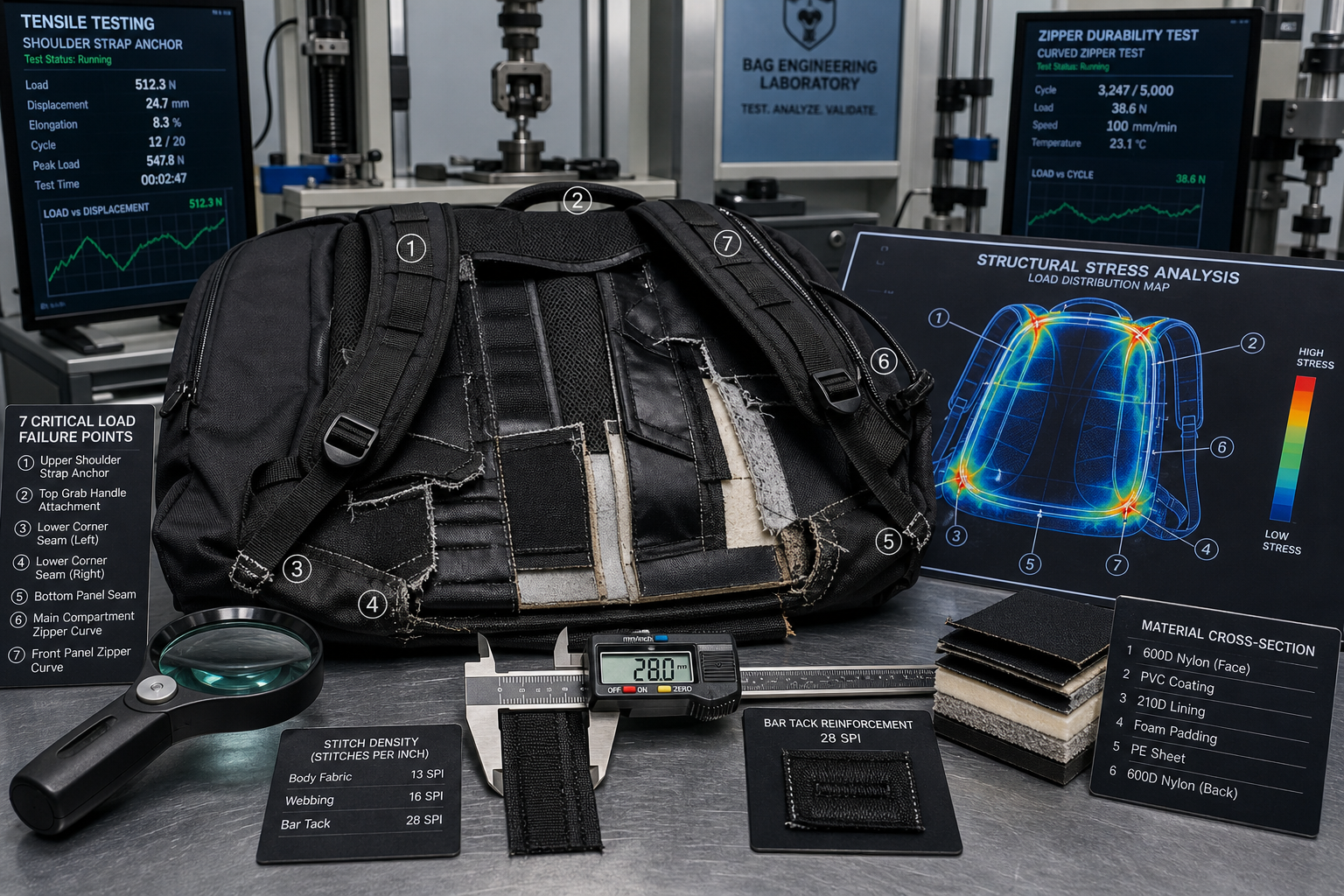
Seven defect patterns account for most of the claims that reach our QC desk on laptop backpack orders. None of them are exotic and none of them are random. All seven are predictable, which means all seven can be designed out before the first bulk run instead of paid for afterwards. What follows is each failure, the cause we usually trace it to, and the prevention step that costs the least to implement at the sampling stage.
The load path failures
The load path is everything carrying weight between your shoulder and the laptop compartment. Failures here are the ones that generate customer returns rather than discounts.
Zipper pull-out
The slider separates from the coil under load, usually on the main compartment where the laptop sits. In our claim records the dominant cause is an under-specified zipper for the opening width: a size 5 coil on a 320 mm main opening, where the load at full packing is 6 kg or more. A secondary cause is a puller attached by a single rivet into a non-reinforced tab.
Prevention is cheap. Use size 8 or size 10 YKK coil on the main compartment, box-stitch the puller tab, and test at 25 kg static pull for one minute, then 500 open-close cycles. At Tianqin we standardized on YKK size 10 for any laptop backpack with a main opening over 300 mm after we traced 11 separate pull-out claims to size 5 hardware in one season.
Strap anchor tear
The shoulder strap pulls away from the back panel at the top anchor. Cause: webbing bar-tacked into the lining only, so the load transfers to a single layer of 210D fabric, or webbing narrower than 32 mm under a heavy load.
The fix is structural, not cosmetic. Anchor the 38 mm webbing through the shell to a 1680D ballistic nylon reinforcement patch, use a box-X stitch pattern at 8 stitches per inch, and run a 25 kg static load test on the finished unit for 30 minutes. A patch adds roughly 12 grams and about 6 cents per unit. The alternative is a return.
Stitch skip
A missed stitch line in a seam, visible as a gap of two or three stitches, most often where several layers converge at the base of the bag. Cause: wrong needle size for the fabric combination, tension set for a lighter material, or an operator running the seam too fast across a thick junction.
Prevention is process discipline. Eight stitches per inch on 1680D shells, needle changed on a fixed schedule rather than when it breaks, and tension re-checked at the start of each shift, not each week.
The material failures
These two only appear after the product is in the customer's hands for weeks, which makes them expensive to detect late.
Foam compression
The laptop sleeve goes soft and the device no longer sits against a protective base. Cause: EPE foam at 18 kg per cubic meter instead of 25 to 30, or an 8 mm sheet where 10 mm is needed at the base of the sleeve.
We test this with a 40C, 85 percent relative humidity chamber for 48 hours, then re-measure thickness. A sleeve built with 10 mm of 28 kg per cubic meter EPE typically retains over 90 percent of its thickness after that cycle. The cheaper alternative retains closer to 70 percent, and the difference is invisible in the sample room.
Color transfer
Dye from a dark lining migrates onto a light shell fabric, or onto a laptop's light-colored case. Cause: cheap dispersion dyes on the lining with no migration test, combined with humidity in transit inside a container.
Prevention: require a migration test at 40C and 85 percent relative humidity for 48 hours on the actual shell and lining combination, not on generic swatches. Where a light shell is specified with a dark lining, we now quote a two-tone specification with a lower-migration lining as the default, because it costs less than a return campaign.
The process failures
Both of these are visible at inspection, which is why they are the cheapest of the seven to catch.
Hardware corrosion
Zinc alloy buckles and sliders develop white rust or pitting. Cause: thin or poorly bonded plating, often on unbranded hardware, combined with salt spray exposure during a two-month sea freight journey.
Ask for a 48 hour salt spray test, and for nickel plating thickness above 3 microns on visible hardware. This is one place where buying unbranded hardware saves 8 cents and costs a warranty claim.
Logo misregistration
A printed or embroidered logo lands off-center, at the wrong height, or with distorted spacing. Cause: a heat transfer applied without a jig, or embroidery digitizing that was scaled without re-digitizing for the new size.
Set a tolerance in the spec: logo centered within 3 mm on both axes, with a photo of the approved position attached to the golden sample. We keep that photo on file for every program and compare it against the first 20 pieces off the line before the run continues.
The defect triage list we give new buyers
Use this on the pre-production sample and again at AQL inspection. If a supplier cannot answer all eight lines in writing, the specification is not finished.
Zipper size and brand stated for every opening, with a pull test value in kg
Strap anchor construction described as shell-anchored with reinforcement, not lining-anchored
Stitch density stated in stitches per inch, minimum 8 on high-stress seams
Foam type and density stated in kg per cubic meter, with thickness at the sleeve base in mm
Color migration test result on the specific shell and lining pair
Hardware plating thickness in microns and a salt spray duration in hours
Logo placement tolerance in mm, with the approved position photo on file
Golden sample signed, dated, and retained by both parties
How to use this before your next order
Run the seven checks in reverse order. Start with the cheap process failures, then materials, then the load path, because a redesign at sampling costs a day while a redesign in bulk costs a container.
There is an honest trade-off here, and one most factories do not state. Making all seven specifications airtight adds about 8 to 12 percent to the FOB cost of a 25L unit, and it adds 2 to 3 days to sampling. For a program priced at USD 24 retail with a two-year warranty, that is arithmetic that pays back. For a promotional run of 300 units sold at USD 12 with a 30-day warranty, over-specifying destroys the margin and the buyer is better served by a smaller set of guarantees.
The first question most buyers ask us is how much of this testing we pay for ourselves. The answer is that destructive tests on our own materials - abrasion, salt spray, foam compression - are internal and included, while compliance testing for your destination market is quoted separately with the report issued in your name or ours.
Send your spec sheet and target price band to [email protected] or visit www.tianqinbag.com. We build the golden sample around your defect tolerances, run 3D sampling before tooling, and ship samples in 7-15 business days.



 Hot News