
 EN



Two quotations land on the same desk for a 25L laptop backpack. The first is USD 2.80 FOB from a supplier in Guangdong. The second is USD 4.10 FOB from a factory in Quanzhou. The buyer takes the first to protect margin, and the program looks successful for one season. The arithmetic that follows is not emotional. It is return handling, warranty replacement, freight, and the cost of running the order a second time through a different plant.
Two units, two cost structures
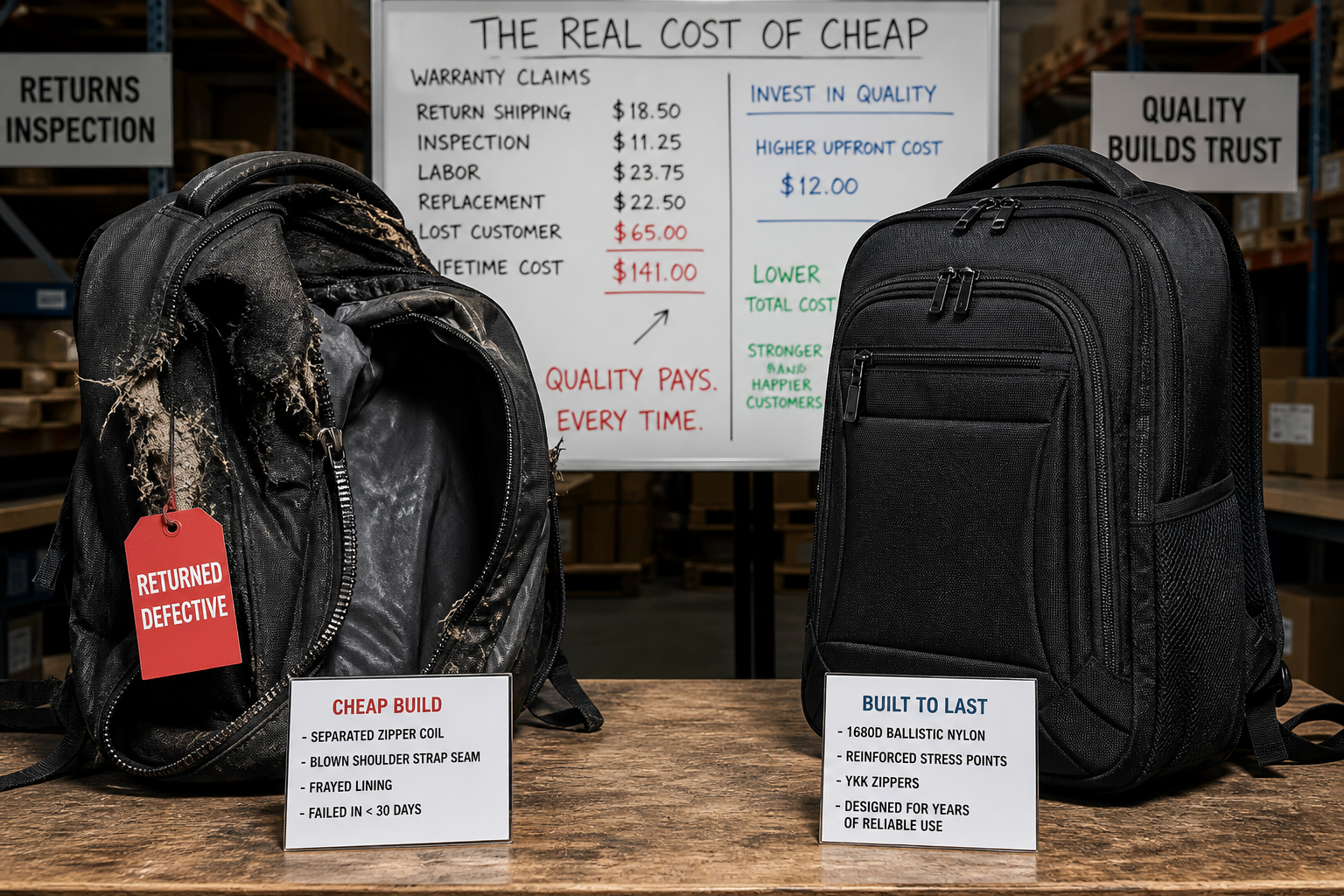
The USD 1.30 gap is not margin. It is specification. The cheaper unit typically carries a 600D polyester shell, size 5 unbranded zippers on the main opening, 8 mm of 18 kg per cubic meter EPE in the laptop sleeve, and hardware plated thin enough to pit in a sea container.
The stronger unit carries 1680D ballistic nylon on the high-stress panels, YKK size 8 zippers, 10 mm of 28 kg per cubic meter EPE at the sleeve base, and nickel plating above 3 microns. Both bags weigh within 40 grams of each other, at roughly 800 grams, so weight is not the tell. Construction is.
On a 3,000 unit order the cheaper spec saves USD 3,900 upfront. Hold that number, because everything below is measured against it.
Return rate is where the math turns
Assume both units sell at USD 29 retail in the US. Our claim and field data across comparable programs puts the low-spec unit at a 4.2 percent return rate and the warranty-level unit at 1.1 percent in the first 90 days. The difference is almost entirely zipper pull-out and strap anchor failure.
At 4.2 percent, 3,000 units generate 126 returns. At 1.1 percent, 33 returns. That is 93 extra units coming back, and each one costs money: customer refund processing, inbound label, grading, and either repacking into sellable condition or writing the unit off. A realistic blended cost is USD 9 per returned unit once labor and depreciation of sellable stock are included. That is USD 837 of extra loss on the cheap unit.
Returns alone do not close a USD 3,900 gap. Anyone who tells you a return rate by itself justifies the specification difference is selling something.
Warranty claims are a logistics problem
Warranty is where the second cost layer sits, and it is larger than returns. Again from comparable programs: 6.8 percent of the low-spec units generate a warranty contact within 12 months, against 1.9 percent for the warranty-level unit.
For 3,000 units that is 204 contacts versus 57, so 147 additional claims. Each one consumes a replacement unit at FOB (USD 2.80), an outbound shipment to the end customer at USD 4.50, and about 12 minutes of support labor at USD 15 per hour, or USD 3.00. Call it USD 10.30 per claim, and 147 claims cost USD 1,514.
Add 29 hours of support time spread across a year, and the administrative drag shows up as headcount rather than an invoice line, which is exactly why buyers miss it in the model.
Freight and the cost of the second order
Cartons are where the cheap unit quietly loses again. Lower-grade foam compresses during transit, so many suppliers add a thicker inner carton, which raises cube. Moving 60 cartons with 0.9 kg more gross weight per carton on a sea lane adds only about USD 200, which is negligible.
Air freight is not negligible. If a defect forces a partial air replacement of 400 units at 8 kg per carton, the air cost can exceed the value of the goods. Buyers who have run that emergency once tend to specify load-path components properly afterwards.
The real freight cost is the emergency reorder. Rebuilding a program at a second factory means new pattern making, a new sampling round at 7-15 business days, a new golden sample, and a second inspection cycle. A reorder placed in a hurry typically lands in a higher weekly production slot and pays for it.
Reorder cadence is the compounding cost, and it never appears on an invoice. A program that fails once in a 12 month cycle and has to be rebuilt elsewhere loses roughly 8 to 10 weeks of shelf time. On a listing that moves 400 units a week at USD 29, that gap is a much larger number than any per-unit saving, and it is invisible in a cost sheet because lost sales do not generate paperwork.
The total cost model you can run yourself
Use this line list with your own numbers. Replace our rates with your retail price, your return handling cost, and your support wage.
Specification difference: USD 1.30 per unit, USD 3,900 on 3,000 units
Unit delta on returned goods: 93 extra returns at USD 9 blended handling, USD 837
Unit delta on warranty claims: 147 extra claims at USD 10.30, USD 1,514
Support labor: 29 extra hours at USD 15, USD 435
Emergency reorder exposure: one triggered reorder, sampling plus premium slot, USD 400 to USD 1,200
Retail margin damage: 40 low-star reviews on a listing, which is outside the cash model
Net position after cash costs: the cheap unit still saves roughly USD 700
That last line is the honest answer. In pure cash terms, the low-spec unit often still wins by a small margin, and buyers should know that rather than be told otherwise. What the model does not capture is variance. The USD 700 saving holds only if the return rate stays at 4.2 percent and no container-level defect appears. One failed strap batch turns a USD 700 saving into a USD 6,000 loss, and the reviews that follow change the sell-through of the next three orders.
How to buy cheaper without buying fragile
Cuts belong in cosmetics, never in the load path. There is real room to reduce cost without touching zipper size, strap anchoring, or foam density at the sleeve base.
Printed packaging versus a rigid gift box: 22 to 35 cents per unit
Single-color lining and one shell color: 8 to 15 cents per unit
Unbranded but fully specified hardware at 3 microns plating: 6 to 10 cents per unit
MOQ moving from 1,000 to 3,000 units on the same pattern: 4 to 9 percent on FOB
Trolley sleeve deleted from a non-travel SKU: 12 to 18 cents per unit
At Tianqin we quote two levels side by side on request: a value build for promotional channels and a warranty-level build for retail programs with a two-year promise. Where a buyer shares their retail price and return rate, we run this model with their numbers rather than ours, because the crossover point moves with channel. A marketplace seller carrying a 6 percent return rate reaches break-even far earlier than a wholesale distributor who never sees the end customer. We show the component difference in writing so the buyer can see which USD 1.30 they are removing. That is a habit we adopted after watching three buyers cut the zipper spec to hit a price and then pay for it in claims.
The first question most buyers ask us is what we would cut first to reach their target FOB. Our answer is always the same: cut the hangtag and the second color, not the strap anchor. Our own limitation is that we will not quote a warranty-level program with a size 5 zipper on a main opening, even when a buyer asks for it in writing. We would rather lose the order than own the defect.
Send your target retail price, channel, and warranty promise to [email protected] or visit www.tianqinbag.com. We will return a two-level costed quotation, confirm material specifications in writing, and ship samples in 7-15 business days.



 Hot News


