
 EN



A brand signs its first purchase order for 500 laptop backpacks and plans to list them on a marketplace and its own storefront in the same month. Then the first FBA shipment comes back with a prep warning, the DTC parcel arrives crushed, and the restock window turns out to be shorter than the production lead time. Two channels need two specifications, and those differences are decided at sampling, not at launch.
Retail Shelf Stock Is Not E-commerce Stock
The bag can be identical. The packaging cannot.
Retail shelf stock is packed for a store environment: a hangtag with a scannable barcode, a polybag for handling, cartons for a distribution center. E-commerce stock is packed for a parcel network. It has to survive being dropped, squeezed, and stacked, and it has to carry the identifiers a fulfillment center scans on intake.
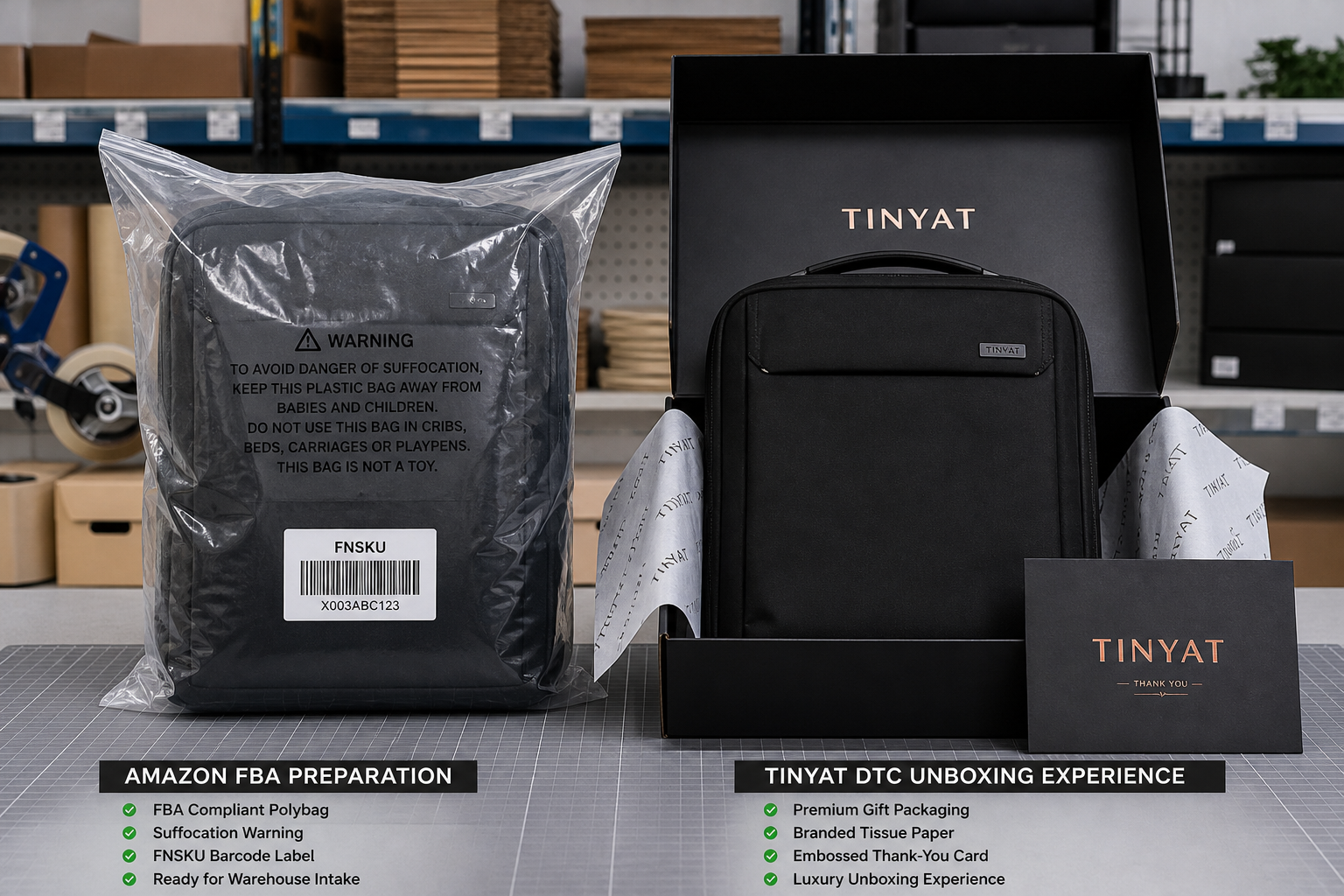
Amazon requires a suffocation warning on any polybag with an opening of 5 inches or more, and it requires a scannable FNSKU label on each unit rather than the plain manufacturer barcode. A retail hangtag with a UPC does not satisfy that on its own. For a DTC brand shipping from a 3PL, the requirement is normally a protective polybag inside a shipping box with a branded insert.
At Tianqin we build the e-commerce variant on the same pattern as the retail version and change only the packing. That keeps sample cost down and avoids a second set of tooling. The first question most buyers ask us is whether one SKU can serve both channels. It can, if the buyer accepts a polybag and insert that suit both and skips the store-specific euroslot cut. The trade-off is that the retail presentation is slightly less refined than a purpose-built shelf pack.
Channel economics also set the target landed cost. A marketplace unit carrying a 15 percent referral fee and a fulfillment fee has less room than a DTC unit, so the two channels can justify different builds. We have seen brands use a 600D Oxford shell for the marketplace SKU and 1680D ballistic nylon for the DTC SKU at a higher price, which keeps both margins intact.
Packaging for Marketplace and Direct Shipping
E-commerce packaging has four jobs: protect the bag, satisfy the fulfillment center, carry the brand, and fit the parcel size tier.
Polybag: LDPE at 0.05 mm, 28 x 40 cm for a 25L backpack, with a 5 mm ventilation hole and a suffocation warning printed at 10 pt.
Unit label: FNSKU on the outside of the polybag under clear tape, with the barcode face flat and not wrapped over an edge.
Hangtag: optional for marketplace shipments, expected for DTC. Keep it 40 x 60 mm at 350 gsm.
Insert: one card under 1 g with care instructions, warranty terms, and a QR code to a registration page.
Shipping box for DTC: 42 x 32 x 18 cm, 5-ply, sized 3 to 5 cm larger than the bag on every side.
Carton for FBA: 60 x 45 x 40 cm with 10 units, gross weight under 20 kg, no protruding staples or straps.
The parcel size tier is where money leaks. An oversized box pushes the unit into a higher fulfillment fee band. Reducing a shipping box from 45 x 35 x 20 cm to 42 x 32 x 18 cm can move a unit into a cheaper band without changing anything inside. Run that test before the first shipment, not after the first invoice.
Unboxing, Inserts, and Review Behavior
A laptop backpack sold online is judged in the first ten seconds after the box opens, and review behavior follows that judgment.
Print one clear warranty card. Customers look for warranty terms before they look for return instructions.
Put the brand name and model code on the polybag so warehouse staff and customers can identify the unit without opening it.
Avoid loose filler inside the laptop compartment. Crumpled paper against a padded sleeve reads as careless, and it hides defects from the final inspection.
Include a sleeve fit note. A 15.6 inch and a 16 inch laptop are not interchangeable in every pocket pattern, and stating the fit reduces size-related returns.
Skip printed price tags on marketplace shipments. A price on the packaging becomes a customer service problem when the online price differs.
Returns are the real cost of e-commerce. A 4 percent return rate on a USD 49.00 backpack against a USD 11.60 landed cost is manageable. At 12 percent, the channel stops being profitable even with healthy gross margin, and most laptop backpack returns are size or expectation related rather than defects.
Photography and packaging should be planned together. A reflective polybag, a hangtag with a dark background, and a matte bag surface all change how the product reads in a listing image, and that difference shows up in conversion well before it shows up in returns.
Inventory Planning for Two Channels
Two channels compete for the same production slots and the same cash.
Amazon: hold 8 to 10 weeks of cover at forecast velocity. Below 4 weeks, a stockout can cost the listing its ranking.
DTC: hold 6 to 8 weeks and replenish in smaller lots, because the brand controls demand timing.
Retail wholesale: hold 10 to 12 weeks before a seasonal window, since store delivery dates are fixed.
Bulk production lead time: plan 30 to 45 days after deposit and material confirmation.
Sampling lead time: 7 to 15 business days for a new colorway or a packaging change.
Ocean freight: 30 to 40 days door to door to a US West Coast 3PL, longer for inland destinations.
Total restock cycle: 75 to 95 days. Any cover level shorter than that produces stockouts.
The trade-off is unavoidable. Holding more cover protects the listing and consumes cash. A brand scaling from 500 to 2,000 units a year cannot usually do both, so the marketplace gets the deeper cover and DTC takes smaller, more frequent deliveries. Brands that reverse that order tend to run out of the channel with the higher acquisition cost.
Launch volume should follow the restock cycle rather than the budget. If the cycle is 75 days and the brand sells 250 units a month, a 500-unit first order leaves two months of cover and then a gap. Sizing the first order at 750 units with the reorder placed in week four is safer, even though the unit price at 1,000 units looks better on paper.
E-commerce Launch Specification Checklist
Confirm each line before the purchase order, not after the first shipment.
Marketplace channel and fulfillment method confirmed, FBA or 3PL
FNSKU or manufacturer barcode decision recorded
Polybag thickness, size, ventilation, and warning text approved
Suffocation warning wording checked against marketplace policy
Hangtag and insert artwork approved with a barcode proof
Country of origin marking present on the product or its packaging
Shipping box dimensions tested against the parcel size tier
Units per carton and carton gross weight within handling limits
First order volume sized to cover the full restock cycle
Reorder trigger and stockout threshold agreed with the factory
Photo confirmation of the first packed carton before shipment
Launch the Channel You Can Actually Supply
Pick the channel you can keep in stock. A marketplace listing that goes out of stock in week six loses a ranking that took months to build. A DTC store with a two-week shipping delay loses the customer at checkout. Both are supply problems dressed up as marketing problems.
To plan an e-commerce or DTC laptop backpack program, contact [email protected] or visit www.tianqinbag.com. Send your target channels and volumes, and we will return a packing specification and an FOB quote. Sampling runs 7-15 business days, and we scan-test the FNSKU or UPC before bulk packing.

 Hot News


