
 EN



Anti-theft is a claim buyers pay for and rarely verify. A hidden pocket that a pickpocket finds in four seconds, a lockable pull that opens with a thumbnail, an RFID-blocking lining that blocks nothing at the frequency the card actually uses: all three ship every month under confident marketing copy.
Here is what each element really does, what it costs, and where the claim breaks down.
Back-panel pockets: the layout that works
A back-panel pocket sits between the shoulder straps, against the wearer's spine, and is only reachable when the bag is off the back. That is the whole security argument, and it is a good one.
Geometry decides whether it functions. Our standard back-panel pocket for a 25 litre laptop bag is 200 x 140mm, positioned 60mm below the top of the back panel and 30mm inboard of each strap anchor. Below that, it sits against the lumbar curve and the contents press into the wearer's back. Above it, the pocket competes with the top handle reinforcement.
The closure matters more than the size. A vertical zip on a back-panel pocket cannot be opened by a hand behind the wearer without the wearer feeling it. A horizontal zip across the top can. We build vertical by default.
Then there is the padding conflict. The back panel is where the foam lives, and cutting a pocket into it removes the foam exactly where the wearer needs it. Two solutions exist: a pocket built on top of the foam, which adds 8mm of depth to the back panel and changes the fit, or a pocket recessed into the foam with a 3mm backing layer, which requires a die-cut and adds tooling cost. We use the recessed version for programs above 1,000 pieces and the surface version below that, and we tell the buyer which one they are getting.
One layout detail that costs nothing and is often missed: the pocket lining. A dark lining in a back-panel pocket makes it very hard to see whether anything is left inside, which matters when the whole point is that the pocket is out of sight. We build these pockets in a mid-grey 210D for that reason, and buyers rarely notice until a customer complains about a lost boarding pass.
The limitation to state plainly: a back-panel pocket holds a passport, a card wallet and a phone. It does not hold a 10-inch tablet in a 25 litre bag, and any supplier showing you a sample that does is sacrificing the lumbar foam to get there.
Lockable pulls and what locks actually stop
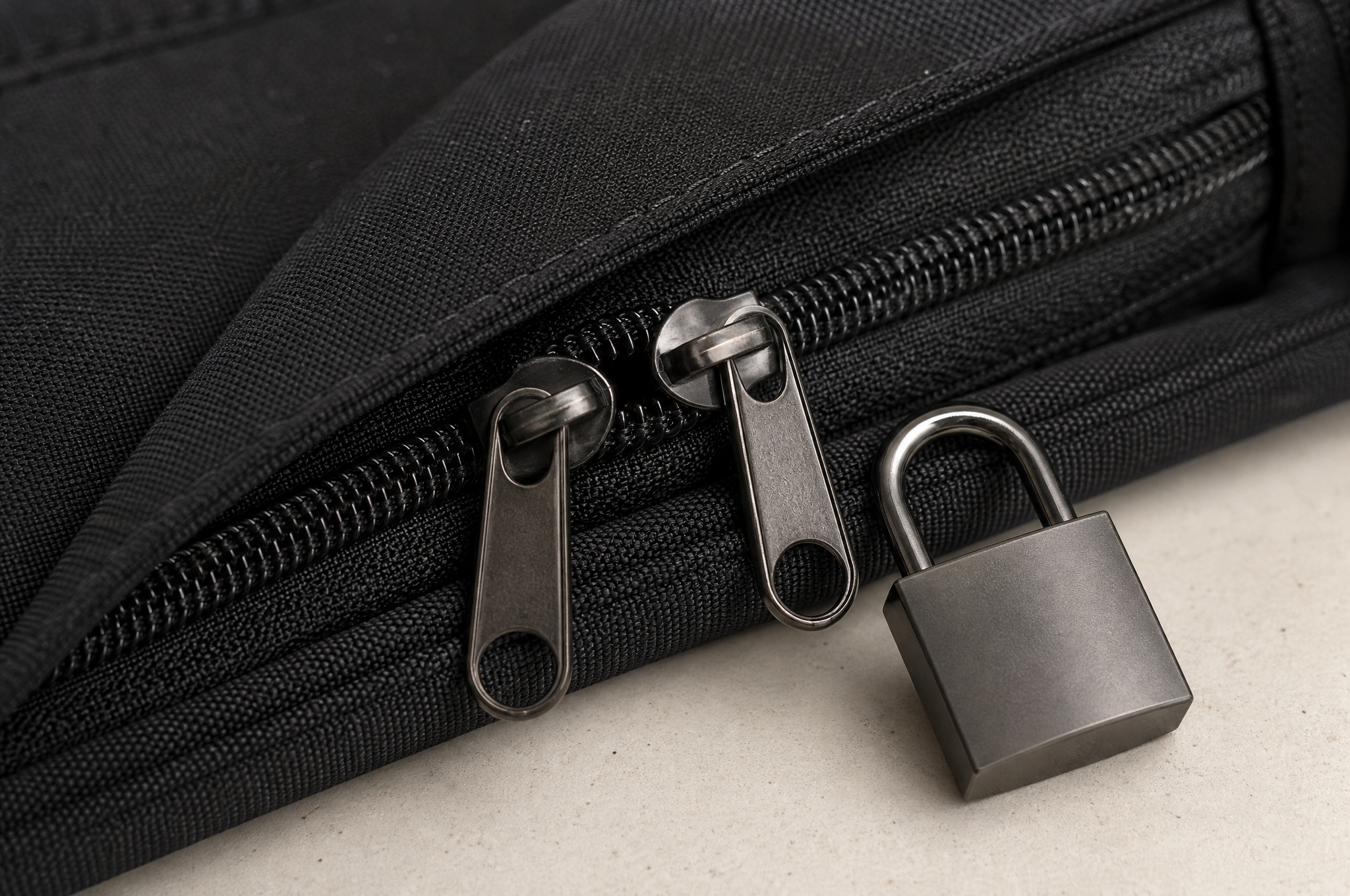
The lockable pull market has two products. The first is a slider with a loop that accepts a small padlock or a cable. The second is a "concealed" slider that sits under a fabric flap.
A padlock-ready loop stops an opportunistic open. It does not stop a determined one, because the fabric around the zipper tape is the weak point, and anyone with a blade can open the bag in two seconds without touching the lock. Buyers should understand that the lock is a deterrent rated against a 5-second attempt, not a security control.
What we do specify is the pull geometry. On anti-theft programs we build a slider garage: a small fabric pocket at the end of the zip run that the slider and pull tuck into. Combined with a locking slider it takes a pickpocket from one motion to three, which is the practical threshold. Cost is about 0.07 USD per garage, and it needs its own pattern piece, so it appears in tooling.
A note on locks that hang loose. Any lockable pull with a 50mm cord loop will catch on shelving, luggage belts and car doors. Return rates on those pulls run higher than plain pulls in our claim data, and the cause is almost always mechanical snagging rather than theft.
How RFID blocking is measured
This is where most claims lose contact with reality.
RFID blocking is a property of the lining, and it is frequency-specific. Contactless bank cards in the US and EU operate at 13.56 MHz (HF, ISO 14443). Access cards and passports also use 13.56 MHz. Some older access systems and inventory tags use 125 kHz (LF). A shielding fabric that attenuates 40 dB at 13.56 MHz may attenuate almost nothing at 125 kHz.
The test that means something is a shielding effectiveness measurement at a stated frequency, reported in dB, with the sample thickness named. A supplier saying "RFID blocking fabric" without a frequency and a dB figure is giving you a fabric name, not a performance claim.
Second problem: the pocket is only as good as its seams. A shielding lining sewn with a plain seam leaves the stitching line unshielded along its full length, and a card sitting against that line can still be read. Our anti-theft pockets close with a folded shielding edge rather than a cut edge, and we run the lining as a continuous piece where the pattern allows. That construction adds roughly 0.15 USD and limits the pocket to shapes the lining can wrap.
Third problem: the claim language. In the EU, a blanket "blocks all RFID" statement is not something we will print on a hangtag, and buyers should not ask for it. "Designed to reduce unauthorised scanning of 13.56 MHz contactless cards" is defensible if you have the test report behind it. SGS reports for the specific lining we use are available on request.
A spec checklist for anti-theft programs
Use this list to write the tech pack and the inspection standard together.
Back-panel pocket dimensions, position in mm from the top edge and from each strap anchor
Closure orientation and slider type
Foam treatment: surface pocket or recessed pocket, and the resulting back-panel thickness
Slider garage location on the main compartment and the laptop compartment
Padlock loop inner diameter, if the design includes one
RFID lining supplier, frequency, attenuation in dB, and the seam construction at the pocket edge
Pull cord length limit, to avoid snag returns
Claim wording approved for the hangtag, with the test report named
The first question most buyers ask us about anti-theft is whether the hardware adds enough perceived value to justify a higher retail price. In practice the back-panel pocket and the slider garage carry the perception, and the lock and the RFID lining carry the copy. Buyers who spend on the first two and describe the second two accurately get fewer complaints.
We learned this the hard way. A client program sold on "full RFID protection" generated a run of complaints from customers whose office access cards still worked through the pocket at 125 kHz. The lining was correct for bank cards. The claim was not. We rewrote the hangtag copy with the client, kept the lining and lost the returns.
Build the layout before you write the claim
Send the pocket layout you want, the claim you intend to print and the retail price band to [email protected]. We will return a construction sheet with the pocket position, the lining specification, the test report reference and the wording we can support, so marketing and QA start from the same document. Sample turnaround is 7-15 working days at our Quanzhou facility, and we can build two pocket variants in the first round so your team can test access with a real wallet and phone. OEM and ODM programs, materials and compliance documentation are at www.tianqinbag.com. Quanzhou Tianqin Bags Co., Ltd has manufactured bags for 17 years and ships to buyers in more than 50 countries.


 Hot News


