
 EN



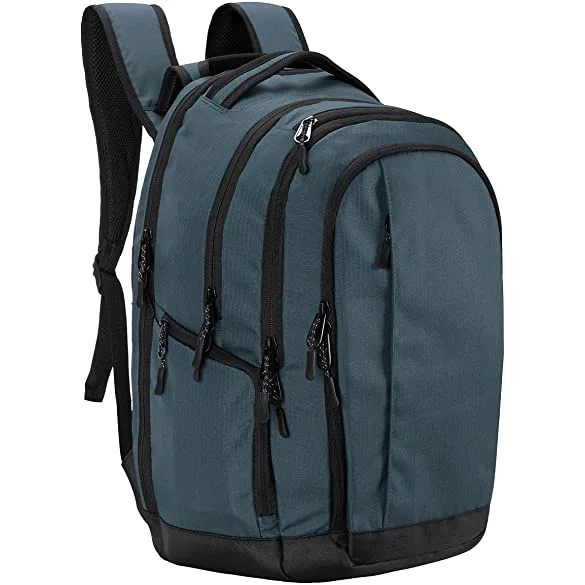
A buyer sends a spec sheet for a 25L laptop backpack, gets a quotation in 48 hours, and signs. Six weeks later the sample arrives with a laptop sleeve 15 mm narrower than specified, and nobody can say who approved the change. That sequence is routine when the company quoting you is not the company cutting the fabric. A middle layer is not automatically a mistake, but its cost never appears on the quotation. It lands later, in revisions, rework, and arguments about who pays for the difference.
Where the markup actually sits
Trading companies usually price on a percentage of factory cost rather than a fixed service fee. An FOB quote of USD 4.20 for a 25L laptop backpack can carry 8 to 15 percent of middle-layer margin, with the balance reaching the plant that sews it. On a 5,000 unit order that spread is roughly USD 1,700 to USD 3,100 that never touches the production floor.
The markup is fair when the middle layer does real work: consolidating several categories, handling export paperwork, managing four factories at once. The difficulty is that it arrives as a single number. A buyer cannot tell whether an extra 40 cents per unit buys coordination or only distance. Ask for a component-level breakdown - shell fabric, lining, foam, zipper, hardware, labor, packaging - and check whether the numbers reconcile with the spec you wrote.
One more leak hides in sampling. When a trading partner offers free samples, the sampling cost is usually amortized into the bulk unit price rather than invoiced. A three-round sample process can add 30 to 50 cents per unit across a 2,000 unit order, and the buyer never sees the line it was recovered from.
Change requests travel the same road twice
Spec changes are where delay becomes measurable. When a revision reaches a factory directly, a liner color swap on an existing pattern is confirmed in 24 hours, because the pattern maker, the fabric buyer, and the sample room sit in the same building. Insert one intermediary and the same request crosses two inboxes, two translation steps, and two approval levels.
Expect 5 to 7 extra working days for a mid-project change, more if the change touches a purchased component such as a zipper length or a custom metal puller. Time is not the only loss. Information decays in the retelling: "a slightly deeper laptop pocket" becomes a 10 mm adjustment at the factory when you meant 25 mm, and the error is discovered at the inspection table.
A German retailer came to us with exactly that problem. Three prior suppliers had produced a sleeve that fit a 15 inch laptop but gripped a 16 inch unit too tightly. We rebuilt the pattern with a 28 mm clearance and a 10 mm EPE base pad, then shipped a corrected sample in 9 working days. The delay was not the interesting part. The interesting part was that two earlier rounds had already been paid for by someone, and it was not the intermediary.
Direct revision: one confirmation loop, 24 to 48 hours
One intermediary: two confirmation loops, 5 to 7 working days
Intermediary plus offshore agent: three loops, 10 to 14 working days, plus a written change order to stop drift
Split accountability is the expensive part
A defect that reaches a port is a commercial event. Somebody pays for sorting, rework, or replacement, and in a three-party chain that question moves slowly. The factory says the specification was ambiguous. The trading company says the specification came from the buyer. The buyer points to an email chain nobody can now locate.
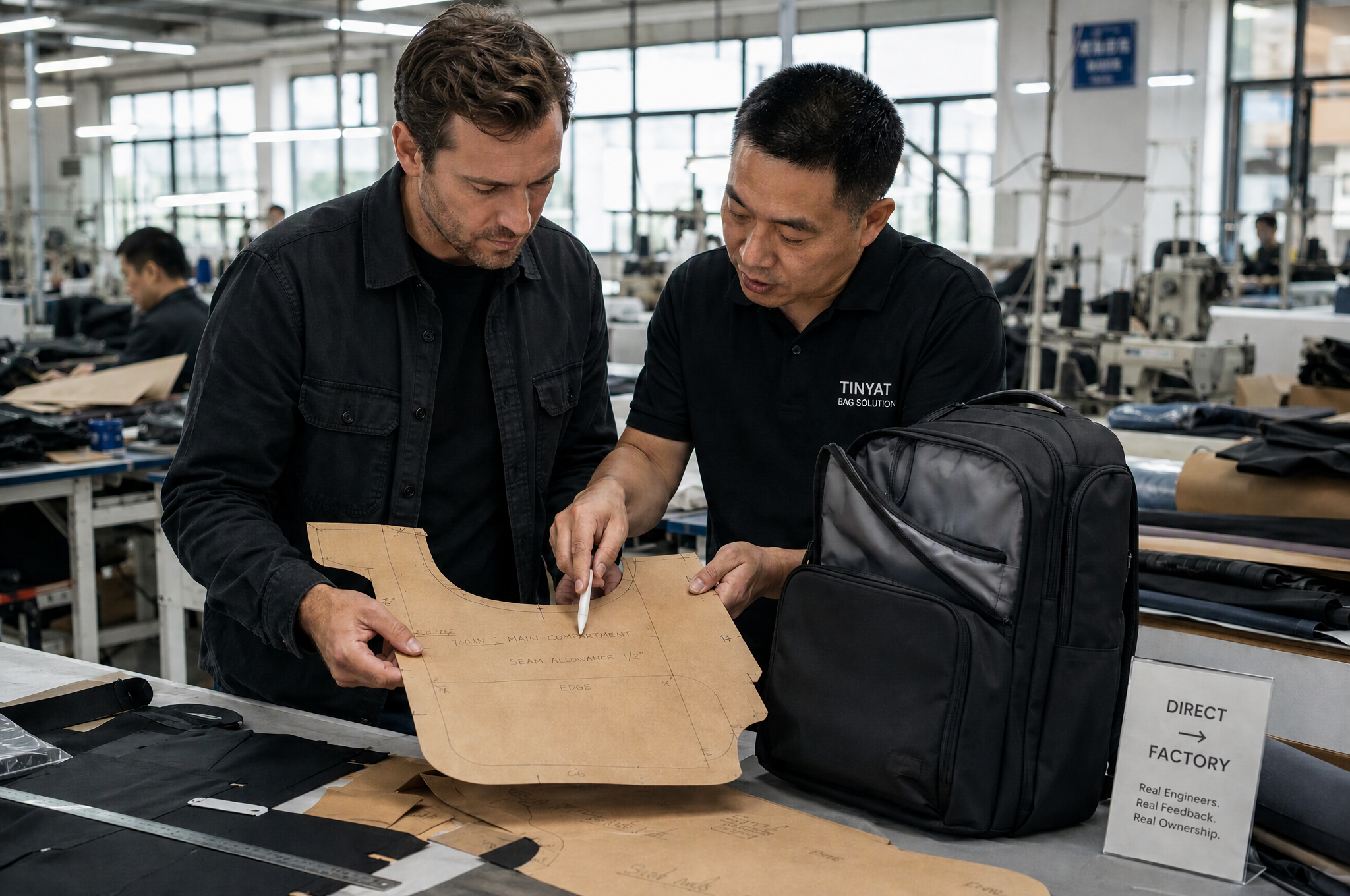
At Tianqin, every bulk order is tied to a signed golden sample that stays in our QC room, photographed from four angles with the approved measurement sheet attached to it. When a claim arrives, we compare the shipped unit against that sample rather than against memory or a written description. That single practice removes most disputes, because the reference is physical and neutral.
It also changes behavior upstream. When the buyer knows a physical reference will be kept in Quanzhou, spec emails get shorter and more precise.
Your QC leverage is one layer away
Inspection leverage comes from being able to stop a line. A trading company can ask a factory to fix something. A brand buying directly can walk into the cutting room, request the current fabric roll ticket, and compare denier and coating weight against the purchase order. Only one of those two actions changes the outcome on a Tuesday afternoon.
I am not claiming intermediaries never push a factory. They do. Pressure weakens with distance, and distance is what you paid the middle layer to create. If you cannot visit, put inspection rights in the contract, choose an AQL level yourself rather than accepting a default, and commission third-party inspection at your cost before the balance payment is released. For bags, AQL 2.5 for major defects and 4.0 for minor is a workable starting point.
A comparison you can run in ten minutes
Apply this list to any offer, direct or intermediated. The goal is not to eliminate middle layers, it is to price what they actually do.
Cost structure: do you receive component-level pricing, or one FOB number with no breakdown?
Change loop: how many parties approve a revision, and what turnaround in working days is committed?
Defect owner: is the entity liable for claims the same entity that issues the invoice?
Factory access: can you or your inspector enter the production floor without prior notice?
Sample provenance: is the golden sample held by the seller, or by the assembly plant?
Test reports: does the SGS report name the factory that will produce your order?
Capacity claim: what monthly output, in units, is committed to you in writing?
Sampling fee: is sampling invoiced, or recovered inside the bulk price?
What to do before your next quotation
If your order is small and spread across several categories, a competent trading partner can be the cheaper answer, and I will say that plainly. At Tianqin we decline mixed-category consolidation work because our lines are tooled for bags, not electronics or drinkware, and pretending otherwise would slow your shipment rather than help it. Our limit is depth, not breadth.
Once a laptop backpack program passes roughly 3,000 units per cycle and repeats, the middle layer is usually the most expensive line on your cost sheet. Before you sign, ask three questions: who cuts the fabric, who holds the golden sample, and who signs the inspection report. If the same answer does not come back three times, you are paying for distance.
The first question most buyers ask us is whether we are the factory or a trading office. Our answer is a factory address in Quanzhou, Fujian, an open invitation to visit the floor, and export records with our own company name as shipper.
Send your spec sheet, target FOB price, and destination market to [email protected] or visit www.tianqinbag.com. We quote component by component, run 3D sampling before tooling on OEM and ODM projects, and ship samples in 7-15 business days.


 Hot News


