
 EN



A UK retailer ordered 20L laptop backpacks for a commuter program and then told us their return rate on the style was 4.2 percent, well above their 2.5 percent target. The bags were not defective. Customers could not fit a 17 inch laptop plus a lunch container, and they found that out at home. Capacity is the single specification that decides whether a laptop backpack works for a buyer segment, and it is also the one that quietly changes freight cost. Here is how 20L, 25L and 30L actually differ in retail terms.
What 20L, 25L and 30L Mean in Real Dimensions
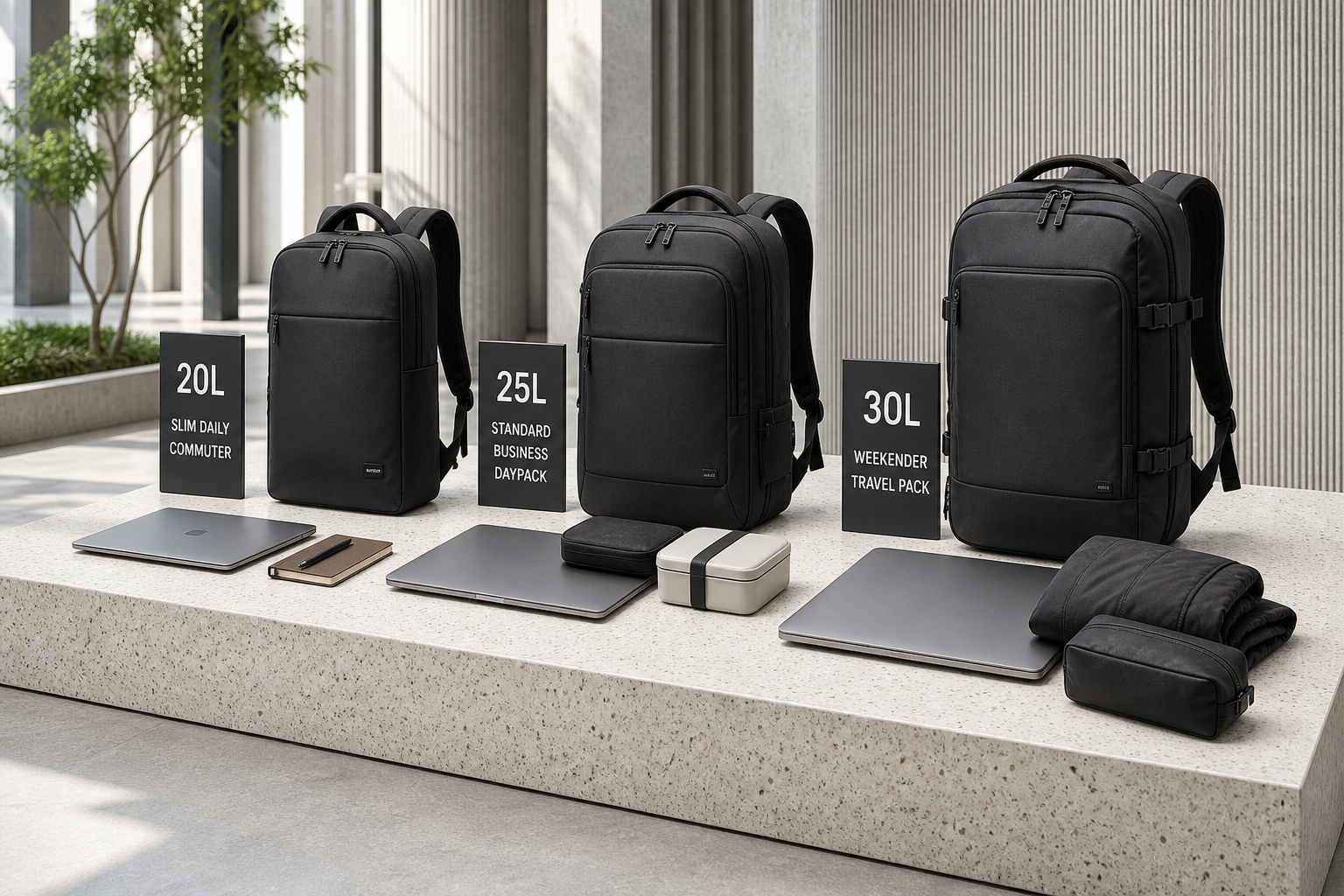
Litres describe volume, not shape, so two bags with the same number can behave very differently. Our own reference builds look like this.
A 20L laptop backpack measures about 430mm by 300mm by 150mm, weighs 700 to 820g empty with standard materials, and fits a 15.6 inch laptop in a padded sleeve with room for a charger, a notebook and a water bottle.
A 25L bag runs about 470mm by 320mm by 180mm and weighs 780 to 1,050g. It fits a 15.6 inch laptop comfortably and a 17 inch laptop in a dedicated compartment with a 30mm allowance on each side.
A 30L bag reaches roughly 500mm by 330mm by 200mm and weighs 900 to 1,150g. It handles a 17 inch laptop plus clothing for one or two nights.
At Tianqin we measure every capacity claim against a filled bag, not against a flat pattern. A 25L bag with heavily structured pockets can lose 2 to 3 litres of usable space, which is enough to turn a comfortable fit into a tight one.
The shape question matters as much as the number. A tall narrow 25L bag and a short wide 25L bag hold different things. Tall designs fit documents, folders and a rolled jacket standing upright. Wide designs accept a lunch container and a headset case. If your channel ships to office workers, the tall proportion usually wins. If it ships to students, the wider box proportion does.
Matching Capacity to Channel and Buyer Type
Capacity decisions follow channel far more predictably than they follow fashion.
The 20L size suits corporate gifting, campus retail and urban commuter listings, where the bag carries a laptop, cables and a small personal kit. It is the lightest to ship and the cheapest to build.
The 25L size is the widest seller across our order book and the safest starting SKU for a new private-label program, because it satisfies both commuters and short-trip air travelers without looking bulky. It is also the capacity we most often re-quote for a second season, because the tooling already exists and only the colorway and lining change.
The 30L size serves business travel, field sales and hiking-adjacent channels. It carries a higher unit price but also a higher return risk, because expectations scale faster than usable volume.
The first question most buyers ask us is which capacity their competitor uses. We usually answer with a question instead: what does the customer put in the bag on a normal Tuesday, and what do they put in it on a travel weekend. The gap between those two answers decides the size.
Fitting a 15.6 Inch and a 17 Inch Laptop
Laptop compartments are where capacity claims become honest or embarrassing.
For a 15.6 inch laptop we spec an internal compartment of 380mm by 270mm by 35mm with 8mm EPE foam on both faces. That fits almost all 15.6 inch devices with a protective sleeve.
For a 17 inch laptop the compartment grows to 420mm by 300mm by 40mm, and the bag body has to grow with it. A 17 inch compartment inside a 20L shell leaves little room for anything else, which is the structural reason we steer 17 inch buyers to 25L or 30L.
A 25L bag with a 17 inch compartment is a workable build, but it needs a suspended sleeve that keeps the device off the base by 25mm. That suspension adds USD 0.20 to 0.35 per unit and about 25g, and it is worth every cent given what a dropped laptop claim costs.
Freight Cube and Unit Cost by Capacity
Capacity scales unit cost and freight in different proportions, and this is where buyers get surprised.
Unit cost rises roughly 9 to 14 percent from 20L to 25L with the same materials, mostly from fabric area and foam. Moving 25L to 30L adds another 8 to 12 percent.
Freight rises with volume, not with fabric. A 470mm by 320mm by 180mm bag packs about 30 pieces per standard export carton; the same carton holds 34 to 36 of the 20L version and 24 to 26 of the 30L version. On a 3,000-piece order that is a difference of several cartons and a measurable change in per-unit landed cost.
Weight compounds it. The 20L to 30L gap is roughly 200 to 330g per piece, which on a 3,000-unit sea shipment is 600 to 990kg of additional weight, relevant for both freight brackets and for carton handling limits in some warehouses.
The trade-off we state plainly: a 30L bag earns more per unit but ships worse and fits a narrower segment, while a 20L bag ships best but caps the price you can charge. There is no capacity that wins on all three of price, freight and fit.
For programs that need one SKU to cover everything, 25L is the compromise we recommend most often, because it accepts a 17 inch laptop without becoming a travel bag. It is not the best answer for either extreme, and buyers who need the extremes should plan two SKUs from the beginning and share the shoulder strap, zipper and hardware specifications between them to hold tooling cost down.
Capacity Selection Checklist for the Next Program
Confirm the two largest items the target customer carries on a weekday
Confirm the two largest items they carry on a travel weekend
Check the largest laptop the channel actually sells, 15.6 inch or 17 inch
Verify the laptop compartment inner dimensions in mm before approving the sample
Confirm the compartment has 8mm foam on both faces, not only on one
Ask whether the sleeve is suspended 25mm off the base
Count usable litres after pockets, not the pattern volume
Request actual packed carton count for the finished bag, not an estimate
Compare landed cost per unit including carton volume, not FOB alone
Test a fully loaded sample with the laptop inside before bulk tooling
Confirm the capacity number you print matches a filled, measured bag
Decide the second SKU before tooling, so shared components stay shared
Lock the Capacity Before Tooling
Changing capacity after tooling is the most expensive revision in this category, because the shell pattern, foam dies, carton size and laptop compartment all move together.
Bring us your channel, the laptops you support and a reference bag you want to beat. We will build 20L, 25L and 30L samples from the same design language and send them with a carton and filled-weight sheet, so the freight consequence is visible before the deposit. Sampling runs 7-15 business days from our Quanzhou factory.
Contact [email protected] or visit www.tianqinbag.com to start an OEM or ODM laptop backpack project. Sample turnaround is 7-15 business days, and we can quote all three capacities from one brief so your buying team can choose on measured volume and landed cost rather than on a number in a listing title.
 Hot News


