
 EN



A German distributor shipped a 30L laptop backpack with a fully featured ergonomic spec: airflow back panel, load-lifter straps, a 38mm hip belt and a padded handle. Their next order cut the hip belt and kept everything else. Sales did not fall, and the unit cost dropped USD 1.40. That single change explains how ergonomics should be budgeted. Some features reduce fatigue and sell. Others only look technical on a specification sheet. This is what each ergonomic feature costs and which ones visibly move the retail price.
What Ergonomic Features Mean in a Retail Spec
Ergonomics in the bag trade is a set of measurable specs, not a marketing word. Contact surface area on the back panel, foam density and thickness, strap geometry, adjustability range and hardware load rating all determine how a 6kg load behaves over an eight-hour day.
At Tianqin we group these into two categories during sampling: features the customer feels in the first minute and features the customer feels in the first hour. The first group sells on the shelf. The second group sells on reviews and repeat orders. Most buyers spend on the first group and forget the second, which is why return reasons so often mention shoulder pain rather than materials.
Weight in the bag changes the calculation more than any single component. A 25L bag loaded with a 15.6 inch laptop, a charger, a water bottle and a folder lands near 6kg. At that load, strap width and foam thickness matter more than the back panel pattern, because the shoulder straps carry the pressure. Every recommendation in this article assumes a 6 to 8kg working load, and a bag that never exceeds 3kg needs a different spec entirely.
Airflow Back Panel: Cost and Shelf Visibility
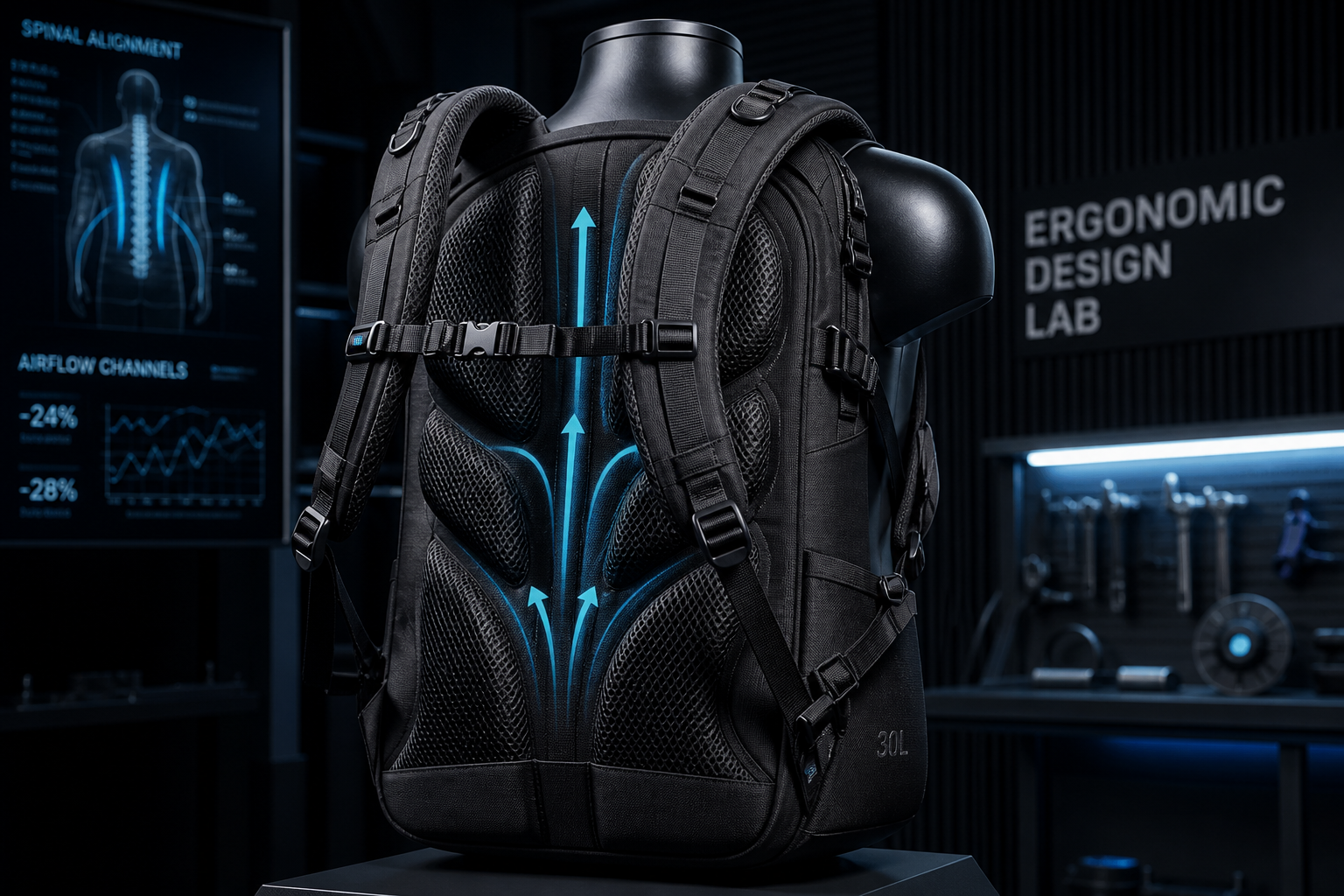
A contoured back panel with 3D spacer mesh channels costs USD 0.45 to 0.90 per unit at 1,000 pieces, depending on whether the channel pattern is molded or sewn. The weight addition is 40 to 60g.
This feature has the best shelf visibility of anything on the list. It appears in the product photo when the bag is turned around, it supports a ventilation claim that buyers can put in the title, and it reads as a technical upgrade. For a bag retailing above USD 45 it is close to mandatory in EU markets, where customers use the backpack for extended commuting.
The limitation we tell buyers about: a deep channel design traps debris in the mesh and is harder to clean. We use a closed-cell foam block with 6mm channel depth as a compromise, which keeps airflow and stays serviceable.
Load-Lifter Straps, Hip Belt and Sternum Strap
These three features solve three different problems and get budgeted together far too often.
Load-lifter straps run from the top of the shoulder strap to the bag body and cost USD 0.25 to 0.45 per unit with webbing and two adjusters. They transfer load off the shoulders, and the customer notices within minutes on a loaded bag. On a 30L travel bag they earn their cost.
Their weakness is visual. Load-lifters make a bag read as technical rather than professional, and several of our EU retail accounts have removed them from business line bags for exactly that reason, even though the ergonomic benefit is genuine. Style and function compete here, and no factory can settle that argument for the buyer.
Sternum straps cost USD 0.12 to 0.20. They keep the shoulder straps from sliding outward, which matters most on narrow shoulders and on cycling commutes. Cheap, light, and almost never a wasted cost.
Hip belts are the expensive one at USD 0.70 to 1.60, plus 80 to 130g of weight and a visible change to the silhouette. On a 30L or larger technical bag they genuinely redistribute load. On a 20L commuter bag packed with a laptop and a charger, they hang unused and get cut from product photography. Our own guidance is to omit them below 25L unless the channel is hiking-positioned, which is a real trade-off because a small number of customers actively search for hip belts.
Padded Handle and the Hardware Detail Nobody Prices
The padded top handle is the cheapest ergonomic feature on the list and one of the most noticeable. A 210D lined handle with 8mm foam insert costs USD 0.15 to 0.35 and adds 15 to 25g. Buyers feel it the moment they pick the bag up in a store, and it protects the grab point that fails first when the handle is a flat webbing loop.
There is a hidden ergonomic cost on the hardware side. Load-bearing adjusters in zinc alloy resist creep under tension, while acetal versions slip after months of use and make a shoulder strap feel loose. The price difference is about USD 0.18 to 0.30 per set. That is a durability decision that shows up as an ergonomic complaint.
Every order leaving our Quanzhou facility goes through a load test on a sample basis, hanging 10kg from the shoulder straps for 24 hours and checking where the adjusters have crept. On the last 12 business backpack programs we ran, the acetal versions slipped 4 to 7mm and the zinc alloy versions held within 1mm. That test costs almost nothing to run and settles a spec argument faster than a catalog page.
Ergonomic Feature Cost Comparison for a 25L Build
Airflow back panel, 3D mesh with 6mm channels: USD 0.45 to 0.90, adds 40 to 60g
Load-lifter straps with two adjusters: USD 0.25 to 0.45, adds 20 to 30g
Sternum strap with elastic stay: USD 0.12 to 0.20, adds 8 to 12g
Hip belt with 38mm webbing and buckle: USD 0.70 to 1.60, adds 80 to 130g
Padded top handle with foam insert: USD 0.15 to 0.35, adds 15 to 25g
12mm shoulder strap foam instead of 8mm: USD 0.30 to 0.55, adds 30 to 45g
Zinc alloy adjusters on shoulder straps: USD 0.18 to 0.30, adds about 35g
Compression straps that stabilize a loaded bag: USD 0.20 to 0.40, adds 20 to 30g
Adjustable sternum track for a wider fit range: USD 0.10 to 0.18, adds 6 to 10g
Total for the full set runs USD 2.45 to 4.93 per unit, which is why the brief matters more than the feature list.
Build the Ergonomic Spec Your Channel Will Pay For
Work backward from the load the customer actually carries. A 20L commuter bag holding a 15.6 inch laptop, a charger and a notebook does not need a hip belt. It needs a contoured back panel, a padded handle and a sternum strap, which together cost about USD 0.75 and are all visible in photography.
A 30L travel bag is the opposite case. Load-lifters and a hip belt become functional, and the price band usually supports the USD 1.50 to 2.00 those features consume.
A European distributor we supply found the same thing with the padded handle. They had treated it as decoration until they weighed the returns data on a current style, where 9 out of 40 complaint cases mentioned a torn grab loop. Adding an 8mm foam insert to the handle solved the failure and cost less than USD 0.30 per unit.
The first question most buyers ask us is how much of the ergonomic spec they can strip while keeping the claim. Our answer is always the same: strip the features the customer cannot see and cannot feel, then test the sample with 8kg inside for 30 minutes.
Send your channel, pack size and target FOB to [email protected], or review our OEM and ODM capability at www.tianqinbag.com. Sample turnaround is 7-15 business days, and we will quote ergonomic features as separate line items so your team can see exactly what each one costs before the bulk order is placed.

 Hot News


