
 EN



A service engineer's bag is a tool box that happens to hold a laptop. By the end of a shift it has carried a 4 kg meter, two hand tools, a coil of cable, a 15-inch rugged machine and a water bottle, and it has been set down on concrete twice and asphalt once. Construction built for a commuter does not survive that for a 12-month warranty, and the claim data proves it quickly.
Design for 12 kg, rate the bag for less
Tool backpacks get quoted badly because buyers and factories both use laptop-bag logic. A laptop bag carries 3 to 5 kg. A technician bag regularly carries 9 to 12 kg, and the peak load is not the steady load: a bag dropped from waist height onto a kerb spikes far higher than its contents.
Our working numbers for a 12 kg-rated tool backpack are a 1680D ballistic nylon shell, a 10 mm PE board in the base with a 2 mm HDPE sheet above it, box-X stitching at every strap junction, and 40 mm shoulder webbing with 12 mm closed-cell foam. Before we release a pattern we run a static load test at 25 kg for 24 hours on the base panel and check for panel deflection. A base board that flexes more than 4 mm under that load will crack at the corners within a season.
There is a marketing decision buried in this. We recommend rating the bag at 12 kg and building it for 15, because the label is a promise and the reserve is what keeps the bag out of the claim report. Buyers who want a 20 kg rating on a 25L bag with a single-layer base are asking us to print a number the structure will not honor, and we decline that request openly.
Where field bags actually fail
The failure pattern on technician bags is narrow and predictable. Five zones account for nearly all of our after-sales feedback.
Base corners: the bag is dragged, not carried, on site. We use a wrap-around base panel rather than a stitched-in one, because a stitched corner puts the seam exactly where the abrasion is.
Webbing attachment points: shoulder strap joins at the top of the back panel take the full dynamic load of a drop. Two bar-tacks per joint at 40 mm, not a single row.
Zipper ends at the gusset: a heavy load pulls the gusset away from the coil, so the slider separates at the end stop. We fit a reinforced end tab with a metal stop on every main compartment zipper.
Tool loop seams: elastic loops sewn through a single layer of lining tear out. Ours are sewn onto a 600D panel that is itself stitched to the shell, so the load is spread across the panel.
Handle: a grab handle on a 12 kg bag is a lifting point. Twill tape alone will not do. We specify a molded or rolled handle with a 25 mm webbing core and two rows of stitching into the back panel.
Salt, oil, and solvent exposure also matter more than buyers expect. A 1680D nylon with a PU coating resists oil better than a plain polyester shell, and hardware needs to be plated rather than painted for anyone working outdoors in coastal or industrial environments.
Modular organization that technicians keep using
Modularity fails when it is decorative. A bag with 14 loops and no defined tool positions gets emptied into a bucket by week three.
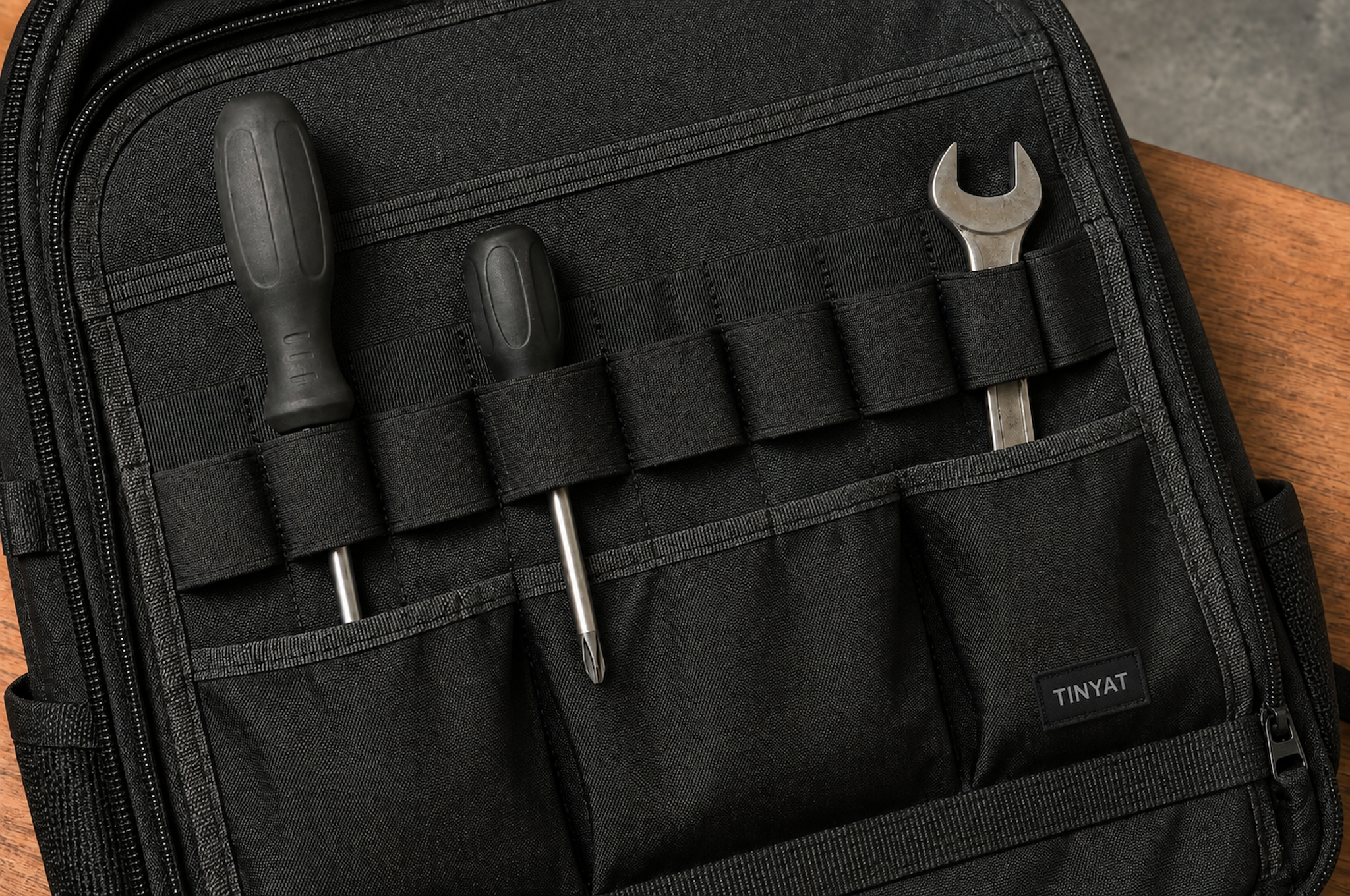
What works, based on the programs we run for telecom and utility installers, is a front panel that opens flat and carries a fixed layout: elastic loops in three widths, 25 mm for screwdrivers and picks, 40 mm for pliers and cutters, 50 mm for a meter or a crimp tool, plus two flat pockets at 150 x 100 mm for consumables. The panel should be removable on a zipper or two rows of hook-and-loop, so the technician can pull it out and lay it beside the panel they are working on.
The laptop compartment stays separate and padded, with 10 mm foam on the outer face. Mixing a laptop with tools in one compartment is the single most common design request we refuse, because a screwdriver handle pressed against a lid for eight hours is a cracked screen in a warranty claim.
A detachable pouch of about 300 x 150 x 60 mm on the side handles the small parts. Detachable matters: if it cannot come off, the technician carries it anyway and the weight saving is theoretical.
Warranty exposure changes the spec, not just the price
Tool backpacks carry shorter warranties than consumer laptop bags for good reason, typically 12 months against 24. What buyers underestimate is the reserve behind that warranty on a heavy-load product.
On a properly built 12 kg tool bag we see claim rates in the 1.5 to 3 percent range over the first year, mostly zipper and strap attachment failures rather than fabric failure. On a build where the base board and the bar-tacks were value-engineered out to hit a price, that rate can reach 8 to 10 percent, and the replacement cost per unit plus freight exceeds the savings on every unit in the order. We show buyers this arithmetic with their own target price in it. Sometimes they still choose the lighter build for a promotional SKU, and that is a legitimate choice as long as the warranty text is written to match.
One limitation we are honest about: a 12 kg-rated bag with a proper base board and 40 mm webbing weighs 2.1 to 2.4 kg empty. Buyers comparing it against a 1.3 kg commuter bag often push back on the weight and the freight. There is no version of this product that is both genuinely load-rated and light. The trick is to sell the load rating, not to hide the weight.
A field service specification and inspection list
Stated load rating in kg, with the test method named
Base construction: PE board thickness and type, plus the abrasion panel
Box-X stitch and two bar-tacks at every strap junction
Metal end stops on all main compartment zippers
Tool loop panel material and whether it is removable
Handle load capacity tested at three times the rated load
Laptop compartment isolated from the tool side by a foam wall
Hardware plating type, stated for corrosion resistance
Carton test: drop one carton from 800 mm on a corner, inspect contents
Written warranty length and what it excludes
Open a tool backpack program with us
The first question most buyers ask when they move into this category is whether their existing laptop bag supplier can build a load-rated tool backpack at all. Usually the answer is no, because the pattern room, the base construction, and the testing routine are different products entirely.
Quanzhou Tianqin Bags Co., Ltd has built tool, business, casual, travel, and sport bags for 17 years at our factory in Quanzhou, Fujian, and our tool backpack line is one of five product families running through the same plant. We work OEM and ODM with buyers in more than 50 countries, use automated cutting and semi-automated assembly for repeatability, and supply SGS test reports on request. If your program needs a 12 kg or 15 kg load rating with documentation, ask for it at the quotation stage rather than after the sample is approved.
Send your tool list and target load rating to [email protected] and we will map the loops, propose the base construction, and quote it. Sampling takes 7-15 business days from confirmed materials. Product families and factory details are at www.tianqinbag.com.


 Hot News


