
 EN



A traveler who flies 40 segments a year does not judge a backpack by its fabric. They judge it at three moments: at the gate when the agent looks at the bag, at security when the laptop has to leave the sleeve, and in a hotel room when everything has to fit back in under five minutes. Each of those moments converts into a number you can put on a spec sheet, and each one is where a travel program quietly loses money.
Cabin size fit: measure the bag packed, not empty
The published cabin envelope on most international carriers is 55 x 40 x 20 cm, and US domestic legacy carriers commonly work to 22 x 14 x 9 inches, which is close enough that most buyers design to the tighter of the two. The trap is that factories quote empty-bag dimensions, and an empty bag is not the object that meets a gate agent.
A 35L travel backpack packed with four days of clothing bulges 15 to 25 mm in the depth direction, especially when the clamshell is filled to the top of its compression panel. Loaded weight also pulls the bag out of shape at the base. A bag trimmed to exactly 55 x 40 x 20 cm empty will fail a box gauge when it is full, and one failed gate check on a sold-out flight costs the buyer a review and a return.
At Tianqin we build a plywood gauge the internal size of 55 x 40 x 20 cm for travel programs and every pre-production sample has to pass through it loaded with 6 kg of dummy weight, not empty. Design margin we work to is 15 mm of clearance in depth and 10 mm in height. That margin is the whole difference between a bag that flies and a bag that gets checked.
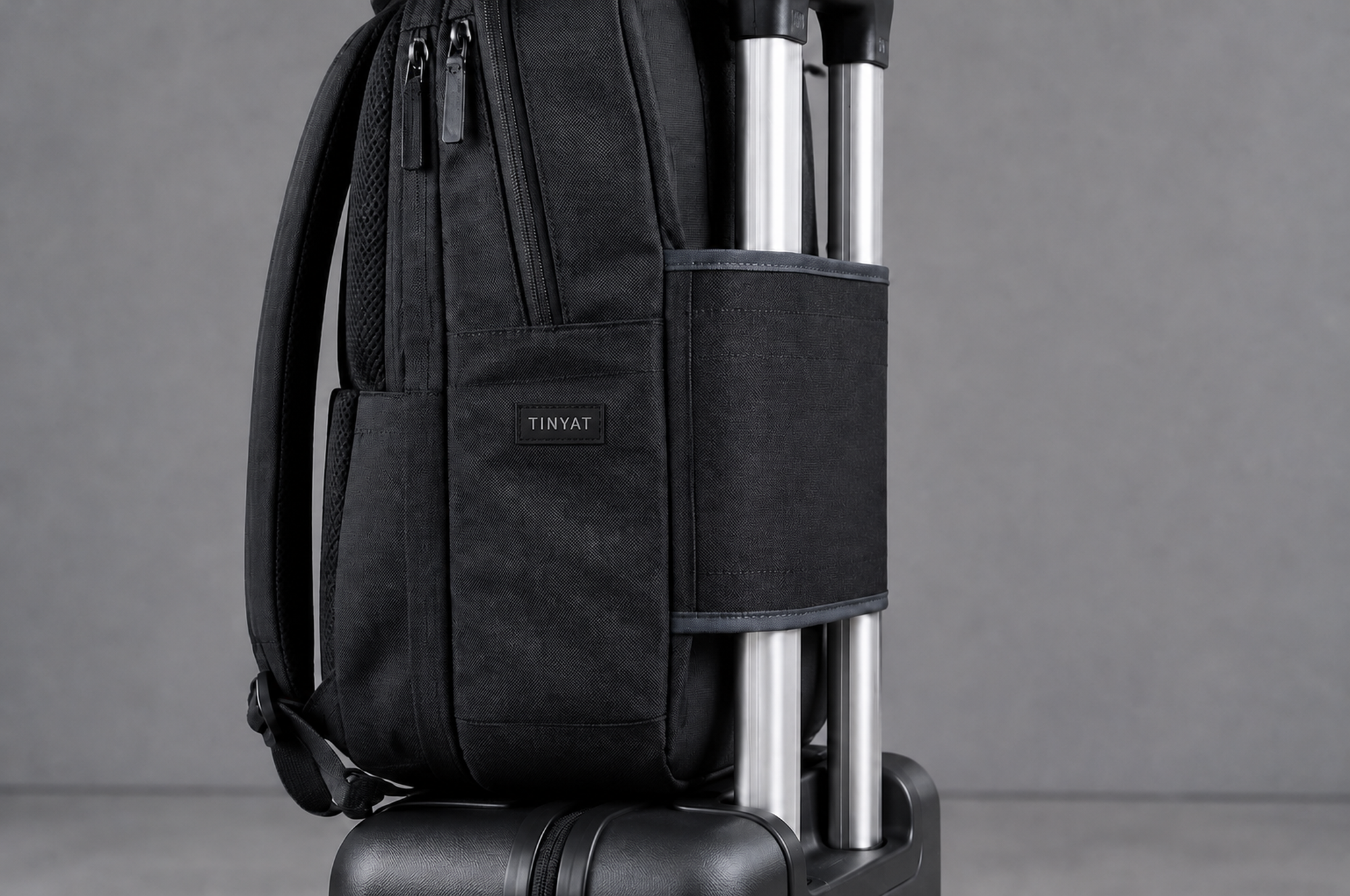
The trolley sleeve has three dimensions that decide whether it works
A trolley sleeve looks like a seam detail. It is a loading component, and it fails in one of three predictable ways.
Clear width: the sleeve must clear the widest common telescopic handle spacing. Handles vary from roughly 150 mm to 180 mm between uprights, so we cut the sleeve opening at 200 to 220 mm clear width to accept a full handle with a soft grip cover fitted.
Depth: 150 mm minimum from the sleeve seam to the back panel. Anything shallower lets the bag rock off the handle when the user turns a corner with the trolley tilted.
Reinforcement: the bottom seam of the sleeve takes the bag's entire loaded weight on a single stitch line. We back it with 25 mm webbing inside the seam allowance and bar-tack both ends. Without that, the sleeve tears out at the corner on the third trip.
Sleeve placement is the other half of the problem. A sleeve sewn across the middle of the back panel sits at handle height on most cabin trolleys, which is fine. A sleeve sewn low, near the base, forces the user to tilt the whole bag forward to engage the handle, and the weight then hangs off the sleeve instead of sitting on the trolley base. We mark the sleeve position on the pattern at 120 mm from the bottom seam and check it against a standard 55 cm trolley in the sample room.
A related question buyers do not ask until it is expensive: a sleeve conflicts with a padded back panel. You cannot have 10 mm of EVA lumbar padding and a sleeve that lies flat against the handle. We normally reduce the panel to 4 mm over the sleeve area and put a separate foam block above it, so the bag still sits flat.
One-bag travel: volume claims against real packing
The volume number on a travel bag is the least reliable figure in the category because there is no single measurement method. A 40L bag with a roll-top closure and no internal structure may pack the same as a 33L structured clamshell, and either may be marked 40L.
What we can control is usable volume after the laptop sleeve and the admin panel are subtracted. On a 35L travel bag with a padded 16-inch laptop compartment and a full front admin panel, real packing space is closer to 27L. For a three-to-four day business trip with one suit packed flat, that is tight but workable. For a five-day trip it is not, and the buyer hears about it.
Empty weight in this category lands between 1.45 and 1.75 kg for a 35L bag with a structured back panel, a trolley sleeve, and lockable sliders. Under 1.35 kg usually means either the frame is missing or the foam is thin. Buyers who request both a cabin-legal size and a sub-1.2 kg weight are asking for a bag that will not stand up on its own when set on a hotel floor, and we say so at quotation stage.
Checkpoint handling: the detail that costs minutes
A traveler who has to open the whole clamshell at security shows the world their packing and then repacks on a plastic tray. The alternative is a laptop compartment that opens as a flat front flap with a hinge at the bottom, so the machine slides out with the bag still on the shoulder.
Two specifications matter here. The first is the hinge: a living hinge in 1680D with a double-stitch line survives 2000 open-close cycles in our in-house test, a single-stitch hinge starts fraying around 700. The second is zipper travel on the laptop compartment: a YKK #5 coil with two pulls allows a bottom-corner opening that stays open while the user holds the tray.
One honest limitation from our own line: a flat-open laptop flap makes the front panel less rigid, so the bag loses some shape when empty. Buyers who want a travel bag that stands upright on its own need to accept a slightly heavier front panel board, roughly 60 grams more. Very few want both once they see the two samples side by side.
A traveler sample inspection list
Measure packed dimensions against the gauge at 6 kg load, not empty
Check trolley sleeve clear width with a real 180 mm handle set
Pull the bag off the handle at 30 degrees and watch the sleeve seam
Confirm laptop compartment opens flat without the admin panel falling open
Cycle the hinge 200 times by hand and look for stitch pulls at the fold
Weigh the bag empty and compare to the quoted figure within 3 percent
Confirm zipper pull diameter is at least 8 mm for gloved handling
Verify the laptop sleeve accepts a 16-inch machine with a hard shell case
Check that a luggage tag and a water bottle both fit without blocking the sleeve
Ask for the hardware plating spec so the bag does not corrode in coastal humidity
Start your travel program with our sample room
The first question most buyers bring us on travel programs is not about volume or weight. It is whether the bag will clear a gate gauge in real use, because a returned bag from a business traveler is rarely a repair cost, it is a listing that dies.
Quanzhou Tianqin Bags Co., Ltd has made business, casual, travel, sport, and tool bags for 17 years from our factory in Quanzhou, Fujian, and our travel programs ship to more than 50 countries under OEM and ODM agreements. Automated cutting and a hanging conveyor system keep pattern consistency between the sample and the bulk run, which matters most on structured travel shapes, and SGS test reports are available on request.
Send your travel brief and target cabin envelope to [email protected]. We will quote the model, flag any dimension that will fail a gauge when packed, and provide a 3D render before cutting. Sampling takes 7-15 business days from confirmed materials, and our material and capacity overview is at www.tianqinbag.com if you need it for an internal approval file.
 Hot News


