
 EN



A commuter opens and closes the same bag six to eight times a day, often in rain, on a crowded platform, with one hand already holding a phone. Returns on commuter models rarely come from bad stitching. They come from a bag that is slow to open, heavier than the listing promised, or wet inside after a 20-minute walk. If you are building a commuter line for a city market, the spec sheet has to answer those three failures before it answers anything about color.
Access speed comes before pocket count
Buyers who sell into London, Seoul, or Shanghai commuter corridors ask us the same thing: how fast can the wearer get a laptop in and out without taking the bag off. On a train platform nobody unloads a full backpack.
We time this. A simple bench test takes 12 people, a stopwatch, and a 15.6-inch dummy unit. The target we work to is under four seconds from shoulder to laptop, and under six seconds back to closed and worn. A top-loading main compartment with a dual-slider YKK #8 zipper hits that. A design where the laptop sleeve sits behind two buckles and a fold-over flap does not, and no amount of front pocket planning fixes it.
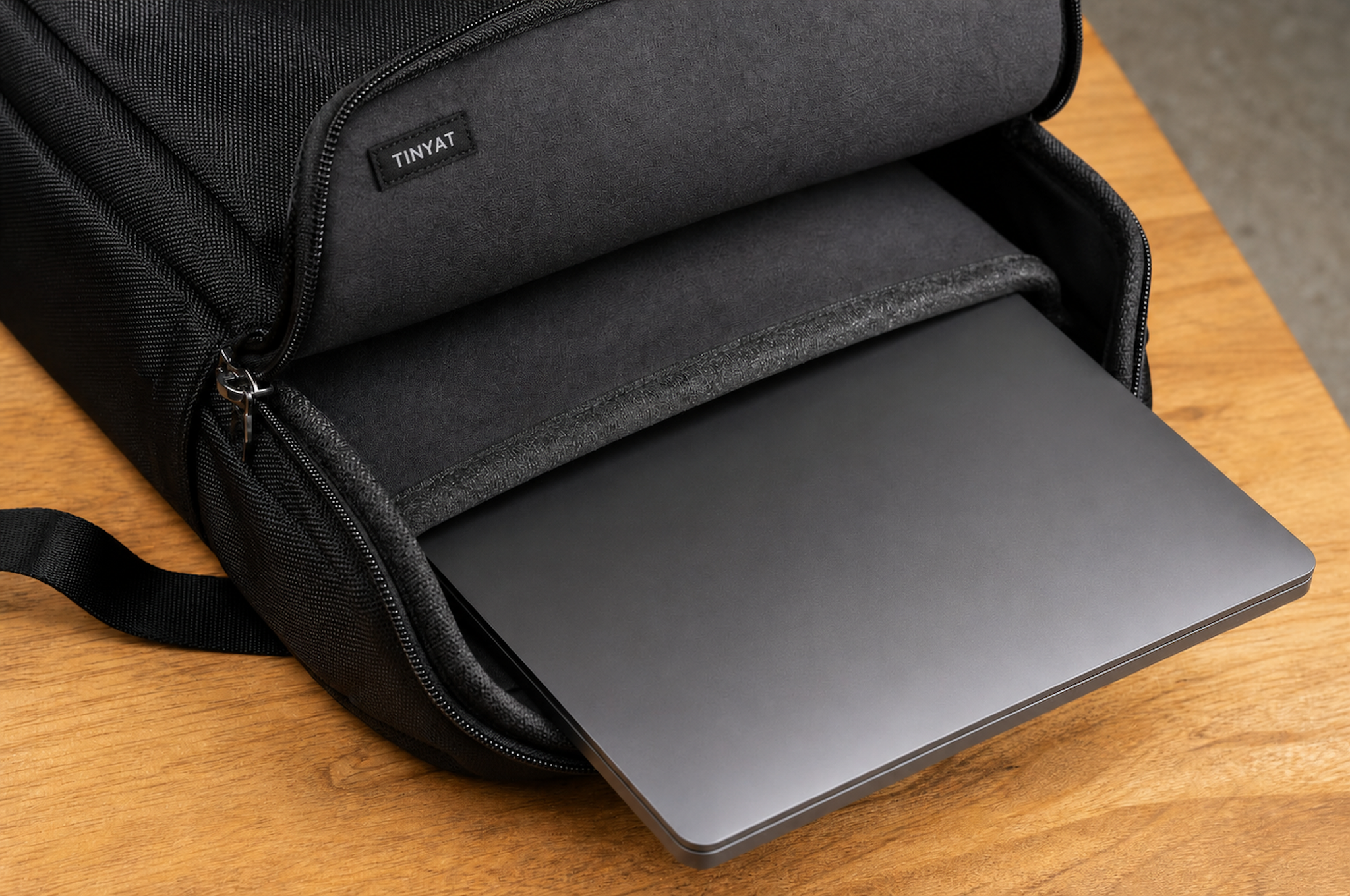
Sleeve dimensions matter as much as sleeve position. A 15.6-inch laptop is commonly 380 x 260 x 25 mm with the lid closed, and current 16-inch machines push past 355 mm of width. We spec a sleeve opening at 400 x 285 mm with 10 mm of EVA foam on the back face and 6 mm on the front, so a slightly oversized machine still enters without forcing. On a 20L commuter bag that sleeve eats about 3L of usable volume. Buyers are often surprised by that. The sleeve is the biggest single consumer of internal space in the whole bag.
Pocket count is a different question. Six front pockets look good in a photo and slow the wearer down. We usually push buyers toward one quick-grab front pocket sized for a passport or a phone, one side pocket, and a clean main compartment. Less to search, less to get wrong at 7:40 in the morning.
Empty weight is a specification, not a feeling
A commuter bag at 1.15 kg empty sells better than the same bag at 1.45 kg. The difference is 300 grams, and it shows up in reviews, in freight cost, and in how often the bag leaves the house.
Weight hides in three places. Foam is the first: 10 mm EVA across a full back panel can add 90 to 120 grams over a 6 mm panel. Hardware is the second: a full set of zinc alloy sliders and adjusters can weigh 140 grams more than acetal equivalents, and the wearer feels all of it on a 25 mm webbing strap. Lining is the third and the most overlooked. A 210D polyester lining instead of 150D adds roughly 40 grams on a 20L body.
At Tianqin we quote every commuter style with an empty weight and a tolerance band, usually 1.20 kg plus or minus 3 percent. Our QC team weighs first-article samples on a calibrated scale before production release, and anything outside the band goes back to the pattern room rather than to the buyer as a surprise three weeks later.
There is a real reason most factories will not promise under 1.15 kg on a 20L commuter bag with a padded laptop sleeve. Structure requires mass. A bag light enough to feel like nothing is a bag with thin foam, a thin lining, and a shell that scuffs through in a season. We say this to buyers before they print a weight claim on the hangtag.
Weather exposure: what a 20-minute walk really demands
Most rain complaints on commuter bags come from the bottom panel and the zipper line, not from the shell fabric.
For city commuter programs we normally specify 600D Oxford polyester with a PU coating rated to 1500 mm water column, or 1680D ballistic nylon at 2000 mm when the price point allows it. The bottom gets a separate panel in 500D tarpaulin or a heavy coated 600D, because that area sits in puddles and against wet pavement all day. Seams at the bottom are the ones we tape.
Zippers are the weak line. Standard nylon coil zippers pass water through the teeth. A PU-coated water-resistant zipper, or a plain zipper with a storm flap behind it, changes the outcome of a 20-minute walk. Coated zippers add roughly 4 to 6 percent to zipper cost and they feel stiffer in the hand, which some users dislike.
Plain limitation: no untaped seam is waterproof under sustained rain. Taping every seam on a commuter backpack adds around 7 percent to unit cost and makes the bag noticeably stiffer to pack. We normally tape the bottom seams and the top lid seam only, and we ask buyers to describe the bag as water-resistant, not waterproof. A retailer who writes "waterproof" on the listing owns every wet-laptop complaint that follows, and those complaints cost far more than the 7 percent.
Abrasion points on a transit commute
Four locations fail first on commuter bags, and each one has a known fix.
Bottom corners: reinforced with 1680D panels and a double-row stitch, tested to 500 Taber cycles on the coated face before we accept a shell.
Shoulder strap attachment: bar-tacked at four points rather than two. A single bar-tack is the most common warranty claim we see on low-cost builds.
Front panel: rubs against turnstiles and train doors, so we keep it free of thin decorative overlays that peel at the edge after two months.
Side pocket: mesh fails in about one season against pavement and escalator edges. 600D pocket fabric lasts longer and looks less worn at resale.
Reflective piping is a separate argument. It sells in northern European markets and it dulls after repeated abrasion. If a buyer wants it, we specify a woven reflective tape rather than a printed strip, at roughly 0.12 USD per meter in our volume. Printed strips are cheaper by half and they are the first thing to look shabby on a returned bag.
A commuter spec checklist you can send to any factory
Empty weight stated with a tolerance band, target under 1.25 kg at 20L
Laptop sleeve inner opening at least 400 x 285 mm with 8 mm minimum foam
Main compartment reachable in under four seconds with the bag on one shoulder
Dual-slider main zipper with 8 mm pulls grippable by a gloved hand
Water-resistant main zipper or a storm flap behind the main opening
Bottom panel in 500D tarpaulin or equivalent, with bottom seams taped
Bar-tacks at all four shoulder strap attachment points
Shell abrasion data in cycles, not a verbal claim of durability
Shell fabric and coating named, with water column stated in mm
Hardware finish specified by plating type rather than by a color name
Build the commuter model with our team
The first question most buyers ask us about a commuter program is not about fabric. It is about how fast a spec sheet becomes a wearable sample, because their selling window is fixed and the physical sample is the only way their own product team will settle the design argument.
Quanzhou Tianqin Bags Co., Ltd has spent 17 years building business, casual, travel, sport, and tool backpacks at our factory in Quanzhou, Fujian, and we run OEM and ODM programs into more than 50 countries. Our floor uses automated cutting machines, a hanging conveyor system, and semi-automated assembly lines, and SGS test reports are available on request for US and EU programs.
Send your commuter spec sheet to [email protected] and we will return a costed proposal with a 3D render in your own color split. Sampling runs 7-15 business days from approved artwork and confirmed materials. Review our material library and current capacity at www.tianqinbag.com, then send the model you want us to quote, and we will tell you plainly which lines in your spec will cost you money and which will not.


 Hot News


