
 EN



Most women's laptop backpacks on the shelf are a men's pattern scaled down by about 10 percent and re-trimmed in a lighter colorway. The result passes a photo review and fails the wearer. The straps sit too wide at the neck, the bag rides too low on a shorter torso, and the laptop sleeve is either too tight for a 15.6-inch machine or so loose that the bag folds in half when it is half full. Buyers inherit the returns, and the returns usually blame fit, not design.
Strap geometry is where the fit is won or lost
The single most important dimension is not strap width, it is the spacing between the two straps where they join the top of the back panel. On a men's pattern that spacing is typically 85 to 95 mm. On a women's pattern it needs to be 60 to 70 mm, because a narrower shoulder and neck structure means a wider spread pulls the straps onto the sides of the neck instead of the slope of the shoulder.
Three numbers we work to when adapting a pattern for a women's fit:
Strap spacing at the top seam: 60 to 70 mm, measured center to center.
Strap width at the shoulder: 55 to 65 mm with 10 mm foam. Wider is not better here. Above 70 mm the strap edge digs into the underarm on a narrower shoulder.
Sternum strap position: 100 to 140 mm below the top seam, adjustable across a 60 mm slide range, so the strap can sit above the bust line rather than across it.
The strap curve also changes. A men's strap curves outward by about 25 mm over its length to clear a broader chest. On a women's pattern that same curve leaves the strap floating off the shoulder. We reduce the curve and shorten the strap by 40 to 60 mm so the adjuster lands in a reachable place on a shorter arm.
Changing those numbers is not a trim change. It requires a new pattern for the strap, a new back panel, and usually a new cutting die. Buyers who expect a women's line at the same tooling cost as a color variant are working from a wrong assumption, and we explain this in the first meeting rather than in the invoice.
Torso fit: the number that never appears on the listing
Back panel length is the second specification that gets ignored. A standard unisex laptop backpack has a back panel of 430 to 460 mm. On a wearer with a 38 to 40 cm torso length, that panel extends past the lumbar area and pushes the base of the bag into the lower back with every stride.
For a women's 20L backpack we normally cut the back panel to 380 to 410 mm and shorten the body by 20 to 30 mm. The bag then sits with its base 20 to 30 mm below the waistband, which is where a loaded bag is actually carried. The trade-off is direct and we state it plainly: a shorter body means a shorter laptop compartment, and a 17-inch machine will not fit. If the buyer's range includes 17-inch, that style has to stay on the unisex pattern.
Volume expectations cluster lower than in the men's range. Around 20L with a 15.6-inch sleeve is the volume center for this category, with a slim 15 to 17L style for daily city use and a 22 to 25L style for anyone carrying a change of clothes. Above 25L, sell-through drops noticeably in most of the programs we ship, and buyers who test a 28L women's style usually come back to the 20L.
Fabric and finish: what sells and what scuffs
The fabric decision in this category splits along color, not along durability.
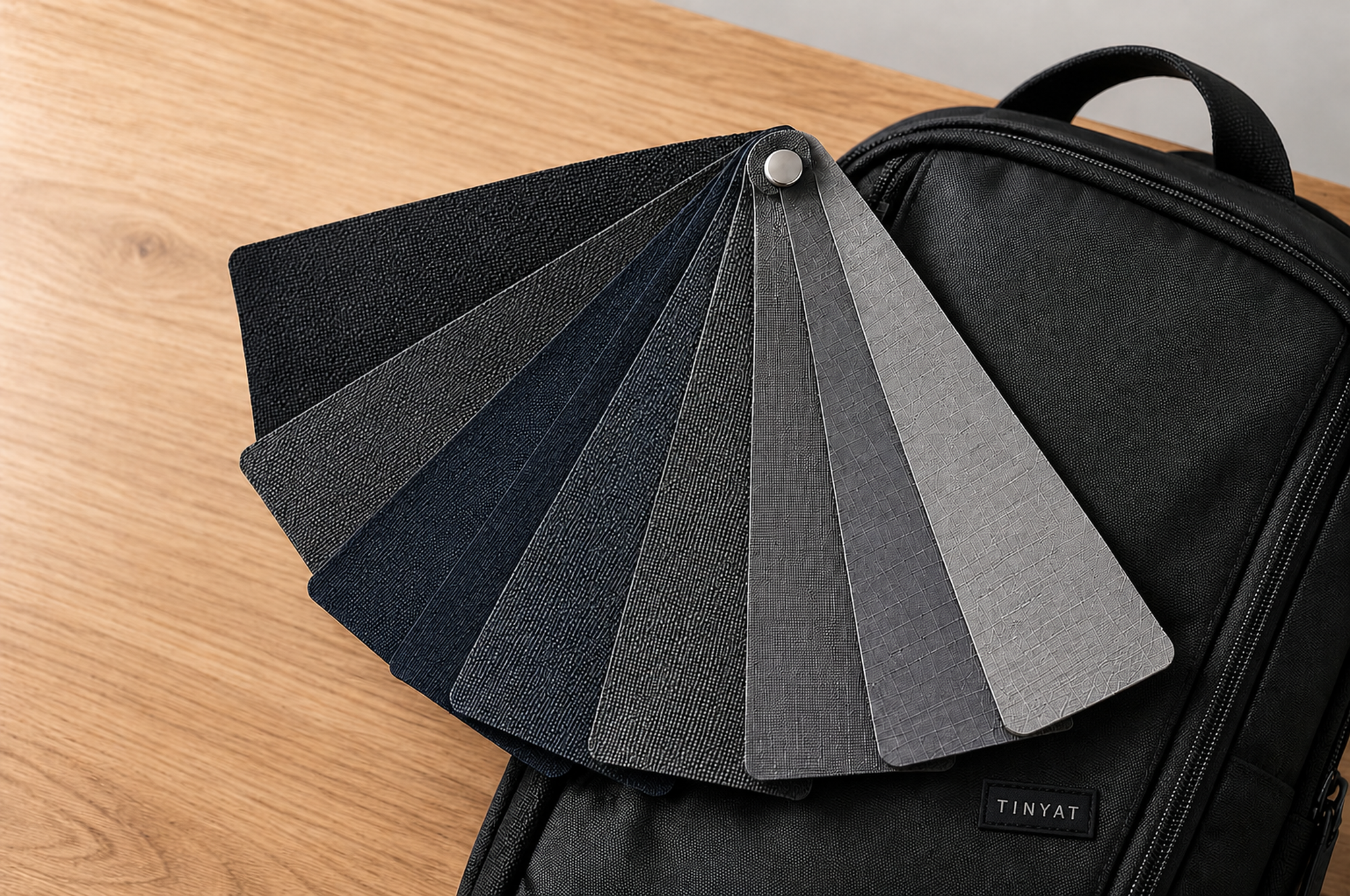
Light colorways sell, and light colorways show every mark. A 600D Oxford polyester with a tight weave and a matte PU coating handles a light sand or pale grey better than a 300D fine-weave fabric, because the coarser surface hides scuffs instead of highlighting them. Heavier 1680D ballistic is the wrong choice here: it is stiff, it creases at the corner folds, and it reads as a work bag in the hand.
Finishes that carry weight in the range we produce:
PU-coated 600D with a 1500 mm water column for the main shell.
A coated 600D bottom panel, since the base is what touches café floors and train seats.
Matte zinc alloy hardware rather than bright chrome, which scratches visibly.
Tonal lining in a light color, which makes the interior easier to search and looks considered when the bag is open.
One limitation worth saying out loud: pale linings show pen marks and coffee stains, and crocking risk goes up on light fabric against dark denim. We run wet and dry crocking tests on every light colorway and ask for a grade of 4 or better. A buyer who skips that test on a cream or blush color will see grey transfer along the back panel within a month of use, and that is a return that looks like a quality failure even though it is a dye selection failure.
Colorway demand and size expectations
Colorways in this category follow a stable pattern across the US and EU programs we run. A five-color range usually splits roughly 60 percent into two core neutrals, black and a warm taupe or navy, 25 percent into one seasonal accent, and 15 percent into a test color that either proves out in one season or disappears.
That split is a production reality, not a merchandising preference. Fabric dyeing has a minimum, and a seasonal accent that sells 8 percent of the range still has to be dyed in a full batch. At Tianqin we quote per-color minimums alongside the style minimum, and we tell buyers when a sixth color stops being commercially sensible. Usually it does at around 300 units per color for a coated 600D body.
Size expectations also include weight. A 20L women's laptop backpack at 0.95 to 1.10 kg empty is the target range. Hardware and foam reductions get us there without touching shell quality, mainly by using acetal adjusters instead of zinc alloy and 6 mm foam on the back panel rather than 10 mm.
A fit and specification checklist for the sample review
Strap spacing at the top seam measured at 60 to 70 mm
Strap width 55 to 65 mm with 10 mm foam at the shoulder
Sternum strap adjustable and positioned to clear the bust line
Back panel length 380 to 410 mm for a 20L style
Laptop sleeve sized to the actual machine, with 6 mm foam front and back
Empty weight target stated with a tolerance band
Crocking test result documented for every light colorway
Hardware finish specified as matte and by plating type
Zipper pulls sized for small hands, with a loop rather than a tab
Sample worn by at least three people of different heights before approval
Develop the women's range with our pattern room
The first question most buyers ask us when they open a women's line is whether the fit work can be done on the existing pattern. It cannot, and pretending otherwise is how a range ends up as a color story with a fit problem underneath it.
Quanzhou Tianqin Bags Co., Ltd has built business, casual, travel, sport, and tool bags for 17 years from our factory in Quanzhou, Fujian, working OEM and ODM with buyers in more than 50 countries. Our pattern room handles block development and grading in-house, our lines run automated cutting and a hanging conveyor system, and SGS test reports are available on request for US and EU compliance files.
Send your target customer profile, volume, and colorway plan to [email protected]. We will quote a new block or an adaptation, show you the strap geometry change in a 3D render, and cut a fit sample. Sampling takes 7-15 business days from confirmed materials and artwork. Our product families are listed at www.tianqinbag.com.

 Hot News


