EN



The order book running through our Quanzhou plant this quarter does not look like 2023. Buyers who used to place one 3,000-piece style per season now place three 800-piece styles and reorder the winner within 60 days. That shift moves everything downstream: cutting setup, sewing line balance, hardware purchasing, and how much single-style risk the factory carries. If you are placing a laptop backpack order in the next two quarters, the signals below matter more than any catalogue photo.
What Actually Changed in the Order Book This Year
Smaller first orders, faster repeats. Our average first bulk order for a new laptop backpack style dropped from about 2,400 pieces in 2023 to roughly 1,100 pieces in 2026, while total annual volume per buyer went up. Buyers are testing more, committing less, and refilling faster. For a factory this is harder work: more cutting setups, more pattern revisions, more colour changes, and more small-lot hardware purchasing at worse unit prices. Our planners now see four to six times as many style changes per account as they did four years ago.
The second change is spec precision. Buyers arrive with a written spec sheet instead of a reference sample and a target price. They name foam thickness in millimetres, zipper brand, webbing width, and the test standard their market requires. That is a healthier conversation, and it shortens our sampling cycle because there is less guessing in the first round.
A fourth pattern is harder to plan around: colour and trim spread. A style that used to ship in two colours now ships in five, and every colour carries its own minimum on fabric dyeing and webbing. We set a 500-piece per-colour minimum on dyed shell fabric and 300 pieces on webbing and lining; below that we apply a small-lot surcharge rather than absorb the cost of a short dye batch.
The third change is destination mix. Order value from US and EU buyers has moved toward mid-price business and commuter styles in the 25L to 30L range, and away from the sub-USD-12 promotional end. Margin pressure has moved from the retail shelf to the sourcing desk, and buyers are asking us to defend every line of the cost sheet.
What US and EU Buyers Ask For Now
The first question most buyers ask us is whether we can hit their target FOB price without moving to a lighter shell. The honest answer is that shell fabric is where the price lives, and no factory conversation can avoid it.
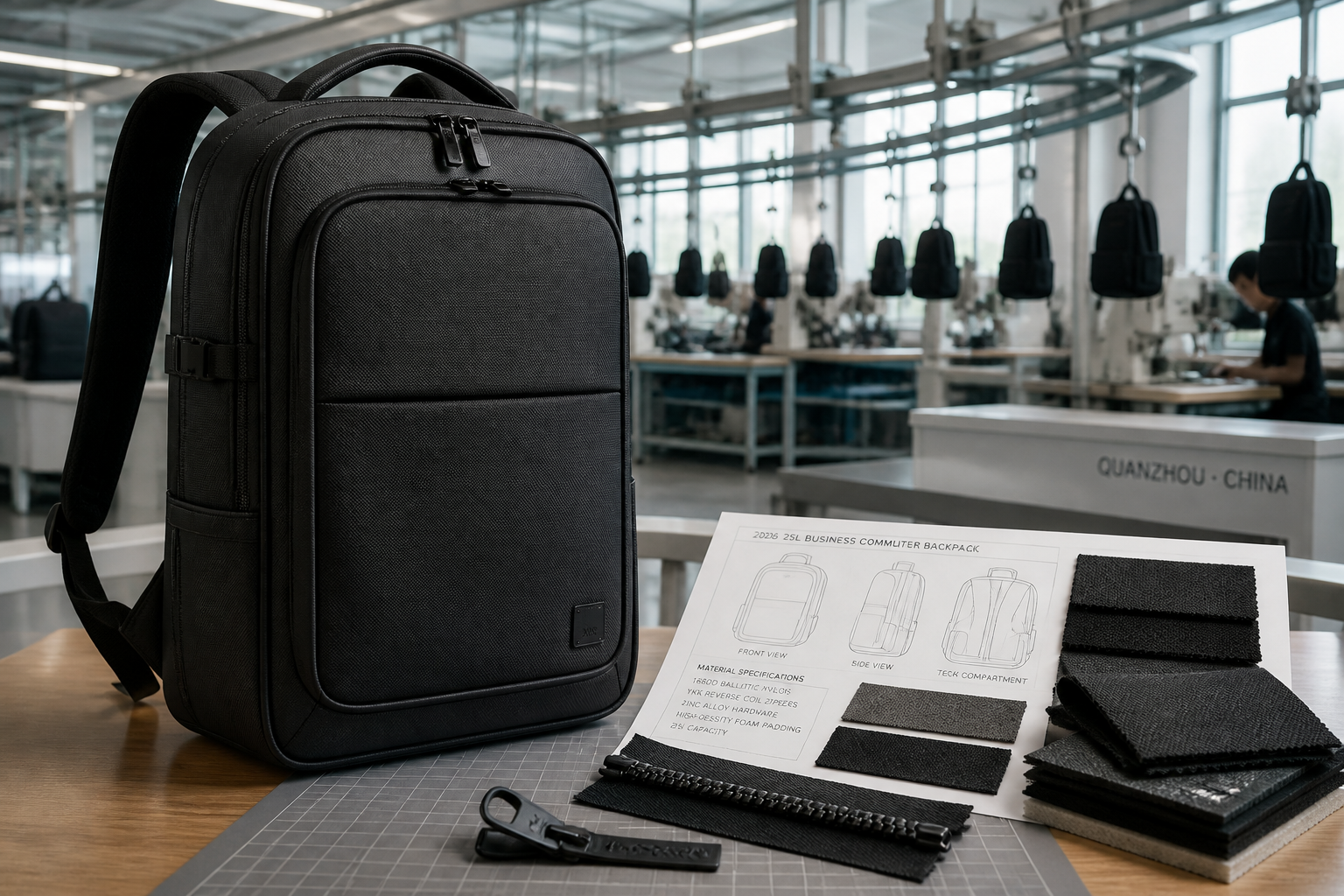
1680D ballistic nylon with a PU backing for 20L and above, on styles targeted at or above USD 45 retail.
600D Oxford polyester with a 0.3 mm PU coating for volume programmes where the landed cost ceiling sits below USD 14 FOB.
YKK zippers on the main compartment and the laptop pocket, with generic zippers only on internal accessory pockets and only with buyer sign-off.
Zinc alloy hardware instead of painted iron, because plating failure shows up as a warranty claim in humid and coastal markets.
Laptop compartment foam in the 8 mm to 12 mm range, with a false bottom at least 25 mm deep.
Trolley sleeve and USB pass-through quoted as paid options rather than defaults.
Design support requests have moved earlier in the buying cycle. Roughly half of new enquiries now ask for a 3D render before a physical sample, so a retail buyer can show the design internally without paying airfreight and waiting 10 days. We run 3D sampling on most OEM briefs now, and on a typical style it removes one full revision round.
Recycled materials are now routine, not premium. rPET body fabric and recycled webbing appear in roughly one in three new briefs, usually with a request for GRS documentation. At Tianqin we can source those materials, and we ask for the mill certificate before we quote them. The price delta is real: expect 4 to 7 percent above standard polyester, and add 10 to 14 days to material lead time if the fabric is not already in our warehouse.
Where the Cost Pressure Really Comes From
Labour and freight are not where buyers think the money goes. On a typical 25L laptop backpack quoted at USD 16.50 FOB, the Tianqin cost sheet breaks down like this.
Shell and lining fabric: 34 percent
Zippers, buckles, webbing, and foam: 22 percent
Labour and factory overhead: 26 percent
Packaging, carton, and inspection: 9 percent
Freight allocation and financing: 9 percent
When a buyer asks for a 10 percent reduction, the request usually lands on fabric and hardware, which is exactly where durability is decided. We will quote a cheaper build, and we write the change list into the quotation so nobody is surprised at the returns desk. What we will not do is quote a 1680D shell at a 600D price. Buyers who need that number will find it somewhere else, and we would rather say so in the first email than in month three.
What This Means for Orders Placed in the Next Two Quarters
Capacity is the constraint buyers underestimate. Our hanging conveyor system runs shared lines, and a 20,000-piece programme booked in August will push a 1,500-piece trial run behind it unless the trial gets its own line slot. Peak season is not the time to discover that.
Book sampling three to four weeks before you need the sample in hand. Our standard sampling window is 7 to 15 business days, and a new fabric adds a week on top.
Confirm zipper and hardware brands before sampling, not after. Swapping a zipper after sample approval invalidates the fit test and usually the drop test with it.
Decide the retail price band first, then build the spec. Building the spec first and pricing it later almost always ends in a downgrade that damages the product.
Reserve the bulk slot at deposit, not at sample approval. Lines fill in order of cleared deposits, not in order of enthusiasm.
Ask for the change list in writing whenever a cost target moves the specification.
Practical Tool: The 2026 Order Readiness Checklist
Work through this before you send a purchase order. Every item is something a factory can answer inside one working day, and every missing item becomes a delay later.
Target FOB price and target retail price, both written down
Destination country and the test standard required there
Capacity in litres, and laptop size at 14 inch, 15.6 inch, or 16 inch
Shell fabric with denier and coating type specified
Foam thickness in millimetres and false bottom depth for the laptop compartment
Zipper brand for the main compartment, laptop pocket, and internal pockets
Hardware material, finish, and salt spray expectation
Logo method: embroidery stitch count, silicone patch, woven patch, or metal plate
Packaging spec including polybag thickness and carton dimensions
Inspection point and AQL level agreed in writing
Sample approval date and bulk delivery date, counted backwards from your retail launch
Move Before Your Competitors Book the Line
Two things decide whether a laptop backpack programme lands on schedule: how early sampling starts, and how stable the specification stays after approval. Buyers who lock fabric, zipper, and foam in the first conversation get a 7 to 15 business day sample turnaround and a bulk slot that holds.
Send us your spec sheet, target price, and launch date. We will return a quote built on the cost breakdown above, a sampling plan, and a written list of what we would change to reach your target cost. Email [email protected] or visit www.tianqinbag.com to start an OEM or ODM laptop backpack project. Samples ship in 7 to 15 business days.


 Hot News