
 EN



A trading company can send you a sharp quotation and a factory tour video that belongs to somebody else. Thirty minutes on the actual floor settles the question. Not because buyers need to be engineers, but because a working production floor is almost impossible to stage: cutting waste, thread trimmings, work in progress carts, and the sound of machines under load tell you more than any certificate pack. Here is what to look at, in order, and which documents to request before you send a deposit.
The First Ten Minutes: Gate, Goods-In, and Work in Progress
Start at the gate, not the meeting room. Look at what is coming in and what is sitting. A factory with real export volume has incoming fabric staged in identifiable lots, usually with lot tags and an inspection stamp. If the inbound area is empty and the warehouse holds four finished cartons and nothing else, ask where the raw material for your order will come from and who owns it.
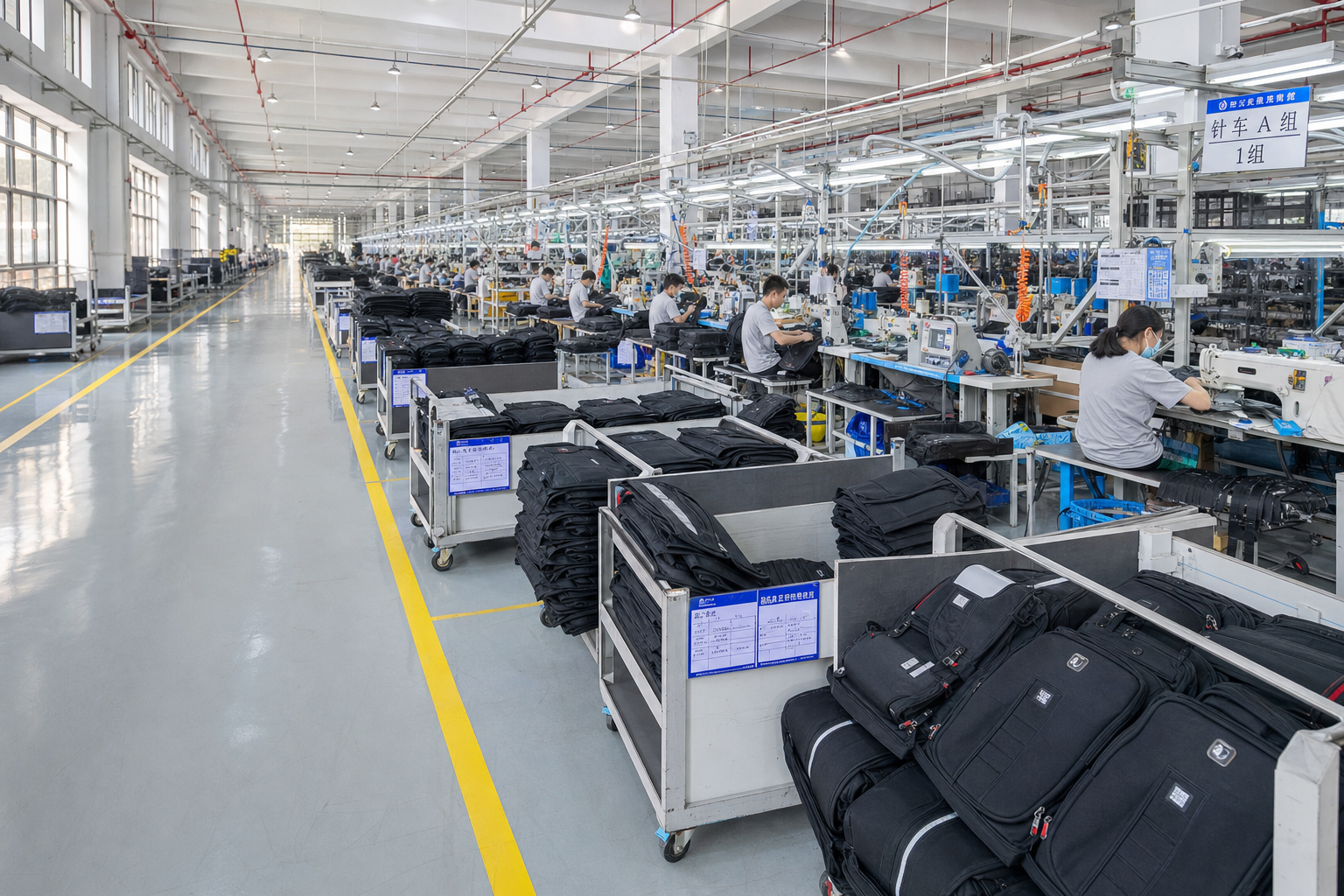
Work in progress is the clearest volume signal on any floor. Count the carts, bins, or hanging rail positions. On our 25L laptop backpack line, a single style in production shows between 600 and 1,200 pieces in work in progress at any moment, depending on how many operations are open. A floor that claims 30,000 units a month but shows a few hundred pieces in progress is not manufacturing that volume; it is sourcing it.
The first question most buyers ask us is whether they are allowed to walk the floor without an appointment. We say yes, during working hours, with two hours of notice.
Three Rooms That Cannot Be Staged
Cutting is the room to visit first. You are looking for a nesting file on screen, a machine actually running, and offcuts in the bin. Automated cutting machines are expensive and rarely rented for a site visit. Ask to see a cut panel measured against the pattern tolerance, and ask who signs off the trial cut on a new style. At Tianqin, our cutting room holds a 1 to 2 mm tolerance on shell panels and runs a hand-measured trial cut before any roll is released.
Sewing is the second room. Count stations, count operators, and count running machines rather than installed ones. Then look at what is under the needle: if every station is working on the same component, the line is balanced. If one station is sewing shells while the next four wait for panels, the floor is running as job shops rather than as a line, and your lead time will drift.
Packing is the third room and the one most buyers skip. Finished bags should be inspected, folded, polybagged, and cartoned at a defined station with a scale and a measuring tape nearby. Cartons should be stacked by purchase order with shipping marks already applied. If there is no scale in the packing area, nobody is verifying gross weight against the packing list.
Loading is worth an extra five minutes. Watch how cartons are counted onto the truck or into the container. A factory running real export volume has a loading plan, a counter with a scanner or clipboard, and carton marks that match the shipping instruction exactly. If loading looks improvised, assume the paperwork is improvised too.
Documents That Prove Capacity Is Real
Ask for these in one email before you fly anywhere. A genuine factory produces them the same day, because they are already in use.
Business licence with the factory name, matching the name on the quotation and the bank account
Recent customs export records or bills of lading for the destination markets you care about
Test reports from a third party laboratory, with the report number you can verify
Machine list with quantities by type, including cutting, sewing, and testing equipment
Photographs of the production floor with visible dates, or a live video call during working hours
Two or three current customer references in your channel, with permission to contact them
Written capacity statement per style family, in units per month
A capacity statement only means something when it names the style family and the line. Ask for units per month by product type rather than one number for the whole plant, then ask what share of that capacity is already committed to current customers. A factory running at 95 percent utilisation will happily give you a delivery date it cannot hold.
If the bank account name, the business licence name, and the name on the bill of lading do not match, stop and ask why. Most deposit risk in this industry starts with that one mismatch.
One more signal sits in response times. A real factory answers a technical question about fabric, foam, or tolerance within a day, because the person answering can walk to the line and check. Answers that arrive a week later with a manufacturer brochure attached usually mean your question travelled to another company first and came back transcribed.
Practical Tool: The 30-Minute Walkthrough
Spend your half hour like this and you will know more than a week of email.
Minutes 0 to 5: gate, raw material staging, and lot tags on fabric rolls
Minutes 5 to 10: work in progress count, and how many distinct styles are on the floor
Minutes 10 to 15: cutting room, machine running, trial cut record, offcut volume
Minutes 15 to 22: sewing floor, running station count, line balance, thread and needle setup
Minutes 22 to 26: assembly and hardware station, foam stock, load test record
Minutes 26 to 30: packing area, inspection station, scale, carton marks, container loading area
Throughout: pick any bag from a finished carton and open it in front of the line supervisor
That last action is the most revealing one. Pick a random carton, not the sample the salesperson brings you, and inspect the bag in front of the person who runs the line.
Signals You Are Talking to a Trading Company
Some of these are legitimate business models, and there is nothing dishonest about a trading company. The problem is paying a factory price for a middle layer, or carrying a warranty that nobody on the floor can honour.
Factory visit is deferred repeatedly, or only a showroom and sample room are offered
The company name on the quotation differs from the licence and the bank account
Test reports are undated scans, or the report holder is a different company entirely
Machine list has no quantities, no ages, and no photographs
Sample arrives fast but bulk lead time is quoted as we will confirm later
Price is firm on everything, including the fabric, because the quote is built on a subcontractor quote
Nobody can answer how many pieces are in work in progress right now
Book the Visit, Then Send the Deposit
The cheapest risk control in laptop backpack sourcing is one trip or one live video call. At Tianqin we host buyers during working hours with two hours of notice, and we will walk you through cutting, sewing, assembly, and packing in the order above, including the parts that are untidy because a real order is running.
If you cannot travel, ask for a live call on the floor rather than a produced video, and ask to see a bag pulled from a finished carton. Send us your order volume, destination market, and target price, and we will tell you which line would run your laptop backpack and when the slot opens. Sampling runs 7 to 15 business days. Email [email protected] or visit www.tianqinbag.com to arrange a visit or request a factory quotation.
 Hot News


