EN



Most sourcing advice reads as if every factory can do everything. We cannot. After 17 years running a bag factory in Quanzhou, I can tell you where we win, where we lose, and when you should place your laptop backpack order somewhere else. That is more useful than another capability page, and it may save you a bad quarter.
What We Do Well
We are good at structured, repeatable laptop backpack programmes where the specification is written down and the buyer intends to reorder.
Business, commuter, and travel laptop backpacks from 18L to 32L, with 15.6 inch and 16 inch compartments as standard builds.
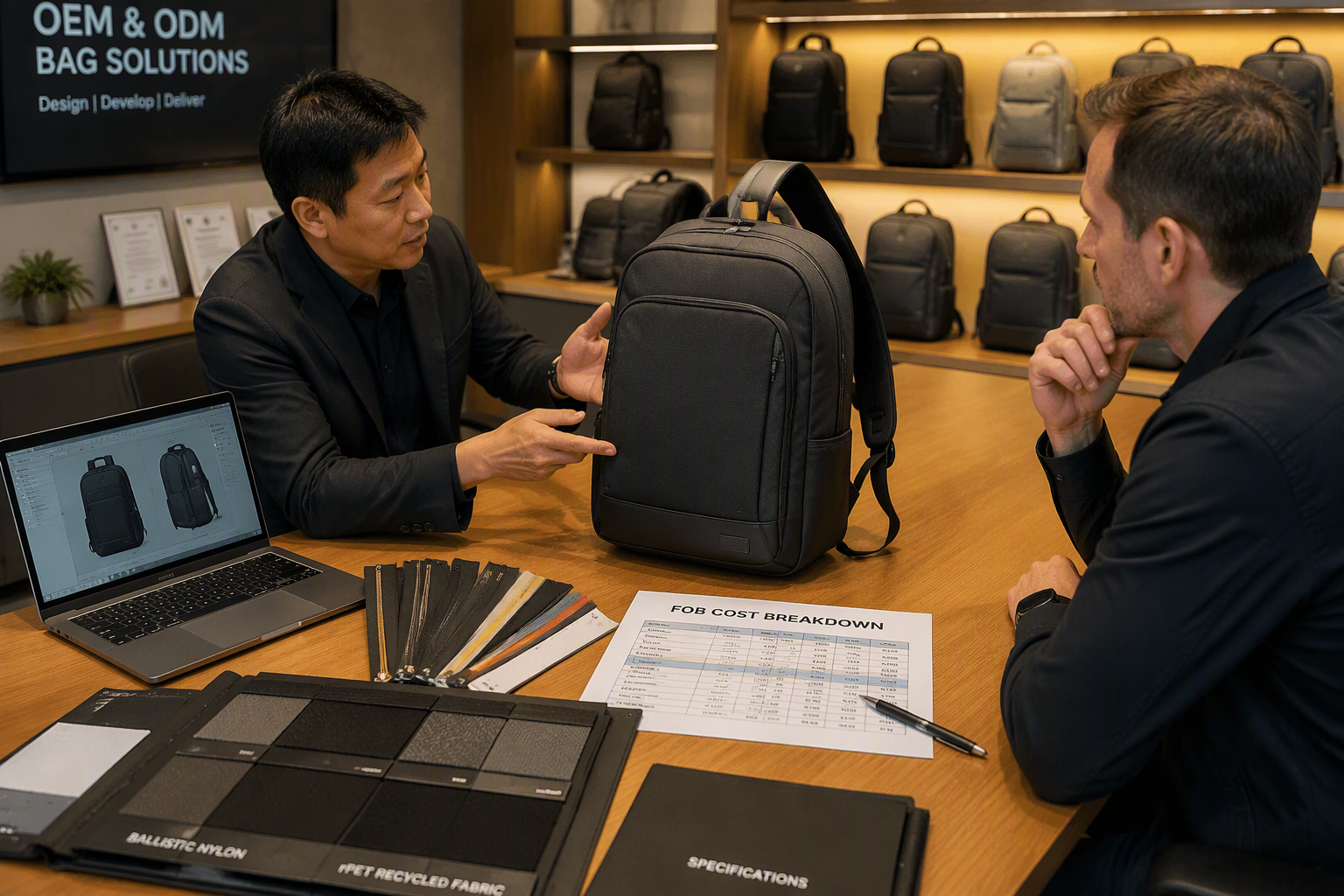
OEM and ODM work with 3D sampling, so colour, logo placement, and pocket configuration get settled before a physical sample is cut.
1680D ballistic nylon and 600D Oxford polyester bodies, YKK zippers, zinc alloy hardware, on automated cutting machines with a 1 to 2 mm panel tolerance.
Volume between roughly 1,000 and 50,000 pieces per style per year, with shared line capacity that we can plan 3 to 4 months ahead.
Compliance work for US and EU destinations, with SGS test reports available on request rather than after a reminder.
Sampling in 7 to 15 business days, and a cost sheet broken into fabric, hardware, labour, packaging, and freight lines so you can see what you are buying.
Order size is where a factory like ours earns its keep. Laptop backpack lines in Quanzhou run across shared capacity in the tens of thousands of pieces per month, and a single style between 1,000 and 50,000 pieces can hold a planned slot for a full quarter. That predictability is worth more than a headline price, because a retail launch date is the one thing a buyer cannot renegotiate with their own customers.
At Tianqin we quote in that structure because buyers who understand the breakdown make better decisions, including the decision to spend more on a shell fabric that will not fail in year one.
What We Say No To
Refusing work costs us orders, and it is still the right call more often than not.
We decline orders where the buyer wants us to copy a competitor's protected design and put a different logo on it. We decline requests to use a branded zipper name in a proposal while substituting a generic tape in production; if the quotation says YKK, the bags carry YKK.
We decline projects where the target price sits below our material cost, because the only ways to reach it are a thinner shell, lower density foam, or a lighter thread specification. All three come back as returns. If a buyer needs a landed cost under about USD 9 FOB on a 25L laptop backpack, we are not the plant for that build, and I would rather say so in the first call.
One request we refuse politely is the deferred specification: send a sample first and we will work out the details later. It sounds flexible. In practice it means shell, foam, zipper, and packaging get decided under time pressure, which is where most quality problems begin. We will build a first sample from a written spec in a day or two, and we would rather spend that time getting the spec right.
We also decline orders with no agreed inspection standard. If there is no AQL level and no defined inspection point, every minor thread end becomes a negotiation, and both sides lose time.
When Another Supplier Is the Better Choice
There are real situations where a different kind of supplier serves you better.
First prototypes and market tests under 300 pieces. A small workshop with flexible setup will beat us on cost and speed at that volume.
Fashion-forward seasonal designs that change every 8 weeks. We optimize for repeatable builds, not for trend churn.
Orders needing in-country finishing, kitting, or retail-ready repacking in the destination market.
Technical bags requiring specialist certifications we do not hold, such as specific PPE categories.
Ultra-lightweight builds where the shell must stay under 250 g per square metre. We can make them, but we are not the cheapest source for them.
The first question most buyers ask us is whether we can also handle their small promotional runs alongside a big OEM programme. Sometimes yes, sometimes no, and the answer depends on whether the small run shares the same fabric and hardware as the volume style.
Trade-Offs We Accept on Purpose
Being honest about trade-offs is what makes a quotation predictable.
We accept a slower sampling start on new fabrics, because we will not cut a sample from a roll we have not inspected. Add roughly a week when the material is not already in our warehouse.
We accept a higher unit price on reinforced strap anchors, denser foam, and branded zippers, because that combination is what keeps a laptop backpack out of the returns process. Our claim rate on laptop backpack programmes runs around 0.6 percent of units, and I would rather hold that number than shave USD 0.60 off a bag.
We accept that peak season changes what we can promise. Between August and October our lines run against volume that buyers booked months earlier, so a new trial style may wait behind committed production. A buyer planning a November retail launch should be sampling in July, not September, and we say that in the first meeting rather than after deposit.
We accept that our factory floor is not a showroom. Visitors see cutting waste, work in progress carts, and machines running, because we do not clear a line to make a tour look tidy. If you want a clean showroom experience, we are the wrong factory for that too, though we will walk you through the real floor with two hours of notice.
Practical Tool: Match Your Order to the Right Supplier Type
Use this to decide who you should be talking to before you spend a month negotiating with the wrong side.
Under 300 pieces, trend-led design: small workshop or domestic converter
300 to 1,000 pieces, simple build, no certification needs: trading company or small factory
1,000 to 10,000 pieces, repeatable spec, US or EU compliance: mid-size direct factory
10,000 pieces and up, multi-colour, OEM or ODM: direct factory with automated cutting and line planning
Programmes needing 3D sampling and design support: ODM-capable factory
Programs needing in-market repacking or kitting: factory plus a destination-side logistics partner
Regulated or safety-certified bags: specialist manufacturer with the specific certification in hand
The pattern behind the list is simple. As volume rises, the cost of a middle layer grows faster than the cost of a factory's own overhead.
Tell Us What You Are Trying to Build
If your laptop backpack brief matches what we do well, we will move fast. Send the destination market, target retail and FOB price, volume in litres, laptop size, shell fabric preference, zipper and hardware expectations, logo method, packaging spec, and launch date. You will get a structured quotation, a written list of what we would change to reach your target cost, and a sampling plan. Samples take 7 to 15 business days, and the bulk slot is reserved against a cleared deposit.
If your brief is one we should decline, I will tell you directly and, if I can, point you toward the type of supplier that fits better. Email [email protected] or visit www.tianqinbag.com to start an OEM or ODM laptop backpack project with Quanzhou Tianqin Bags Co., Ltd.
 Hot News