EN



Most custom laptop backpack quotations arrive as a list of twenty add-ons with no guidance attached. A European distributor we work with added six options to their 25L laptop backpack one season and saw no movement in reorder rate. Two of those options added 1.10 USD per unit at FOB. The mistake was not customization. It was treating every option as if the shopper standing in front of the shelf could see it.
What the Shelf Actually Tests
A retail shopper handles a laptop backpack for about four seconds before deciding whether to keep looking. In that window they pull the main zipper, press the front panel, open the laptop compartment, and read the price tag. Customizations that survive those four seconds earn their cost. Everything else is a line on a spec sheet.
Three shopper types dominate the 20L to 25L band. The daily commuter tests the laptop sleeve and the zipper drag. The student tests total capacity and the front organizer. The business traveler tests the trolley sleeve and whether the pack stands upright on its own when loaded. If your customization budget sits somewhere none of those three touch with their hands, the money is gone before the container ships.
There is also a price-band ceiling to respect. Below 39 USD retail, shoppers compare on capacity and zipper brand. Between 49 and 79 USD, they start comparing lining quality, stitching neatness, and hardware finish. Above 99 USD, materials and hardware color become purchase drivers on their own. The same option can be worth 0.80 USD in one band and worthless in another.
Options That Change Sell-Through
Three categories earn their cost consistently, across most channels we ship to.
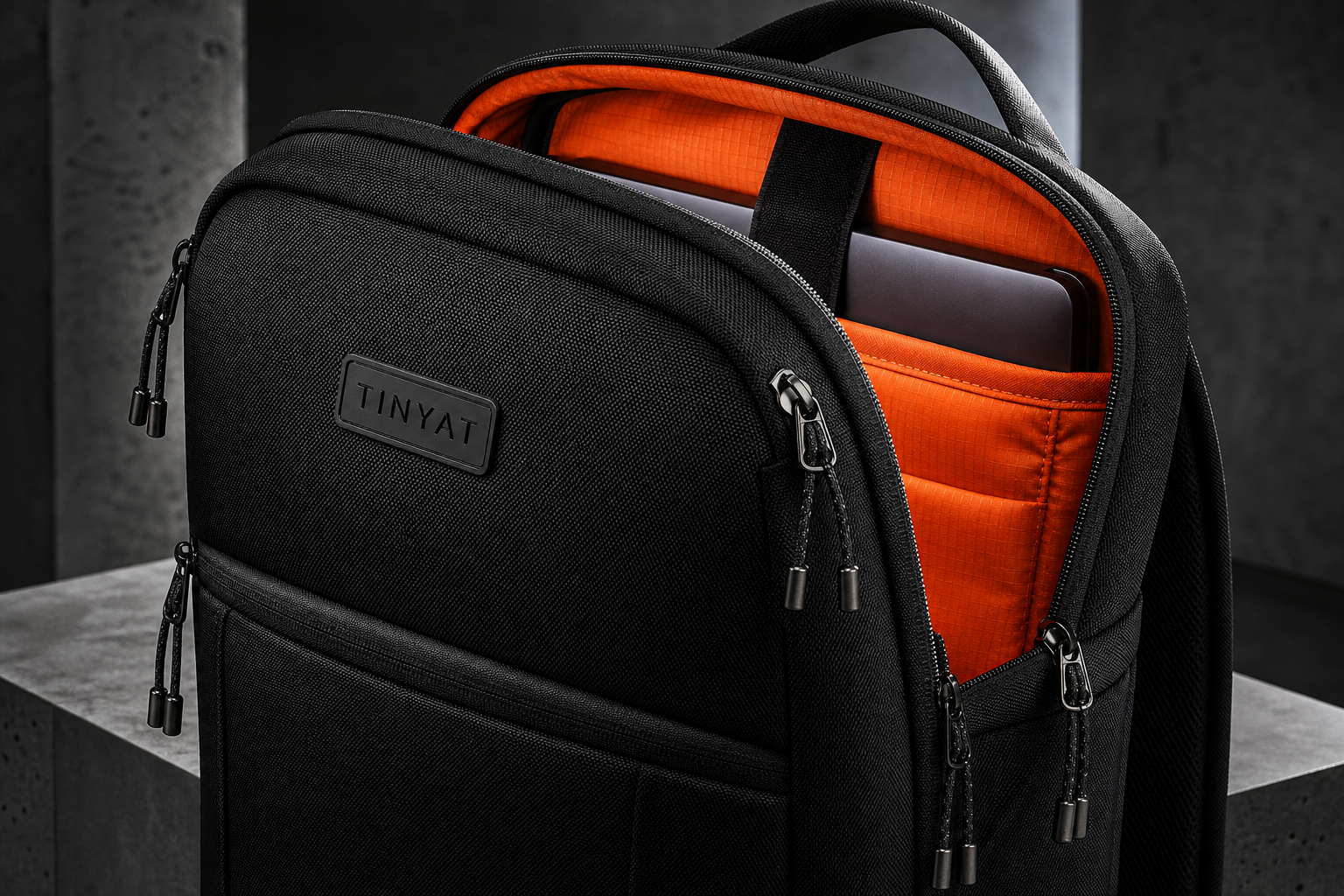
Zipper feel comes first. A YKK zipper on the main compartment changes both the sound and the drag of the pull. Shoppers register this before they register fabric. Replacing a generic nylon coil with a YKK number 8 on a 25L pack adds roughly 0.45 USD per unit on our Quanzhou line, and it is the change most likely to appear later in a retail review.
Second is the laptop sleeve. Buyers with a 15.6 inch machine press the padding through the fabric wall. Moving EPE foam from 5 mm to 8 mm on the back panel costs around 0.30 USD and reads immediately as protection, especially to shoppers who have cracked a screen before.
Third is hardware finish. Zinc alloy pulls and sliders in matte black or gunmetal change how the backpack photographs, and photography carries online conversion. If the hardware is already zinc alloy, the finish change is close to free.
Lining color deserves a mention. A light grey lining inside a dark shell costs about the same as black lining and makes interior photographs readable. For any brand selling on a marketplace where an interior image is mandatory, this is close to a free win.
Zipper brand: high visibility, about 0.45 USD per unit, shows up in reviews
Sleeve padding thickness: medium visibility, about 0.30 USD per unit, reads as protection
Hardware finish: high visibility online, near zero cost on existing zinc alloy
Lining color: medium visibility, low cost, improves interior photography
Options That Add Cost Without Moving Units
This list is longer than most buyers expect, and it is where margin quietly disappears.
Internal organization panels are the most common overspend. Ten elastic loops and two mesh pockets add 0.60 to 0.90 USD per unit and stay invisible until the pack is open in someone's hands. Unless you sell through a channel with a salesperson who opens the bag, the shopper never sees the loops.
Reflective piping along the side seams costs about 0.20 USD per unit. It matters in Northern European commuter markets, where buyers often write it into their own brief for visibility requirements. In Southern European and US general retail, it is decoration.
Compression straps on a 20L pack rarely earn their cost. There is not enough volume to compress, and the straps bring webbing, two buckles, and four extra stitch operations with them.
Custom-molded rubber pulls are a special case. Tooling runs 180 to 400 USD depending on the shape, and we normally need 1,000 units per design to amortize it sensibly. A brand ordering 300 units pays a heavy premium for a part that most shoppers never touch.
The Trade-Off We Tell Buyers About
There is a genuine tension between shell durability and weight, and buyers should hear it before they fall in love with a specification.
Our default shell for 20L and larger laptop backpacks at Tianqin is 1680D ballistic nylon, because it holds structure through abrasion cycles and keeps its shape after a year of daily loading. The trade-off is mass and stiffness. A complete 25L pack in a 1680D shell runs about 1,180 g. That is heavy for a commuter segment now comparing against 900 g competitors built on 600D Oxford polyester.
When a buyer's retail price band sits under 39 USD, we usually recommend 600D Oxford with a PU coating and say so plainly, even though the ballistic version carries a better margin for us. Shipping a specification the market will not pay for does not produce reorders, and reorders are the number that matters to both sides.
We also tell buyers where the cost ceiling sits. Automated cutting machines and a hanging conveyor system let us switch lining colors and hardware finishes between rounds without retooling, which is why cosmetic changes can move through sampling in a single round while structural changes usually need two.
Score Every Option Before You Approve the Quote
Use this list in your next internal review. Score each option before it enters the quotation.
Visibility: is it touched or seen in the first four seconds of handling? If not, it scores zero.
Channel fit: does your market or channel require it, for example reflective trim for commuter retail? Requirements stay, preferences get questioned.
Incremental cost: what does it add per unit at FOB in USD, and what does that do to your landed margin?
Minimum quantity: does the option need tooling or a separate print setup that raises your MOQ?
Repeatability: if it works, can you repeat it next season at the same cost, or does the tooling expire?
Removal test: if you delete the option, what does the shopper lose? If you cannot answer in one sentence, delete it.
Run the exercise every season. An option that scored well two years ago does not automatically score well now, because competing products and price bands move underneath it.
Build Your Shortlist Before You Build the Bag
The first question most buyers ask us is what our minimum order quantity is. The more useful question is which three options will do the most work on the shelf, at the price band you actually sell in. Send us the options you are considering along with your target retail price and your channel, and we will tell you which ones we would keep and which ones we would cut.
Contact [email protected] or visit www.tianqinbag.com to request samples, get a factory quote, or start an OEM or ODM project. Sample turnaround is 7 to 15 business days, and we quote each customization as a separate line so you can build a shortlist that pays for itself.
 Hot News