
 EN



A buyer sent us a 40-page technical pack for a 28L laptop backpack last year. Before quoting, we asked how many units they planned for the first order. The answer was 500, at a 45 USD retail price, in a design that sat close to a model we already run for two other brands. A full OEM build would have consumed development money they could not recover at that volume. That conversation saved them about 2,600 USD and six weeks of sampling.
What Actually Differs Between OEM and ODM
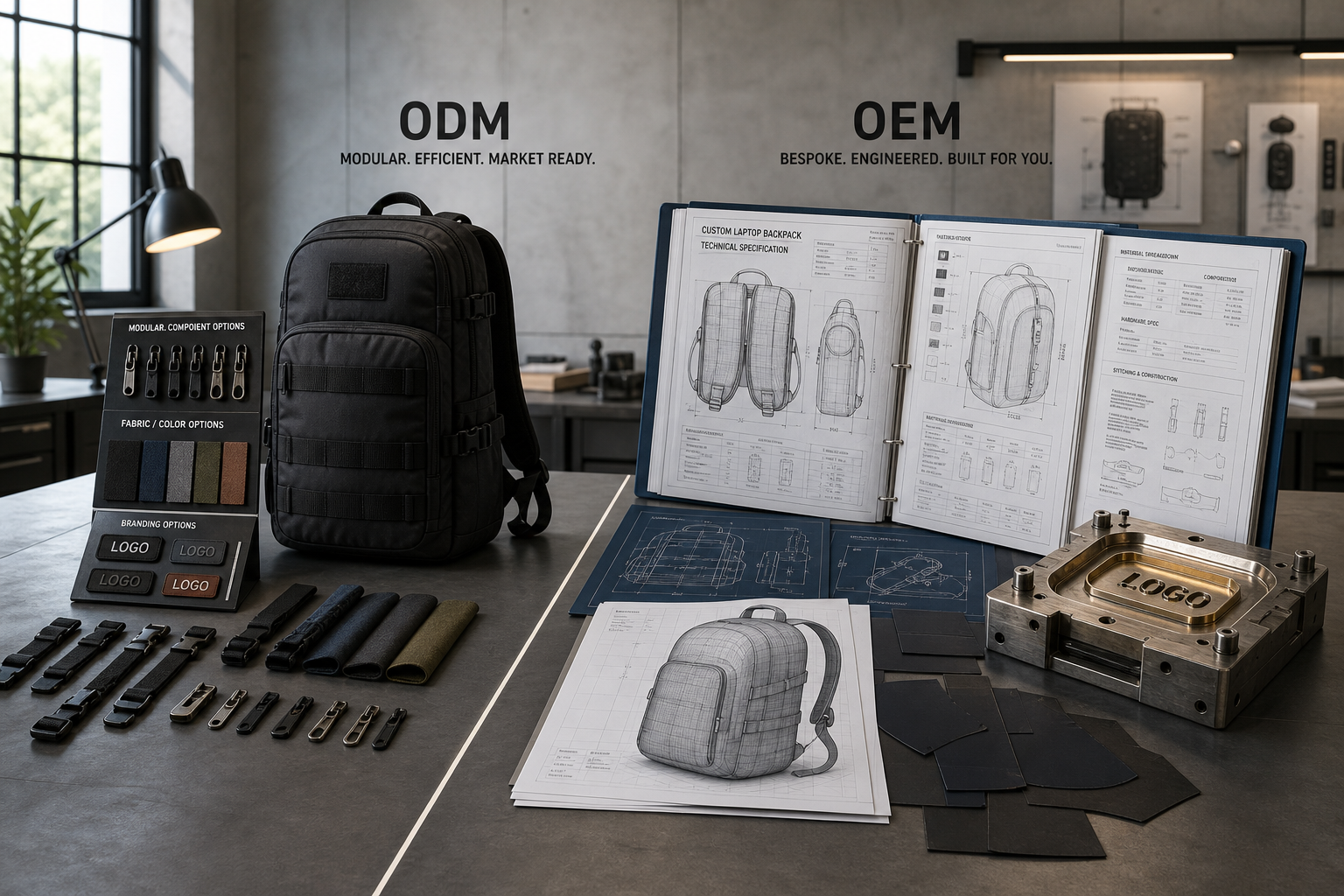
OEM means original equipment manufacturing. You bring the design, the measurements, and the construction details, and the factory builds to your specification. The pattern, the molds, and the print screens are developed for you.
ODM means original design manufacturing. The factory brings an existing, already-tested design, and you brand it with your logo, labels, lining, and packaging.
At Tianqin we run both paths on the same production floor, and the split in our order book is roughly 60 percent OEM and 40 percent ODM. The tooling and the machines are identical. What changes is who carried the development risk, and how long that risk took to resolve before bulk could start.
Development Time and Pattern Cost, in Real Numbers
OEM development starts with pattern making. A new laptop backpack pattern takes 5 to 8 working days to draft, grade, and cut in our sample room. Then come sample rounds. Our standard sampling turnaround is 7 to 15 business days, and a genuinely new OEM design usually needs two to three rounds before the fit, the foam, and the strap angles are right. That is roughly 4 to 8 weeks from confirmation to an approved golden sample.
Costs sit in three places:
Pattern development: 150 to 450 USD for a new laptop backpack pattern, depending on how many panels and how much internal structure it carries.
Tooling: a custom logo mold runs 180 to 400 USD, and a custom die-cut foam piece for the laptop cavity runs 120 to 260 USD.
Print setup: silkscreen or heat transfer setup costs 60 to 120 USD per color position, and the setup is charged per artwork, not per unit.
ODM development is shorter because the pattern already exists and has already survived bulk production. If you take a stock model with your logo and labels, sampling typically takes one round. If you modify an existing model, for example changing the front pocket or the laptop sleeve depth, expect two rounds and a light modification fee rather than a full pattern charge.
How the Two Timelines Compare
An ODM order can reach an approved sample in about 8 to 12 working days from deposit. An OEM order with a new pattern typically reaches the same point in 25 to 40 working days. The gap is not machine speed. It is drafting, fitting, and re-cutting a new pattern, plus the buyer's own internal approval loop, which we cannot compress from our side.
Minimum Order Quantity, Tooling, and IP Ownership
This is where the two paths separate most sharply, and where most of the negotiation happens.
OEM orders at our factory start at 500 units per colorway for a custom pattern, because a new pattern plus tooling has to be amortized somewhere. Below 500 units we will still quote, but the unit price rises steeply and we say that plainly rather than hiding it in the freight line.
ODM orders start at 300 units per colorway, and can go lower for a stock model in a stock color where only the logo and labels change.
Who Owns the Design Afterwards
IP ownership is the part buyers underweight. In an OEM project where you pay the pattern and tooling, the pattern belongs to you. We sign an NDA, we will not run it for anyone else, and you can write the tooling into the contract as your property. We hold it in our Quanzhou facility for your repeat orders.
In ODM, the base design stays with us and may be sold to other brands.
That is the trade-off, and it is real. An ODM design is not exclusive unless you pay for exclusivity. We offer 12-month channel exclusivity on an ODM model from 1,000 units per colorway, which locks the colorway and the logo placement to you for the period. Buyers who need genuine design separation should be in OEM, not in a modified ODM program that they believe is exclusive but is not.
Which Path Fits Which Buyer
The answer is usually obvious once you know the buyer's channel.
A first-time private label brand testing a category should start with ODM. You get a proven pattern, one sampling round, and a 300-unit entry that lets you test sell-through before committing to development money.
A retailer with existing private label programs and a clear gap in the assortment should go OEM. Differentiation is the reason the program exists, and a shared ODM design undermines it.
A distributor replenishing fast-moving inventory should stay ODM and add light modification: a different lining color, different hardware, a custom logo. Speed and predictable margin matter more than uniqueness in that channel.
A brand with an in-house design team should be OEM from the first order. Otherwise the team's work never reaches the product, and shoppers will not pay a premium for a design the brand did not really own.
Six Questions Before You Choose a Path
Work through this list before you ask for a quotation. The answers usually settle the decision.
Do you have a completed technical pack with measurements, seam construction, and material calls, or only a mood board?
Is your design visibly different from what already sells in your channel, or close to an existing model?
What is your realistic first order quantity, and does it absorb the pattern, tooling, and print setup cost?
Who owns the pattern and the molds after the project, and is that written into the contract?
Can your retail price recover development cost across the first two orders, not the first one alone?
What is your reorder plan over 18 months? A one-off order rarely justifies custom tooling.
If another brand could buy the same bag, how much does that cost you in sell-through?
Choose the Path Before You Approve the Pattern
The first question most buyers ask us is which path is cheaper. The honest answer is that ODM is cheaper up front, OEM is cheaper per unit at volume, and the crossover sits somewhere between 800 and 1,200 units for a moderately complex laptop backpack. Below that line, ODM with your own logo, lining, and labels usually returns more margin per dollar invested. Above it, development cost pays itself back quickly and gives you a design no competitor can list.
Send us your technical pack or your channel plan and we will tell you which path fits, including the case where the answer is ODM and we do not sell you development work at all. Contact [email protected] or visit www.tianqinbag.com to request samples, get a factory quote, or start an OEM or ODM project. Sample turnaround is 7 to 15 business days.


 Hot News


