EN



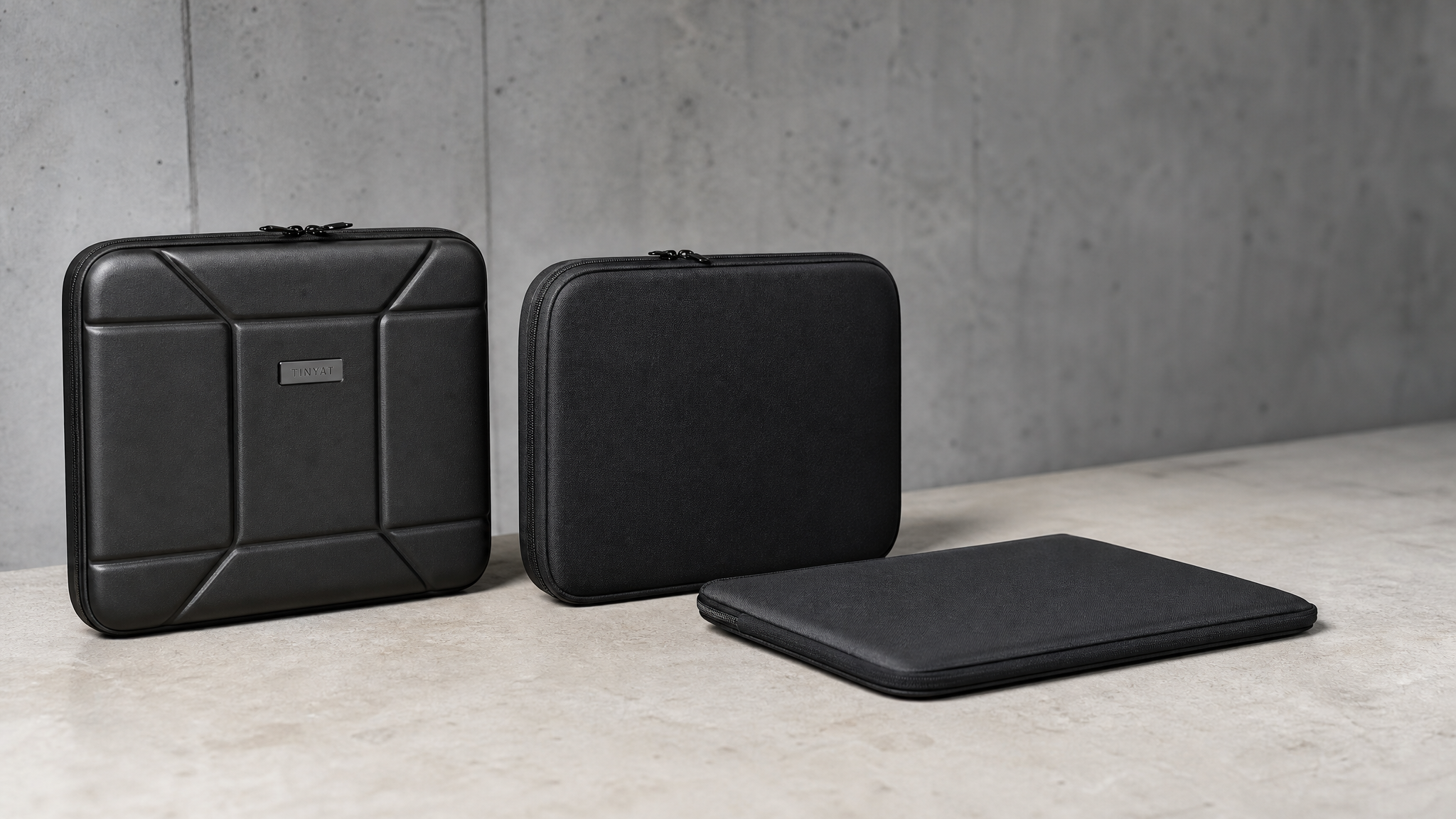
A moulded case is the only laptop product where a buyer pays for a shape rather than a pattern. That shape comes from a tool, and the tool costs between 2,000 and 3,800 USD before a single unit is made. Working with a custom laptop case manufacturer is therefore a decision about format and volume first: which shell, how many walls, and whether the order is large enough to carry the mould. Here is how the construction works and where the money goes.
Hard Shell Does Not Mean Rigid Plastic
The cases we build are moulded EVA with a fabric face, and they behave differently from both a foam sleeve and a polycarbonate shell.
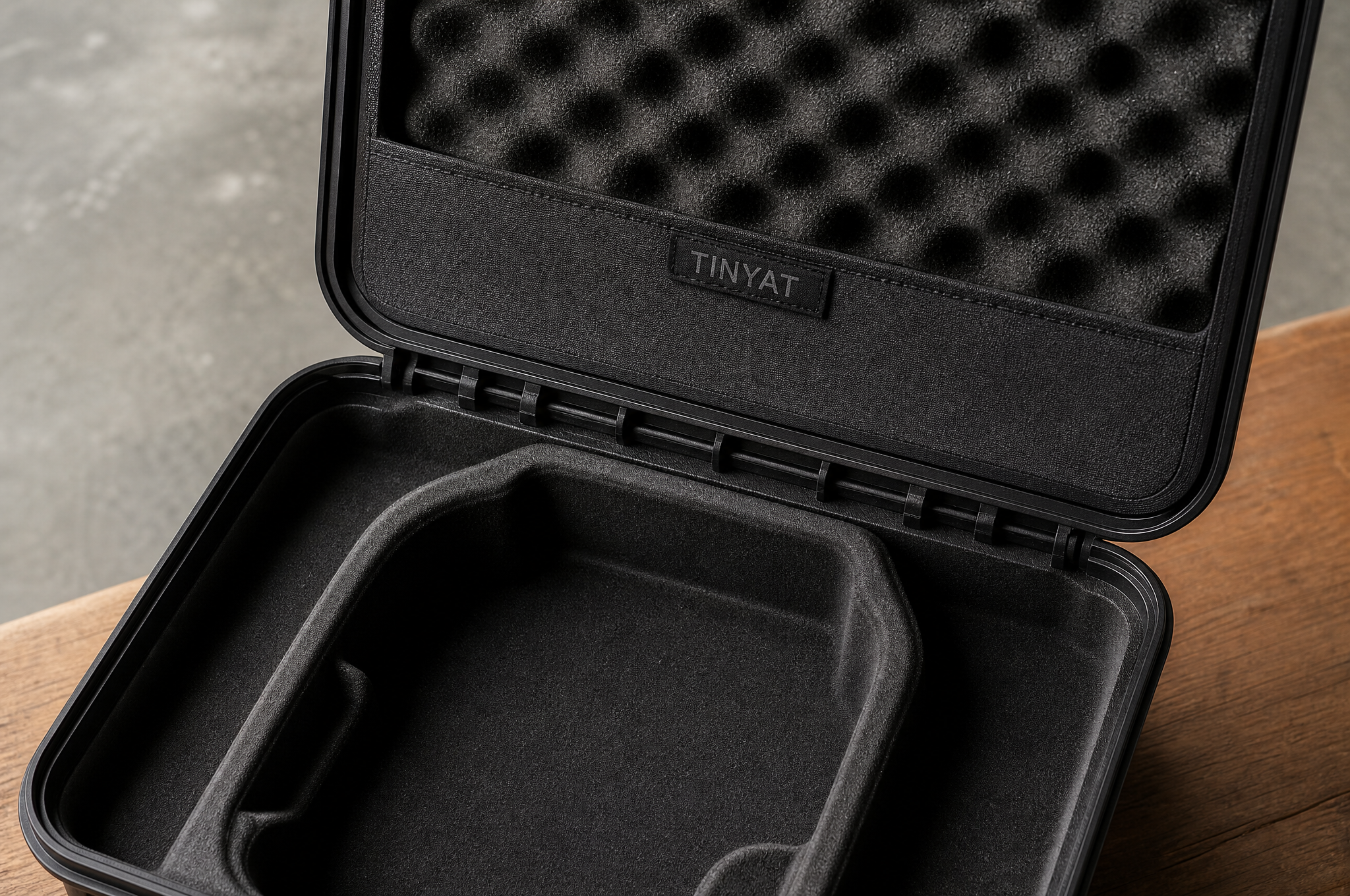
The construction is a sandwich. A 3 to 4 mm EVA sheet is heated until it softens and then pressed over a tool into a shape. A face fabric, usually a 600D polyester or a 75D fine weave, is bonded during the same operation. A lining and an internal foam layer are added afterwards, and a zip runs around the perimeter of the moulded halves.
The result is a shell that holds its shape under light load, flexes before it cracks, and weighs about half of a comparable polycarbonate case. That combination is why the format survives: it is rigid enough to protect a device in a rucksack and light enough to carry alone.
What it is not: it is not crush-proof. A 3 mm EVA shell will deflect under a heavy suitcase and recover, which is the right behaviour. A buyer who needs a genuinely rigid case is looking at a different product, and we say so before quoting a mould.
Moulded EVA: Tooling, Wall Thickness, And Format
The tool is the first cost and the first decision.
Tooling: 2,000 to 3,800 USD per shape, depending on size, wall detail, and whether the tool needs two halves
Tool lead time: 18 to 25 working days, which sits outside the 7-15 working day sampling window
Minimum order: 500 pcs per shape and colourway, since a mould run below that does not recover setup
Wall thickness: 3 mm standard, 4 mm at the edges, and 5 mm on the base of a clamshell
Face fabric: 600D polyester, or 75D for a smoother finish that shows moulding marks less
Zip: a #5 or #8 coil around the perimeter, with a 20 mm radius at every corner
Wall thickness is the specification buyers argue about, and the honest position is that 5 mm everywhere is not better. A thicker wall adds mass, resists the zip stitch, and makes the case harder to close on a full load. We thicken the base and the corners, where impacts land, and leave the top at 3 mm.
Moulding marks are the other practical issue. A dark 75D face shows a faint line where the tool seam sits, and a coarse 600D hides it. Buyers who want a clean look on a black case get the 600D or accept the line, and it is better to know that before the tool is cut.
Formats Worth Building
Four formats cover most of the market, and each one has a different device fit.
Clamshell: two moulded halves, a full perimeter zip, an internal device sleeve and a mesh pocket. The most protective and the heaviest at about 380 to 480 g
Sleeve case with a handle: one moulded body, a zip on three sides, a 40 mm handle. About 300 g, and the format that sells best in a corporate channel
Slim shell: single-wall front and back with a soft edge, 25 to 30 mm external depth, and the weakest corner protection of the four
Hybrid with a device sleeve inside a small moulded body: adds a second interior operation, 0.55 USD of labour, and is the format buyers ask for when they want organisation
The clamshell is the format that justifies the mould, because a soft bag cannot reproduce its internal structure. The sleeve case is the volume product in most programs and competes directly with a padded sleeve at two to three times the price, so the buyer has to be selling protection rather than padding.
What A Custom Laptop Case Manufacturer Tests
Moulded cases get a test set that soft products do not need.
Drop test: 1,200 mm onto concrete, six faces, with a 2.5 kg dummy, checking the shell for cracking rather than scuffing
Compression: 40 kg distributed load for 24 hours, checking for permanent deformation above 4 mm
Zip cycle: 3,000 cycles around the perimeter, which is where a moulded case zips fail
Corner radius check: 20 mm minimum, since a tighter radius fatigues the coil
Handle pull: 400 N static on a sleeve-case handle
Wall thickness: measured at six points per case with a gauge, 3 mm minimum
Zip stitch: 8 to 10 stitches per inch through the moulded edge, which is harder than through flat fabric
The zip is the component that decides whether a moulded case is a good product, and it fails at the corners. A moulded shell has a fixed geometry, so a slider has to turn through the corner radius on every pass, and a 20 mm radius distributes that turn. We have rebuilt tools to widen a corner radius after a season of corner zip failures, and a tool change costs more than the zip ever will.
The volume reality
A moulded case only makes sense above roughly 500 units per shape. At 500 units, a 2,800 USD tool adds 5.60 USD per case before a single material or labour cost, which puts the product well above what a mid-market buyer expects for a case. At 2,000 units the tool contribution falls to 1.40 USD and the case competes properly.
There is a second limit, which is colour. Each colourway is a separate moulding run with its own fabric cut, so four colours on 2,000 units means four runs of 500 and the setup cost per unit rises again. Two colours is the practical number for a first order, and buyers who insist on four usually move to two after the first season.
What the buyer sees when the case arrives
From your side, the case arrives with a shape and a weight that feel considered, and the first check is the zip. Run it once around the perimeter with one finger and feel for the point where it hesitates. If it binds at a corner on the sample, it will bind on every unit, because the corner radius comes from the tool and not from the operator.
A Hard Case Spec Sheet
Send these lines with a case brief.
Format: clamshell, two moulded halves, perimeter zip
External size: 400 by 290 by 60 mm at 15.6 inch
Wall: 3 mm EVA standard, 4 mm at edges, 5 mm at the base
Face fabric: 600D polyester, bonded during moulding
Internal: 5 mm foam plus a 3 mm device sleeve, false bottom 10 mm
Zip: #8 coil, 20 mm corner radius, two pulls
Handle: 40 mm, 400 N static gate
Weight: 380 to 480 g depending on format
Tooling: 2,000 to 3,800 USD, 18 to 25 working days
MOQ: 500 pcs per shape and colourway
Drop gate: 1,200 mm, six faces, 2.5 kg dummy, no cracking
Compression: 40 kg for 24 hours, deformation under 4 mm
That MOQ line is the one to read first, because it decides whether the format is available to your program at all.
Send The Device And The Volume First
Tell us the device size, the format you have in mind, and the quantity you can commit to the first order. We will tell you whether the volume supports a tool, what the tool costs, and what the case lands at per unit with the tool amortised, so the decision is made on landed cost rather than on a sample photograph.
Contact [email protected] or visit www.tianqinbag.com to request samples, get a factory quote, or start an OEM/ODM project with Quanzhou Tianqin Bags Co., Ltd. Sampling lead time is 7-15 working days for fabric products, with mould tooling at 18 to 25 working days. Seventeen years of bag manufacturing in Quanzhou, exports to more than 50 countries, SGS test reports covering REACH, CPSIA and Prop 65 on request.


 Hot News