
 EN



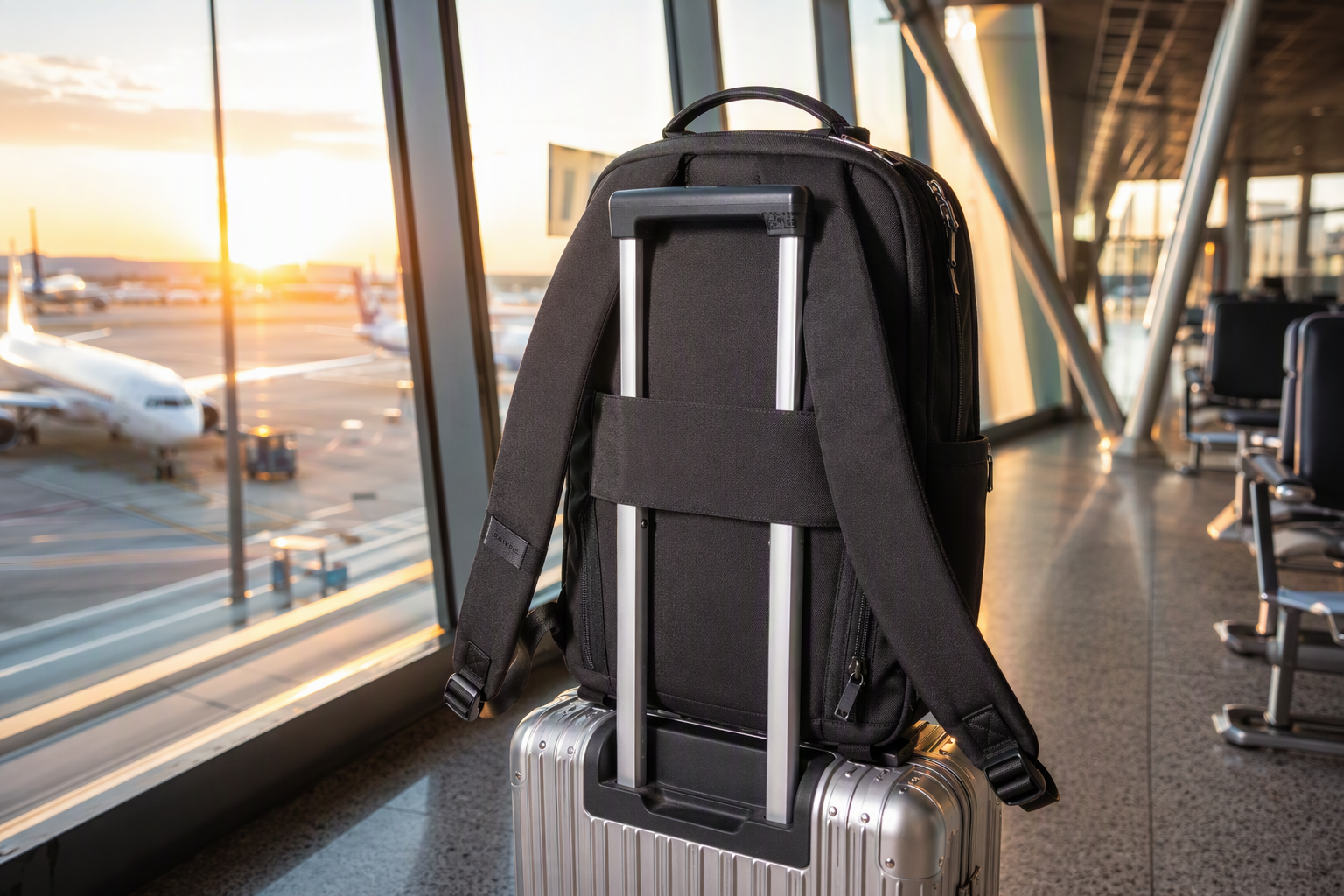
A US importer sent us two versions of the same 25L laptop backpack last spring, identical except for one detail: a rear trolley sleeve. The corporate gifting buyer took the sleeve version at 3,000 units. A marketplace listing aimed at students sold the plain version better. Same shell, same padding, different result. That is the honest answer to the trolley sleeve question. The cost is small and knowable. The payoff depends entirely on who is carrying the bag and how they travel.
What a Trolley Sleeve Costs on a 25L Laptop Backpack
At 1,000 units, a basic single-layer 600D Oxford sleeve with a 40mm elastic top band adds about USD 0.35 to 0.55 per unit. A structured version with 210D taffeta lining, two 25mm webbing reinforcement straps and a covered zipper closure runs USD 0.80 to 1.20. On a 25L backpack sitting at USD 9.40 FOB, that is 4 to 12 percent of the unit price for a feature that is invisible from the front of the bag. Labor is the smaller part of that number. The cost driver is pattern work, an extra cutting pass on the rear panel, and one more stitching operation on the assembly line.
At Tianqin we quote trolley sleeves as a separate line item instead of folding the cost into the base FOB, because buyers negotiate on FOB and want to see what each feature consumes. It also makes the trade-off visible: remove the sleeve and you recover roughly USD 0.90 per unit at 1,000 pieces, which is enough to move a fabric spec one grade higher.
A second cost rarely appears in quotes. A padded sleeve adds 60 to 90 grams and about 3mm of rear-panel depth. Across a 1,000-unit run that is 60 to 90 kg of extra freight weight, and the depth change can shift carton fill from 40 pieces to 38 depending on packing style. On a full container that difference is real money, and it never shows up in the sleeve price.
Which Buyer Segments Actually Use It
The first question most buyers ask us is not how much the sleeve costs but whether their end customer will ever touch it. Segment behavior answers that better than any feature list.
Corporate gifting and uniform programs show the highest usage. The end user travels with a carry-on, the backpack rides on the handle, and the sleeve does its job on most trips. Bags in this channel are often given to sales teams and field engineers who fly monthly.
Travel-adjacent retail converts too, meaning the channel that already sells packing cubes, luggage tags and carry-on accessories. Here the sleeve reinforces a message the listing is already making.
Student and campus listings behave differently. The buyer carries the bag from a dorm to a lecture hall, and a trolley sleeve is a feature they read about but do not use. Conversion data in that channel barely moves.
Commuter and cycling lines are the weakest fit, near zero in our experience. A sleeve adds bulk where a reflective loop or a light mount would earn more attention.
There is a second axis: the type of trade buyer, not the end user. Distributors selling into mixed retail assortments usually take the sleeve because one SKU has to serve several account types, and the sleeve widens the appeal at almost no cost. A private-label brand with a tight positioning often refuses it, because a travel feature dilutes a work-focused story. Both decisions are rational. The mistake is ordering the sleeve by default and then wondering why the brand page feels unfocused.
Geography matters less than buyers assume. We ship to more than 50 countries from Quanzhou, and sleeve adoption tracks channel far more closely than country. An urban commuter brand in Germany and a campus brand in the US behave more like each other than two travel brands in the same country.
What Reorder Data Says About Conversion
A trolley sleeve sits on the rear panel, so it almost never appears in the main listing image. That limits its effect on click-through rate, and any supplier claiming a large click lift from a rear feature is stretching the numbers.
Where we see measurable movement is in travel-oriented listings. On one program, adding a sleeve to an otherwise identical 25L bag coincided with a 2 to 4 percent conversion lift over the following quarter. That is worth having, but it is not a feature you build a listing around.
In general-purpose laptop backpack listings the lift is closer to zero. The sleeve functions as a review-quality detail rather than a purchase trigger: it appears in five-star text, not in the thumb.
Review content is where the feature earns its keep over time. On one 3,000-unit program the sleeve appeared in 12 percent of written reviews and in none of the negative ones. That is a modest but durable signal, and it supports the listing long after the launch promotion ends.
Where the Sleeve Helps and Where It Hurts Returns
Specification failure is the main risk. Sleeve openings narrower than 180mm will not clear many telescopic handles, and the complaint that follows becomes a return the buyer cannot argue against. Our standard opening is 200 to 220mm wide with a 30mm elastic return, positioned 380mm down from the top edge so the bag sits level against the case.
Construction matters as much as size. When a sleeve is sewn as a flat unlined panel, repeated use stretches the seam line and the panel sags. We use a doubled stitch line with a bound edge and a light interlining, which holds shape after the bag is loaded with 8kg of contents.
Here is the limitation, and it is a genuine one. We cannot build a universal sleeve. Trolley handle spacing varies between luggage brands, and a sleeve wide enough for the widest handle looks oversized on a slim commuter bag. Choose which end of that range your channel sits on, and accept that some customers will still find a poor match.
Checklist: Specifying a Trolley Sleeve That Sells
Confirm the channel uses carry-on luggage before adding the feature
Set opening width between 200mm and 220mm as the default
Add a 30mm elastic return band to hold the bag against the handle
Position the sleeve 380mm down from the top edge for level hanging
Specify doubled stitching and a bound edge, not a flat sewn panel
Use 210D taffeta lining on the inward face to reduce friction wear
Keep the sleeve unzipped unless the bag already carries a security story
Confirm the sleeve does not block a luggage pass-through claim on the label
Add 60 to 90 grams to the quoted unit weight and update freight math
Recheck carton fill after the depth change, not before
Ask for a physical handle-fit sample, not a render
Quote the sleeve as its own line so the buyer can remove it in negotiation
Next Step For Your Next Production Run
Test the feature instead of debating it. Order two 25L samples from the same pattern, one with the sleeve and one without, and put both in front of the channel that actually buys. Bring the luggage you expect your customer to own and try the bag on a real telescopic handle, because a render will not reveal a sagging panel. Sampling runs 7-15 business days at our Quanzhou factory, and a physical handle-fit check costs less than a wrong full run.
If the sleeve stays, lock the specification before bulk tooling: opening width, elastic tension, stitching pattern and weight addition. If it goes, redirect that USD 0.90 per unit into a shell upgrade or a better foam spec where the customer will feel the difference on day one.
Send your target channel, target FOB and a reference bag to [email protected], or review our OEM and ODM capability at www.tianqinbag.com. Sample turnaround is 7-15 business days, and we can quote a sleeve and no-sleeve version of the same pattern so your buying team can compare real numbers.


 Hot News


