EN



Two quotes land on the same desk for the same 22 litre laptop backpack. One is 17.90 USD, the other 18.65 USD. The difference sits mostly in one line: a 9,000 stitch embroidered logo against a heat transfer patch. Both suppliers are telling the truth, and neither has explained what the buyer is actually choosing.
The Four Methods and Where Each One Fits
Four application methods cover nearly every laptop backpack program we run at Quanzhou Tianqin Bags Co., Ltd: embroidery, silicone patch, heat transfer, and metal plate.
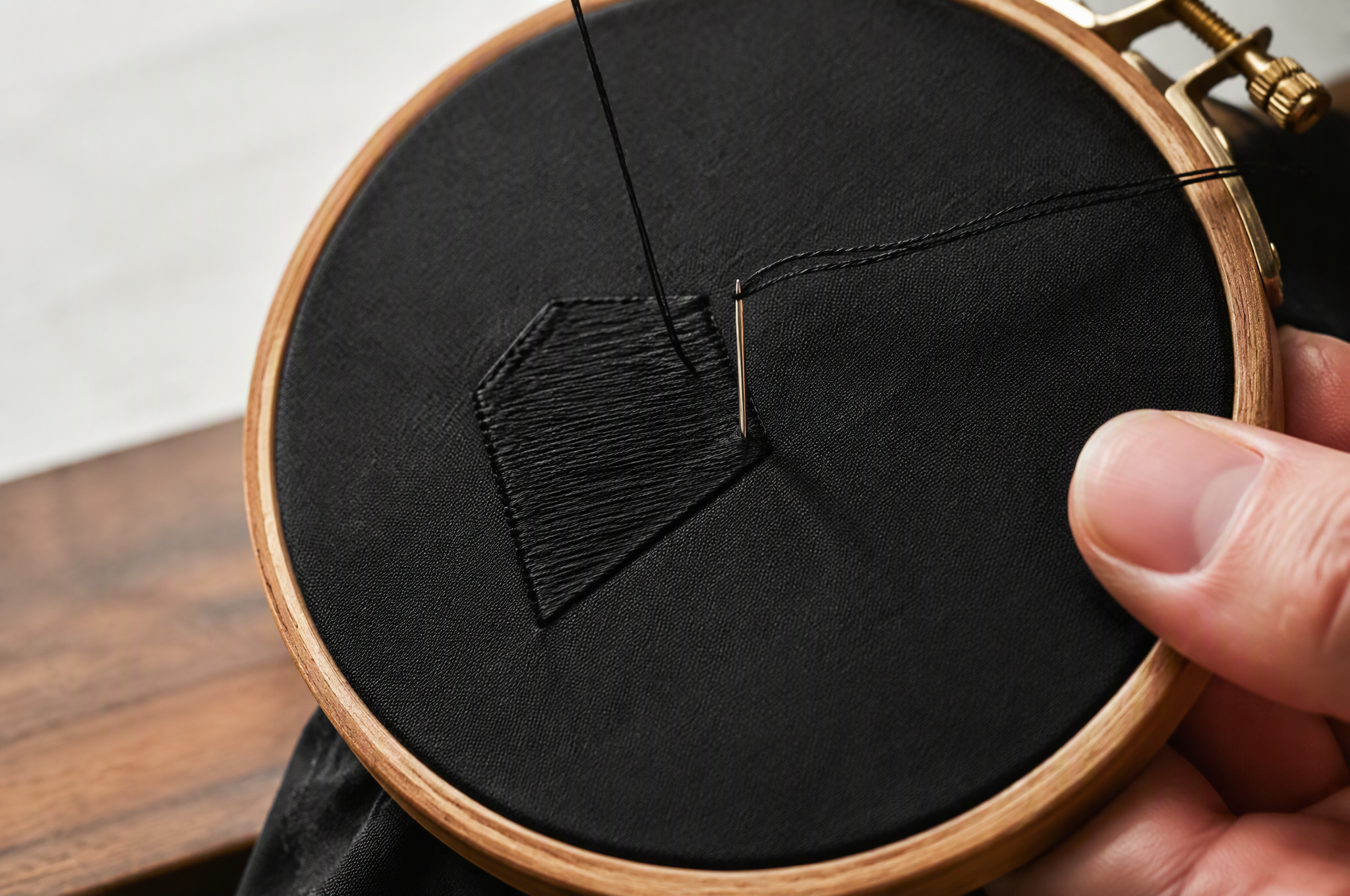
Embroidery is thread on fabric. It suits 600D Oxford polyester and 1680D ballistic nylon, handles multi-colour logos through thread changes, and reads as a value signal on business and campus bags. It sits slightly proud of the surface, which matters on a front panel that may be printed or debossed nearby.
Silicone is a moulded patch, usually 1.5 to 2.5 mm thick, applied by high-frequency welding or stitching. It gives a clean graphic edge, works for brand marks with simple silhouettes, and is the current default for tech and lifestyle positioning. It requires a mould, so it is a volume decision.
Heat transfer is a printed film pressed onto the shell. It is the cheapest route per unit, allows fine detail and gradients, and needs a flat, smooth, non-coated surface to bond reliably. On textured 1680D with a water repellent finish, adhesion becomes a genuine problem, and we usually steer buyers away from it on the main shell.
Metal plate means a zinc alloy badge, riveted or screwed through a reinforced panel. It carries the strongest premium signal and the highest tooling cost, and it adds 8 to 15 grams per bag plus a hard point that can catch on shelving.
Cost per Unit at Different Order Volumes
Logo cost is not a single number, and the tooling line is where quotes diverge most.
On a 1,000 unit order, a 9,000 stitch embroidery logo runs roughly 0.35 to 0.55 USD per bag including setup amortisation, depending on thread colours. Each additional colour adds a thread change and a small per-unit increment. A silicone patch with a 350 to 600 USD mould typically lands at 0.45 to 0.80 USD per unit at 1,000 pieces and improves to 0.35 USD at 5,000.
Heat transfer sits lowest, commonly 0.12 to 0.30 USD per unit, with artwork and plate setup in the 60 to 150 USD range. That low entry point is why it wins promotional programs with short lead times.
A metal plate carries a die cost of roughly 400 to 800 USD, then 0.25 to 0.60 USD per piece for the badge plus attachment labour. Below 500 units the die dominates the maths and the logo can easily add 1.50 USD per bag.
Reorders change the picture. Tooling, including embroidery programme files, silicone moulds, heat transfer plates, and metal dies, is normally held and reused, so the second order prices at the per-unit rate plus material movement only. Ask in writing who holds the tooling and whether it transfers if you move suppliers.
Durability: What Fails First on Each Method
Every method has a characteristic failure, and buyers do better choosing the failure they can live with than hunting for one with none.
Embroidery fails by abrasion and snagging. Thread fuzzes where a strap or a trolley handle rubs it, and loose thread ends appear after repeated contact with a laptop sleeve edge. A tight satin stitch with a 40 weight polyester thread holds up well; a loose stitch on a coarse weave does not.
Silicone fails at the bond line. If the patch is stitched as well as welded, it survives. If it relies on adhesive alone, edges lift after 30 wash cycles or a season of flexing at a pocket mouth. We specify a stitched perimeter on any silicone patch above 40 mm wide.
Heat transfer fails by cracking. Film applied at the wrong temperature or pressure delaminates along the edges, and low temperature exposure, which is normal on a winter commute, makes a stretched film brittle. On stretch panels the film cracks along the stretch line within weeks.
Metal plate fails by the attachment, not the badge. A rivet pulled through thin shell fabric leaves a hole, and a screw loosened by vibration falls out. We use a 1.5 mm HDPE backing sheet behind every metal plate and specify two rivets minimum on plates over 30 mm.
Numbers help here. Our engineers run a 500 cycle abrasion test on the logo area of any new development before we standardise a method, and we wash test decorated samples for 30 cycles at 30 degrees. When a method fails either, we change the method rather than the test.
How Logo Choice Moves MOQ and Lead Time
Logo method can raise a program's real minimum order more than any other single design decision.
Embroidery: no tooling MOQ, but each additional thread colour adds setup time; viable from 100 units
Heat transfer: lowest MOQ, workable from 100 to 300 units, but plate setup adds 5 to 7 days
Silicone: mould cost pushes practical MOQ to 500 units, mould production adds 7 to 10 days
Metal plate: die cost pushes practical MOQ to 1,000 units, die lead time 10 to 15 days
Lead time effects compound. A silicone mould made after artwork approval adds a week before sampling even starts, so a buyer planning a 7 to 15 working day sample window on a silicone patch should approve the artwork first and treat the mould as a parallel task.
Our moulds and dies are stored with the buyer's item code, and we photograph the mould cavity before storage, because a worn cavity produces flash on the patch edge that nobody notices until the third order.
Matching the Method to Fabric and Brand Tier
Fabric decides more than brand preference does, and this is where we push back on buyers most often.
On 1680D ballistic nylon, embroidery and silicone both work. Heat transfer works poorly because the weave texture prevents full contact, and no press operator can fix that with pressure alone. On 600D Oxford with a light PU coat, all four work, and heat transfer is genuinely viable. On stretch mesh or a softshell front panel, only a stitched patch or embroidery holds.
Brand tier sets expectation. A business bag at 45 to 70 USD retail usually carries a small embroidered or debossed mark, 30 to 45 mm wide, on the front panel. A tech lifestyle bag at 90 to 140 USD retail expects silicone or a metal plate, often with a tonal treatment. A corporate gifting order at 25 USD usually takes heat transfer or a single-colour embroidery, because the budget is per unit and the volume is fixed.
There is one limitation we state directly. No method gives a photographic, full-colour logo on textured 1680D that survives five years of daily abrasion. Buyers who need photographic detail should move the mark to a smooth panel, use a woven label inside a seam, or accept a shorter decoration life. We will say which of those we recommend rather than accept an order we know will come back as a complaint.
The first question most buyers ask us is why two suppliers quoted a 0.60 USD gap on the same logo. Usually it is stitch count, thread type, patch thickness, or whether the tooling was amortised. Ask for the specification behind the line, not just the number.
Send the Artwork and Get a Method Recommendation
Send the vector logo file, the target retail price band, your annual volume, and the fabric you have chosen. We will come back with a method recommendation, a per-unit cost at your volume, tooling cost, and the durability data behind the choice.
Artwork review takes 1 to 2 working days, quotes 2 to 3 working days, and samples 7 to 15 working days from approved artwork and files.
Contact [email protected] or visit www.tianqinbag.com to start the review, request a factory quote, or open an OEM/ODM laptop backpack project. Our team will tell you which logo method fits your fabric and price band before you commit to a mould.
 Hot News