
 EN



A buyer approves the second sample in a single email that reads "looks good, proceed". Nine weeks later the bulk cartons arrive with a shoulder strap that sits 15 mm wider than intended and a laptop sleeve that grips a 14-inch machine too tightly. The reply to the claim is a copy of the same email. Approving a photo is not a gate, and this is where most development schedules go wrong.
Round One: 3D and Rendering, and What It Cannot Tell You
A 3D build is where we start at Quanzhou Tianqin Bags Co., Ltd, and it takes 3 to 5 working days from a complete tech pack. Our designers model the panels at true scale, apply fabric texture and colour, and produce renders from six angles plus one on-body view.
What it resolves well: proportion, panel balance, logo scale relative to the front panel, pocket placement, colourway direction. We often render 5 to 8 colourways in one pass so a buyer can kill two of them before anyone cuts fabric.
What it cannot resolve is worth saying clearly. A render cannot show fabric hand-feel, stitch quality, seam bulk, hardware weight, or how a 12 kg load deforms a back panel. Buyers who treat a 3D approval as a design approval arrive at the first physical sample expecting a confirmation and instead get a list of problems.
We therefore use 3D as a filter, not a gate. It removes the ideas that will not survive a pattern, and it lets a buyer settle colourway and logo scale cheaply. It should not be signed off as a sample.
Round Two: The First Physical Sample
The first physical sample runs 7 to 15 working days from approved files. Our sample room cuts from available stock fabric, which may be a close substitute if the specified shell has a 30 day mill lead time, and this is stated on the sample tag.
This round has one job: prove the structure. Laptop sleeve internal dimensions against the real device, base depth against a packed load, gusset behaviour at full expansion, strap anchor position against a torso, and handle drop against a gloved hand. We measure every critical dimension against the tech pack and record the delta.
Most structural problems appear here, and most are cheap to fix. A sleeve that is 6 mm tight is a pattern adjustment. A gusset that gaps at the base under load is a seam allowance and reinforcement change. A strap that cuts into the neck at 40 mm width is a geometry change, not a padding change.
What buyers should not do at this round is comment on colour. Stock fabric is a placeholder, and colour approvals belong with lab dips running in parallel, not with a photo of a sample room cut.
Sample cost per round is small against the cost of the loop it prevents. A typical sample set from our sample room runs 80 to 250 USD depending on shell fabric and logo method, and it absorbs 6 to 10 machine hours across pattern, cutting, sewing, and finishing. Buyers who negotiate the sample fee to zero often pay for it later, in a second attempt nobody budgets for.
Round Three: The Revision Sample and the Wear Test
Revision rounds run 5 to 10 working days, and their job is to close the comment sheet, not to redesign the bag. We ask for one consolidated comment sheet per round, with each point numbered against a photo, and we reply to each point in writing with either a change or a reason.
Two elements belong in this round and are often skipped. The first is hardware iteration: a buckle that releases too easily under a 9 kg load, or a zipper pull that is too small for a gloved hand, only shows up when someone carries the bag for a week. The second is a wear test. We run a 30 day field test with 8 to 12 internal staff, logging abrasion points, strap slip, and access friction, and we photograph the bag at day one and day thirty.
Field data changes design decisions more often than drawings do. One program moved its water bottle pocket 20 mm higher after three testers reported the bottle contacting the hip on stairs, and another changed the laptop sleeve opening angle after nine of twelve testers pulled the device out at an angle rather than straight.
Record what testers carried, not only what they thought. Two of our programs changed sleeve depth after testers logged the same 14-inch laptop plus charger bundle, and one program found that a 30 litre design was being carried at roughly half load, which told the buyer the real demand sat at 22 litres.
A limitation is worth naming. Internal wear testers are not your customers. They do not carry your load mix, and 30 days does not simulate three years of daily commuting. The test catches obvious failures early, and it does not replace a warranty reserve.
Round Four: The Golden Sample and the Sealed Reference
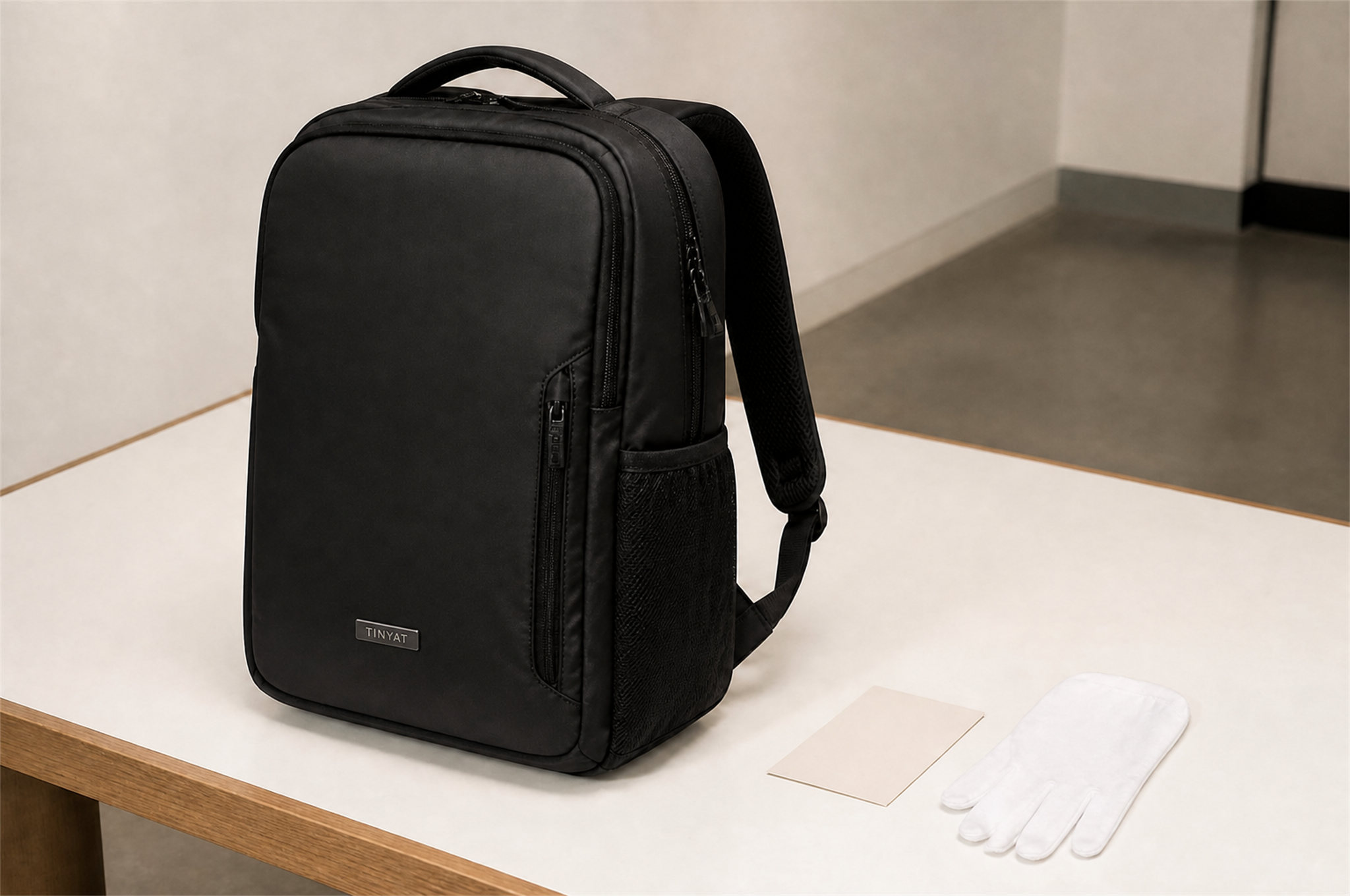
The golden sample is the physical contract. It must be built from production materials, at production settings, with the final logo application method, the final lining, and the final packaging if packaging affects fit.
We photograph the golden sample on a numbered grid with a scale bar, record all critical dimensions on a signed sheet, and seal two pieces: one stays in our sample library in Quanzhou, one ships to the buyer. Neither is opened for inspection purposes; a separate reference piece is kept for that.
Labels belong in this round too. Care content, origin marking, and the hangtag attachment point are checked on the golden piece, because a missing care label found at packing adds a rework pass across the entire order, and that pass costs more than every sample in the program.
Our sample library holds more than 300 reference pieces across programs, indexed by item code and season, because the most common dispute five seasons in is what a bag used to look like.
One honest caveat about the golden sample. A piece made in a sample room can still differ from bulk, because sample room machines are set up for single pieces and production lines are set up for hundreds. We therefore require the golden sample to be run at production settings, and we inspect the first 50 pieces off the bulk line against it before the line runs free. Buyers who skip that first-50 check lose the only comparison point that matters.
Common Rework Loops and How to Break Them
The same four loops repeat across programs, and each is broken by a written gate rather than more samples.
Verbal or emailed approval with no numbered comments, so the next round fixes the wrong things
Colour approved from a screen or a JPEG, producing a bulk lot that satisfies nobody
Golden sample built from sample room remnants, so bulk material behaviour is untested
Artwork changed after a mould or die is cut, restarting a 10 to 15 day tooling task
Comments from three stakeholders, unconsolidated and partly contradictory
Changes made after the golden sample without a change order, so the reference no longer matches bulk
The fix is procedural and cheap. One comment sheet per round, one owner on the buyer side, three working days to comment, and a written sign-off that names the round. In our experience that cuts one full sample round from a typical development, which is 7 to 15 working days returned to the calendar.
Set the Approval Gates Before Round One
Development timelines are set by the number of gates, not by the factory's machine speed. A four round program with clean approvals takes about 20 to 25 working days of factory time. The same program with two loops takes six weeks and often ships late.
Send your tech pack, reference sample, and target retail price, and we will map the rounds, tell you which decisions must be made at each gate, and flag the items that will add tooling time. Quotes come back in 2 to 3 working days and first samples in 7 to 15 working days from approved files.
Contact [email protected] or visit www.tianqinbag.com to schedule a development slot, request a factory quote, or open an OEM/ODM laptop backpack project. We will send the gate checklist before the first 3D file so your team knows what it is approving.
 Hot News


