EN



Two bulk cartons of the same navy sit side by side on a distributor's dock in Rotterdam. One reads blue-black under the warehouse lights, the other reads slightly purple. Same Pantone reference, same factory, two dye lots six weeks apart. The distributor photographs both and asks for a credit, and the buyer discovers that the approval was made on a monitor in February.
Why a Pantone Number Does Not Guarantee a Match
Pantone is a reference, not a recipe. The same TCX reference reads differently on 1680D ballistic nylon, on 600D Oxford polyester, and on a PU-coated shell, because the surface texture and the coating change how light leaves the fabric.
Glossier surfaces reflect more directly, so a coated navy looks darker and richer than an uncoated one under the same lamp. Textured 1680D scatters light and reads lighter, sometimes by half a shade. Our dye house can get close, but "close" is a number, and buyers who treat a Pantone code as an exact instruction will be disappointed at first bulk.
At Quanzhou Tianqin Bags Co., Ltd, we ask for two things at the start of any colour program: the Pantone reference written as TCX for textiles, and the exact fabric and finish it will be applied to. A reference approved for cotton canvas does not carry over to a water repellent PU-coated polyester without a new dip.
Water repellent finishes add their own shift. A C6 or C0 finish on a mid-tone fabric typically darkens the face by 3 to 5 percent, and it does so after dyeing, so a dip approved without the finish will not match the bulk that has it.
Lab Dips: What to Ask For and What to Reject
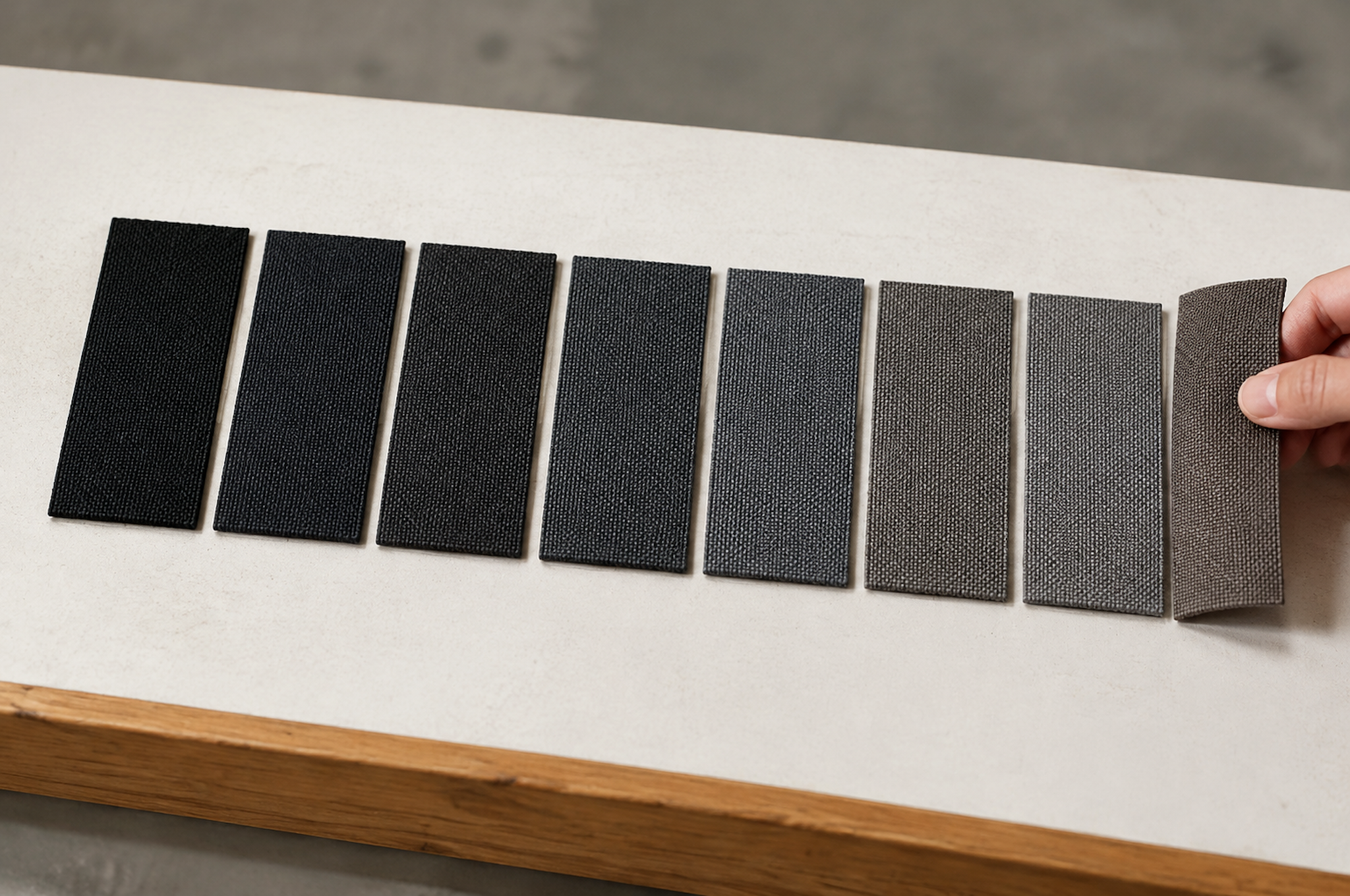
A lab dip is a small piece of the actual fabric, dyed to the target reference by the mill. Ask for three per colour, not one: one at the target, one slightly lighter, one slightly darker. Most mill dye houses will produce that set within 5 to 7 working days, and it lets a buyer choose a direction instead of accepting or rejecting a single attempt.
What a dip must show is often missed. It has to be on the same base fabric, at the same weight, with the same finish as production. A dip on 210D lining presented as a match for a 600D shell is a different question entirely, and it is a common shortcut when a mill wants to save a setup.
Reject a dip if the fabric base is wrong, if the finish is missing, if it arrives as a printed colour chip rather than dyed cloth, or if it comes without a measurement. We ask our mills for a spectrophotometer reading on every dip, with the value recorded, because the eye and the instrument disagree often enough that both are useful.
Physical standards matter more than files. We keep a sealed standard card for each approved colour and hold it for 24 months, because a bulk shipment 18 months into a program has to be judged against something that has not faded in a drawer. Buyers should keep a sealed duplicate.
Light Sources: One Dip, Three Colors
Colour approval depends on the light, and most approvals happen in the worst possible light, which is a meeting room or a laptop screen.
The same navy dip can look correct under D65 daylight, slightly green under TL84, the lamp family common in European retail, and noticeably warmer under incandescent store lighting. That behaviour is metamerism, and it shows up when two colourants match under one source and diverge under another. A buyer who approves under a phone photo and then judges bulk under store lighting is testing two different questions.
Our standard practice is to view dips at 45 degrees on a matte grey card, under D65 and again under a warm source, and to note both readings on the approval sheet. When a colour is critical, such as a black shell that must match a black webbing exactly, we approve the pair together in the same lighting condition, since black-on-black mismatch is the most common visible complaint at retail.
Screen approval is the failure we see most often. Monitors are uncalibrated, phone cameras apply automatic white balance, and a JPEG of a dip loses the surface sheen entirely. Send a physical dip by courier, it costs less than a single air freight correction.
Batch Variation and the Tolerance You Can Sign
Dye lots vary. That is a fact of the process, not a supplier excuse, and the useful question is how much variation the buyer is willing to accept in writing.
We work to a tolerance of Delta E 1.0 or better on critical exterior panels, and up to Delta E 1.5 on lining, webbing, and binding where the material sits inside the bag or in small areas. Delta E is a calculated difference between the sample and the standard, where roughly 1.0 is at the edge of what a trained eye catches in a side-by-side comparison.
Between lots, we allow 1.5 on exterior panels and require the two lots to be compared against the sealed standard, not against each other. Two lots compared directly can look different while both sit inside tolerance, and that argument is impossible to win without the standard.
For programs above roughly 3,000 units in one colour, ask the mill to dye in a single lot and reserve the balance. It costs a little more per metre and removes the two-lot risk entirely.
One hard limit is worth stating. On textured 1680D nylon we cannot deliver a zero-difference match to a Pantone chip, and neither can any mill working with a coated, textured substrate. We can deliver Delta E 1.0 and a signed standard. A buyer who needs an absolute guarantee on a fabric colour is asking for something the process does not offer, and the honest answer is to pick a colour with more tolerance headroom, such as charcoal or black, rather than a saturated mid-tone.
What to Write Into the Color Specification
A colour spec is one page and it prevents most disputes. Include the following.
Pantone TCX reference and the name used internally by the brand
Base fabric: construction, denier, weight in g per square metre
Finish: water repellent type, calendering, or coating, stated explicitly
Approved lab dip number and its Delta E reading
Tolerance for exterior panels, stated as a Delta E limit
Tolerance for lining, webbing, and trim, stated separately
Light sources for approval, named, not described as "daylight"
Whether the colour must match an existing component such as a zipper tape or logo
Sealed standard location and the name of the person holding it
Reorder rule: compare to standard, never to the previous lot
Lab dip turnaround expectation, in working days
Who may approve, by name or role, so verbal approvals cannot occur
Approve the Dip Under the Right Light
The first question most buyers ask us is whether their Pantone will be achievable on the fabric they have chosen. Usually it is, with a tolerance agreed before the dip is made rather than after bulk arrives.
Send the Pantone references, the fabric choice, and any existing trim you need to match, and we will order lab dips and report the readings before sampling starts. Lab dips take 5 to 7 working days, samples run 7 to 15 working days from approved files, and quotes come back in 2 to 3 working days.
Contact [email protected] or visit www.tianqinbag.com to request dips, get a factory quote, or start an OEM/ODM laptop backpack program. We will tell you which of your colourways are realistic on the fabric and which ones should be adjusted before the first cut.


 Hot News