
 EN



A buyer signs off on a bulk price of 18.40 USD and nothing on the drawing changes. Four months later the same bag quotes at 19.15 USD. No one raised labour, no one moved the FOB terms, and the factory is not being greedy. Three component lines had been swapped to keep a delivery date, and the swaps had never been written into the BOM the buyer was holding.
What a Laptop Backpack BOM Has to Carry
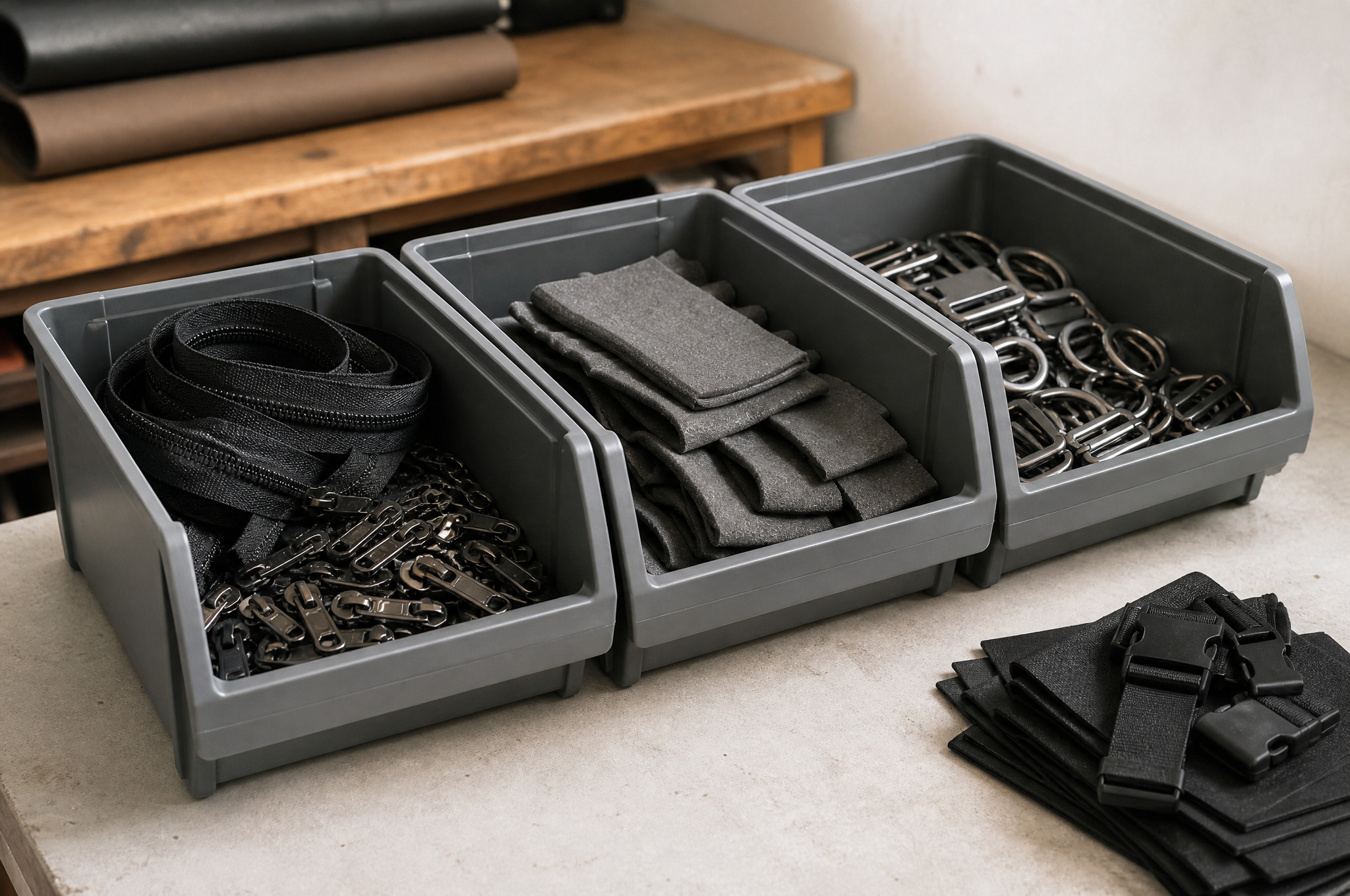
A production laptop backpack typically runs 60 to 90 BOM lines. Buyers who come from apparel expect 12. Ours include every shell panel, lining, foam sheet, board, webbing, binding tape, zipper chain, slider, pull, buckle, D-ring, mesh, elastic, thread, label, hangtag, polybag, and carton.
At Quanzhou Tianqin Bags Co., Ltd, each line carries seven fields: item code, description, full spec, approved supplier, consumption per bag, wastage allowance, and unit cost. Drop any one field and the line stops being a purchasing instruction and becomes a description.
Consumption per bag is the field buyers underestimate. A 22 litre laptop backpack uses roughly 0.55 to 0.70 metres of 1680D ballistic nylon across front, gusset, and base, before wastage. We write wastage separately, at 5 to 8 percent for cut panels and 12 percent for directional fabrics where a pattern cannot be nested freely. When those two numbers are merged into one line item, nobody can tell whether a price rise came from consumption or from a fabric price change.
Specification depth separates a working BOM from a wish list. "YKK #8 coil zipper, black, auto-lock slider, reverse pull" can be bought. "YKK zipper" cannot, because the size, slider type, and tape colour are three separate cost and function decisions.
Version Control: The Boring Discipline That Prevents Silent Changes
Every BOM gets a revision letter, and every revision gets a date, a reason, and a name. That is the whole system. It works because we treat the BOM as frozen at golden sample approval, and no line moves afterwards without a written change order that states the cost effect per unit.
Our standard change order is one page: line affected, old spec, new spec, reason, cost delta per unit, effect on lead time, effect on any test report already issued. It needs three signatures, buyer, our merchandiser, and our purchasing lead. Two signatures means the change does not happen, even when the material is already on the floor.
The failure mode this prevents is unglamorous. A lining runs short at the cutting table because a previous order over-consumed. Someone substitutes 190T polyester for the specified 210D. The bag still looks correct, the weight changes by 8 grams, and the abrasion result on the lining drops. Nothing reaches the buyer because on paper nothing changed.
Reorders are where version control pays. Our clients who reorder a 20 litre commuter model every quarter often run three purchase orders against one BOM. If the BOM has three revisions and the purchase order does not cite which one, the bulk can legally and reasonably differ from the sample.
Approved Substitutions and How to Word Them
"Equivalent or better" is the most expensive sentence in bag sourcing. It has no measurable meaning, and it hands the substitution decision to whoever is under the most delivery pressure that week.
We ask buyers to write substitutions as a named list instead. For each critical component, the BOM carries a primary and up to two pre-approved alternates with their own item codes and their own test history. If the primary is unavailable, the line uses alternate one, and the buyer gets a notice the same day, not at shipment.
What counts as critical is worth agreeing on early. On our programs the list is short: shell fabric, lining, foam density, zipper brand and size, strap webbing, and any metal hardware that touches skin or rain. A pull style change is not critical. A webbing change from nylon to polypropylene is, because it alters stretch under load and the strap tensile result.
Substitution approval should also carry a test trigger. Any alternates for metal hardware need a 48 hour salt spray result before use. Any alternates for shell or lining fabric need a crocking result, since a dark 1680D against a light lining is the classic source of a grey smudge complaint after two weeks of use.
There is a real constraint here and we say it to buyers plainly. We cannot promise that a specific dye lot of coloured webbing, or a specific Pantone-matched pull, stays available across a 12 month program. Suppliers discontinue colours, and MOQs on custom webbing can sit at 500 metres for a shade we need 60 metres of. That is why the approved alternate list exists rather than a promise of perpetual availability.
How Cost Drift Happens Without Anyone Noticing
Cost drift is almost never one large decision. It arrives as five small ones, each of which looks sensible in isolation.
Lining moved from 210D to 190T, saving around 0.02 USD per bag
Foam on the back panel dropped from 8 mm to 6 mm at 30 kg per cubic metre, saving 0.05 USD
Zipper pull changed from a metal alloy pull to a moulded one, saving 0.03 USD
Webbing changed from nylon to polypropylene, saving 0.04 USD
Binding tape width reduced by 2 mm, saving 0.01 USD
Each line is defensible. Together they shift 0.15 USD per bag, and on 3,000 units they fund the difference in a price negotiation that otherwise looked impossible. The buyer sees a bag that still fits a 15-inch laptop and still looks right in a photo, and a returned-goods rate that climbs by half a percent three months later.
The reverse also happens. Cotton canvas prices move with the crop, and a 600D polyester quote from January can be 4 to 7 percent different by August. When the BOM shows fabric cost per metre rather than per bag, the buyer can see immediately whether a price increase request is a market movement or a margin grab.
The first question most buyers ask us when a reorder price comes in higher is which component moved. With a maintained BOM, that answer takes ten minutes and comes with the supplier quote behind it. Without one, the answer is a paragraph of general explanation, which is worth nothing in a negotiation.
A BOM Review Checklist for Buyers
Run this against the file before you approve a golden sample. It is short enough to do in one sitting.
Revision letter and date on the BOM header, matching the tech pack revision
Consumption per bag stated in metres, grams, or pieces, not as a lump material cost
Wastage allowance stated separately, with directional fabric flagged
Every line with an item code that purchasing can actually order against
Zipper lines split by size, slider type, and tape colour
Foam and board lines showing density and thickness, not only thickness
Thread specification with ticket number and fibre
Label, care label, and hangtag content listed with placement
Carton and polybag lines including carton dimensions and mark
Primary and at least one approved alternate for each critical component
Test trigger noted for each alternate, such as salt spray hours or crocking grade
Change order template attached, with signature blocks
Unit cost per line, so drift can be traced to a component
Total BOM cost reconciled against the quoted FOB before approval
Lock the BOM Before the Purchase Order
A locked BOM is the cheapest insurance in a bag program. It costs a buyer a few hours at golden sample stage and saves the argument that starts when a bulk shipment weighs 40 grams less than the approved piece.
Send your BOM, or ask us to build one from your tech pack and approved sample. Our merchandising team issues a full BOM with consumption, wastage, and component cost before the first bulk order, and we quote in 2 to 3 working days. Samples run 7 to 15 working days from approved files.
Contact [email protected] or visit www.tianqinbag.com to request a BOM template, get a factory quote, or open an OEM/ODM laptop backpack project. We will show you exactly which lines carry the cost and which ones carry the risk.
 Hot News


