EN



A buyer in Rotterdam asked for one number: how many times the main zipper opens before it fails. We sent the report, and his follow-up was sharper than the first request - failed how, exactly. That is the question most zipper data cannot answer. A cycle count without a written failure definition is a sales figure, not a test result. What follows is how the test runs on our line, where the numbers come from, and what to demand in a report before you approve a bulk order.
What a Cycle Test Actually Counts
A machine grips the slider pull and runs it from one end stop to the other and back. One full open and close is one cycle. That sounds simple until two reports sit side by side with different machine speeds.
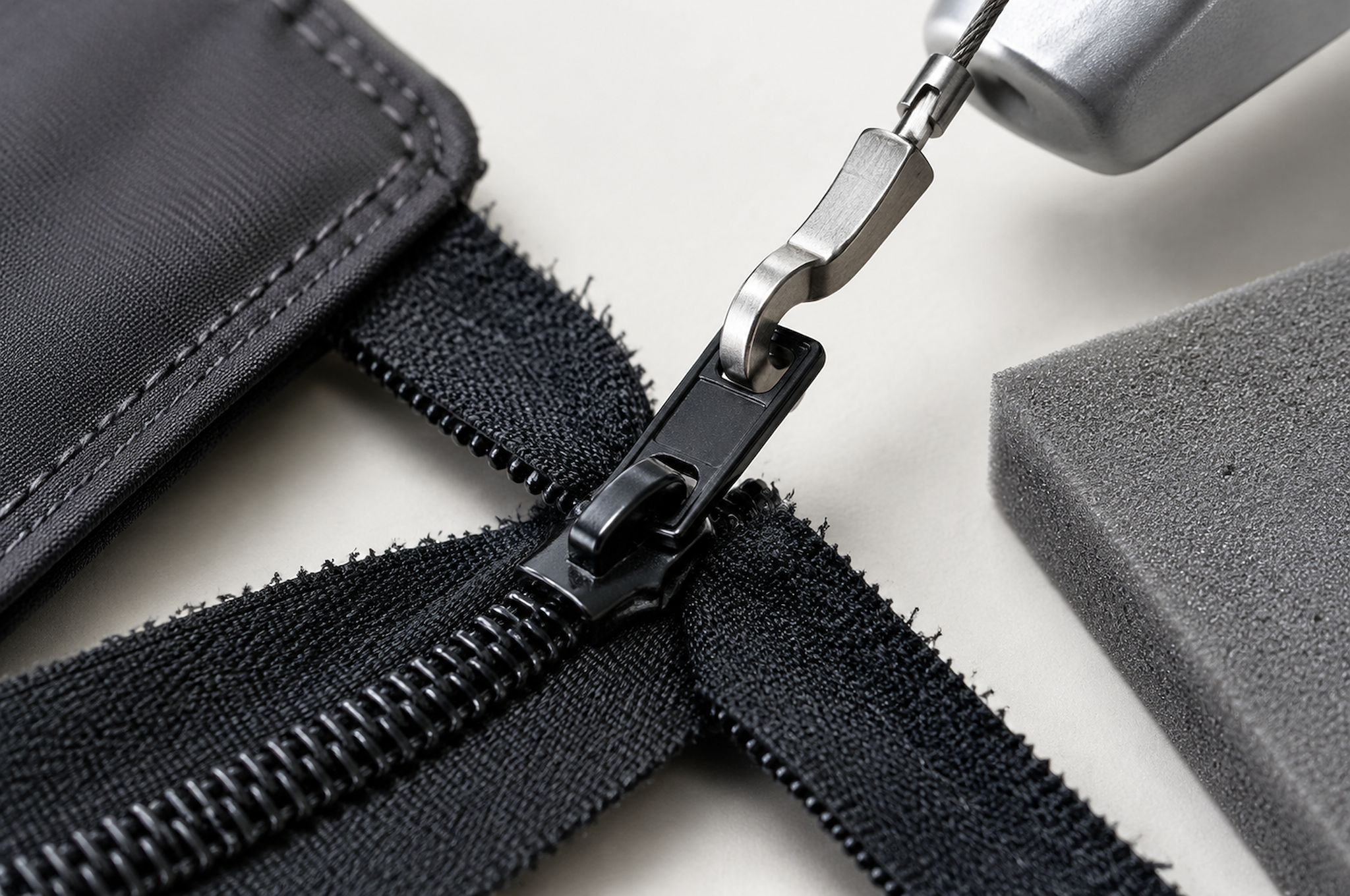
Speed changes the result. A slider run at 30 cycles per minute builds less heat and less tape stress than the same slider at 60. We run at 25 cycles per minute with a 500 g lateral load pulling the two tapes apart at roughly 90 degrees, which simulates a packed main compartment. That lateral load is the part most suppliers leave out, and it is the part that matters on a laptop backpack, because a loaded 20 L body pushes against the zipper along its whole length.
We test three specimen sets per style, six zippers per set, and we report the lowest result rather than the average. Averaging hides the single slider that quit at 3,000 cycles, and that slider is the one that becomes a customer complaint six months after the container lands.
Cycle Targets We Use by Zipper Position
A single target for the whole bag is a shortcut that costs money in the wrong place. Our gates, run on finished bags rather than loose tape:
Main compartment, YKK #8 or #10 coil: 8,000 target, 5,000 absolute minimum
Dedicated laptop compartment zipper: 6,000 target, 4,000 minimum
Front organizer pocket, #5 coil: 3,000 target, 2,000 minimum
Curved side water bottle pocket: 2,500 target, 1,500 minimum
Hidden back-panel or rain cover pocket: 1,500 target, 1,000 minimum
These gates sit above the retail chain specs we receive, most of which land between 2,000 and 3,000 cycles for a main zipper. A big-box program we ran in 2023 required 3,000 cycles on the main and 1,000 on pockets. We kept our internal gate at 8,000, because a zipper claim costs a retailer a full unit replacement plus the freight, while the zipper itself is a few cents of the bill of materials.
Metal and coil behave differently under the same test. A #10 metal zipper on a 1680D ballistic shell usually clears 10,000 cycles before measurable tooth wear. The same slider on a 600D Oxford body with a poorly aligned tape path can drop to 6,000, not because the zipper is worse, but because the seam that holds the tape is not straight.
Defining Failure Before Counting It
This is the section buyers should read twice. On our reports, a unit fails when any of the following occurs:
The slider skips a tooth twice within 100 consecutive cycles
The self-locking pull releases under 15 N of pull force, or the lock spring stops engaging
Two teeth separate under 20 N of lateral pull at any point along the closed chain
The tape tears, or the stitch line holding the tape to the body opens more than 10 mm
The slider body cracks, or the pull tab separates from the slider
Stroke force exceeds 40 N at any cycle after the 1,000th
We log stroke force every 500 cycles for that last item. A zipper that still opens but needs 55 N to move it has already failed in the customer's hand, even though a counter would mark it as a pass. Buyers who only count cycles buy zippers that are technically alive and functionally dead, and those are the ones that come back as "stiff from day one" reviews.
What a Credible Report Should Show
Use this as an inspection list on any test document, whether the supplier sends it or a third-party lab does:
Zipper brand and model number, with tape width in millimetres, not just a number sign and a digit
Machine make, stroke speed in cycles per minute, and the applied lateral load in grams or newtons
Specimen count, plus the lowest, average, and failed-at values for each position
A written pass and fail definition signed by the technician who ran the machine
Stroke force readings at fixed intervals across the run, not only a start and end value
Photographs of each failed specimen at the failure point, with the cycle count visible
Lab name, test date, and the referenced method, typically BS 3084 or an ASTM D2061 based procedure
Specimen conditioning, usually 24 hours at 23 degrees Celsius and 50 percent relative humidity
The conditioning line looks like paperwork. It is not. A nylon coil pulled straight out of a humid warehouse in June behaves differently from one rested for a day, and a lab that skips conditioning tends to skip the lateral load as well.
Where Cycle Numbers Stop Predicting Reality
Two limits need stating plainly. The first is dirt. A cycle machine runs a clean zipper, and field failure is usually a dirty one. Sand, dust, and food crumbs work into the coil and abrade the slider channel, and no machine we know of feeds grit into the track between strokes. Roughly 60 percent of the zippers returned to us under warranty show visible contamination in the channel, and those bags were not abused. They were set down on the ground by ordinary users.
The second is load. A cycle test at 5 kg internal load does not describe a bag stuffed to 12 kg with a 17-inch laptop, two chargers, and a bottle. For programs where returns are expensive, we add a 500-cycle screening variant with grit and a 9 kg load. We tell buyers that variant is a screen, not a certification, and we do not print it on a hangtag.
Age is the third gap. Tape stiffens, factory lubricant dries, and a 30-day accelerated run cannot reproduce two years of UV and temperature swings. A supplier who claims a cycle number proves long-term durability is overstating the evidence.
How Tianqin Handles the Zipper Question
We spec YKK coil and metal zippers as the default above 20 L, and we hold tape straightness to 1.5 mm over a 300 mm run, because a curved tape path is the most common reason a slider that should reach 8,000 cycles quits at 4,000. On a program that has to hit a lower FOB, the zipper is the last place we cut, and we put that commitment in the quotation rather than in conversation.
A US importer once told us his previous supplier sent a certificate showing 10,000 cycles and a photograph of a machine. He had no way to know whether a bag had been attached. He now asks for specimen photos and the failure definition, and two pages of that answer him faster than any certificate.
Fix the Zipper Specification Before Tooling
Send us your target cycle count, your bag volume, and your FOB band. We will tell you which zipper build clears the target, which position it belongs in, and what the change costs per unit at your order quantity. If a target is unrealistic for the price, you will hear that before sampling rather than after the first inspection.
Contact [email protected] or visit www.tianqinbag.com to request a zipper and cycle test report with your sample set, get a factory quote, or open an OEM/ODM project with Quanzhou Tianqin Bags Co., Ltd. Our sampling window runs 7-15 working days, and we send the test documentation with the sample rather than after approval. Seventeen years of bag production in Quanzhou, exports to more than 50 countries, and SGS reports available on request.

 Hot News