
 EN



A warranty claim from a German chain came with a photograph of a strap hanging off a 25 L backpack at the top attachment, webbing intact, stitching gone. The bag had carried a laptop and a lunch. This is the failure mode that tensile testing exists to prevent, and it is almost never the webbing that gives way. It is the joint. Here are the standards we test against, the forces we use, and why the difference between a bar-tack and a box-X decides whether your program survives year two.
What the Strap Joint Has to Survive
Three loads act on a shoulder strap, and only one of them is the weight of the bag.
The first is static load, the bag hanging from one strap while the user opens a door. The second is dynamic, the bounce of a loaded bag on a walking human, which multiplies the static load by roughly 1.8 to 2.2 at a normal pace and more when the user runs for a train. The third is angled peel, when the strap is pulled sideways off a car seat or a luggage rack, loading the anchor in a direction it was not sewn for.
A vertical pull test covers the first two. Peel is the one that opens anchors in the field, and it needs a separate setup with the strap pulled at 90 degrees to the seam.
Pull Forces: Standards and Real Numbers
We reference ASTM D6775 for webbing breaking strength and ASTM D5034 for the fabric side, then apply our own joint protocol on finished bags because no single published standard describes a sewn backpack anchor precisely.
The numbers we work to:
25 mm polypropylene webbing: 900 to 1,200 N breaking strength
25 mm polyester webbing: 1,300 to 1,700 N
38 mm polyester webbing, used on 17-inch and tool models: 2,200 N and above
Finished strap to body joint, static: 700 N held for 30 minutes with no seam opening beyond 3 mm
Finished strap to body joint, dynamic: 400 cycles between 50 N and 600 N at 1 Hz
Peel test at the anchor: 300 N at 90 degrees, no stitch rupture
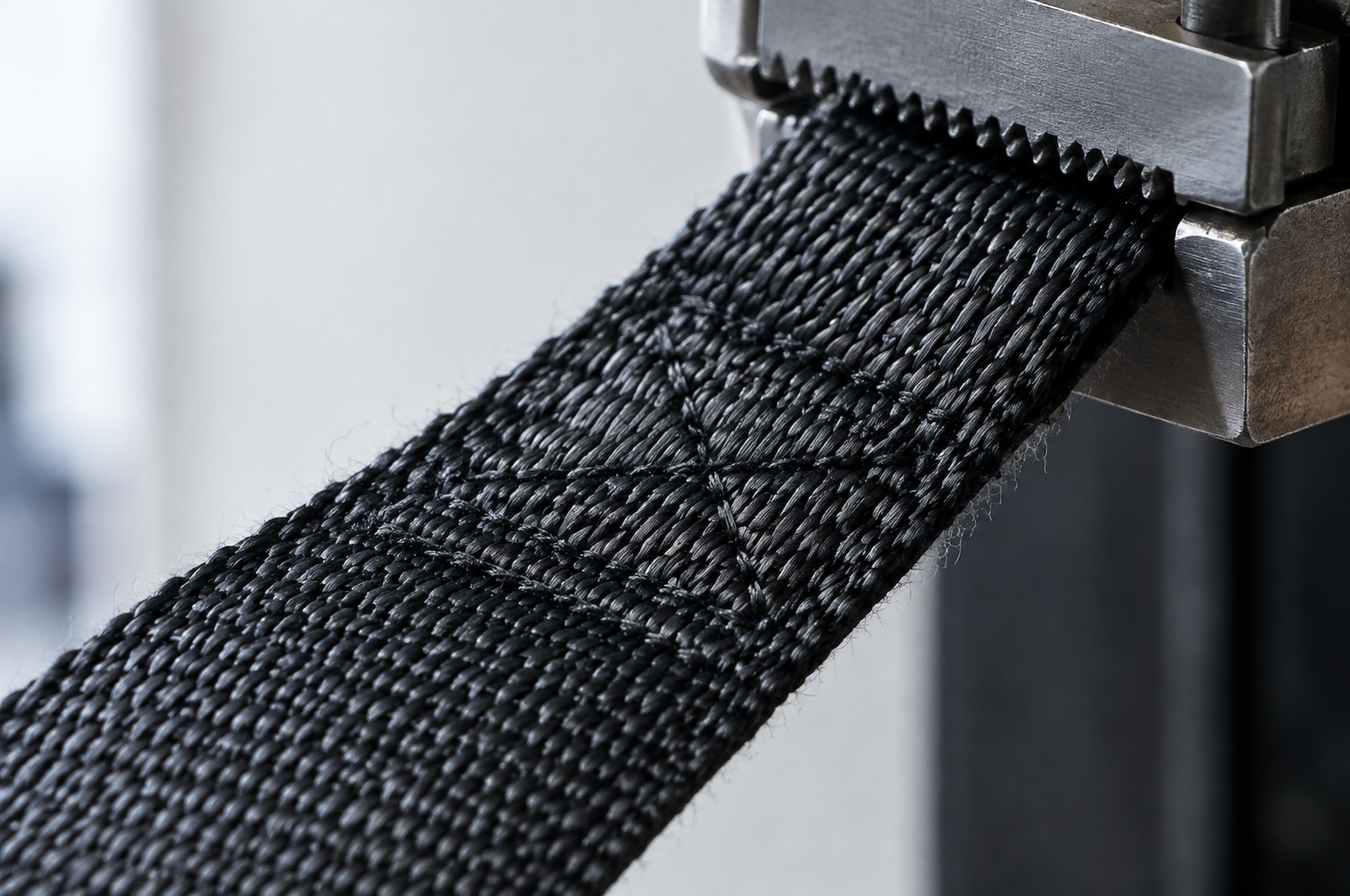
Test speed matters more than buyers expect. We run at 300 mm per minute on a universal tensile machine with a 5 kN load cell. A machine run at 100 mm per minute gives a higher peak reading on the same joint because the thread has more time to distribute stress. Two suppliers can quote the same standard and report numbers 15 percent apart purely on speed.
For context, a 1,000 N joint is about 102 kgf. A loaded 25 L commuter bag sits near 8 kg, so the joint carries 4 to 5 percent of its tested capacity in normal use. The margin absorbs the bounce, the one-strap carry, and the user who hangs the bag on a chair by a single strap every day for two years.
Attachment Methods Compared
Strap anchors are not interchangeable, and the cost difference between them is smaller than the failure difference.
Single box-X with 40 stitches of Tex 70 bonded nylon: adequate up to roughly 400 N on 600D Oxford, the weakest method we still accept
Double box-X, two passes offset by 5 mm: 650 to 750 N, our floor for any laptop backpack
Bar-tack, 42 stitches, 12 mm long, plus a box-X: 900 N and above, standard on 1680D ballistic models
Bar-tack with a 25 mm webbing reinforcement strip behind the anchor: 1,100 N, used on 17-inch and tool backpacks
Strap sewn into the side seam and locked with a topstitch through the binding: 700 N but poor peel resistance, and the first thing to fail when a bag is dragged
The reinforcement strip is the cheapest gain in the list. A 120 mm strip of 25 mm webbing behind the anchor adds about USD 0.07 per bag at 3,000 units and lifts the joint from roughly 700 N to 1,100 N, mostly by spreading load across four stitch rows instead of two.
Why Bar-Tacks and Box-X Stitching Matter
A bar-tack is a dense zigzag block, usually 12 to 15 mm long and 3 to 4 mm wide, that packs stitches into a small area so the load transfers across many thread legs at once. A box-X is a rectangle with a diagonal cross inside it, which resists peeling from four directions. They solve different problems, which is why good anchors use both.
Our engineers cut open failed anchors from a returned retail batch in 2022 and found the pattern clearly. The failed units had a box-X sewn at 6 stitches per inch with a single pass. The thread had not broken. The fabric around the stitches had torn out, because at 6 SPI each stitch carried too much load and the needle holes acted as a perforation line. Moving to 9 SPI with a second pass and a Tex 70 thread moved the failure point from the fabric to the webbing itself, at 300 N higher.
Thread choice is the second lever. We use bonded nylon Tex 70 on strap anchors and will not accept a monofilament or an unbonded thread there, because the knot slips under cyclic load. On a light 210D lining a Tex 70 thread would tear the panel, so we match thread to substrate rather than using one spec everywhere.
There is a real cost trade-off. Full bar-tack plus reinforcement on both anchors adds about 22 seconds of machine time per bag, and at a line rate of 180 bags per hour that is a capacity cost we have to schedule, not a free upgrade. For a program targeting a USD 39 retail price, the two-anchor bar-tack package often has to become one anchor bar-tacked and one box-X, and we say which anchor we reinforced and why.
Running an Incoming Pull Test on Samples
A buyer does not need a 5 kN machine to screen a supplier. A hand-pull rig with a digital scale and a fixed clamp will expose the weakest anchors in a sample set in under an hour.
Cut the test bag open so the anchor is visible, or mark the seam line before pulling
Clamp the strap 100 mm from the anchor so the webbing is not the variable
Pull at a steady rate, roughly one second per 50 N, and record the peak value
Test both anchors on at least three bags from the same lot, and report the lowest
Photograph the failure surface, because a clean thread break and a torn panel mean different fixes
Check the reverse side of the anchor, where skipped stitches hide
Confirm the thread is bonded nylon by feel and by the supplier's invoice, not by eye
Repeat after 24 hours of a 15 kg static hang, which loosens bad tension before you pull
One limitation is worth stating plainly. A tensile machine loads a joint in one direction at a controlled rate, and a commuter loads it thousands of times in many directions at unpredictable rates. Passing a 700 N pull does not certify a two-year life. It certifies that the joint is built to a known standard, which is the only thing a warranty policy can honestly rely on.
At Tianqin, every strap anchor on a laptop backpack model is pull tested at the start of each production run, not only at sample approval, because a thread cone change mid-order can shift tension without anyone noticing. We keep the peak values in the run record and send them with the pre-shipment inspection file.
Fix the Strap Specification Before Sampling
Tell us the bag volume, the target retail price, and whether the bag will be sold with a warranty longer than 12 months. We will propose an anchor build, give you the pull force it should reach, and show you the per-unit cost of the reinforcement strip at your quantity.
Contact [email protected] or visit www.tianqinbag.com to request a sample with a strap pull test record, get a factory quote, or start an OEM/ODM project with Quanzhou Tianqin Bags Co., Ltd. Sampling runs 7-15 working days, and we include the anchor construction drawing with the sample so your team can see what is being tested. Seventeen years of bag manufacturing in Quanzhou, OEM and ODM programs in more than 50 countries, SGS test reports available on request.

 Hot News


