EN



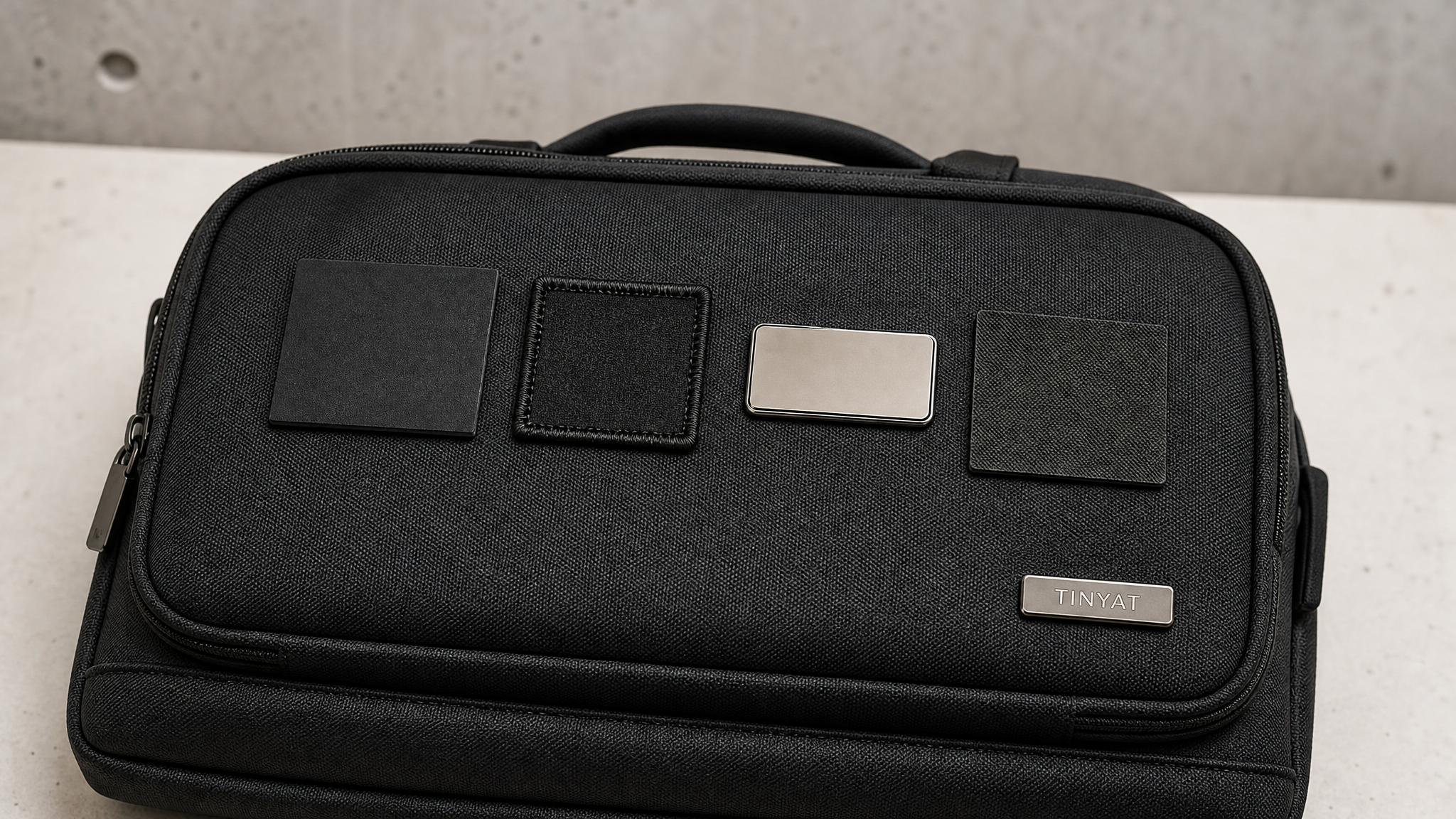
A laptop bag has flat panels, which sounds easier than a curved backpack and behaves differently in one way: the logo sits where a hand rests and where the bag rubs against a coat, a desk edge, and a car seat. Talking to a custom laptop bag with logo manufacturer about six methods before artwork is fixed saves a tooling charge and a rework cycle. Here is how each method behaves on a flat bag panel, what it costs, and where it fails first.
Six Methods, One Flat Surface
The six methods we run on laptop bag panels are embroidery, a woven label, silicone print, heat transfer, a metal badge, and a leather patch with a debossed or foil-stamped face. Each has a cost band, a tooling cost, a best panel, and a failure mode.
Flat panels remove one common problem, which is puckering over a double-curved surface. They introduce another, which is that a laptop bag is handled at the logo. A messenger flap is lifted by the same corner every time. A briefcase is set down on the panel that carries the badge. Whatever you put there gets touched more than a logo on a backpack.
That contact pattern is the deciding factor, and it comes before the price comparison. A cheap method in the wrong place costs more than an expensive method in the right one, because the claim that follows is a full replacement.
Most laptop bags carry two marks rather than one: a main logo on the front panel and a small maker label near the handle or the side seam. Treat them as separate decisions. The side label is a woven label in almost every case, because it is small and the cost difference is irrelevant, while the front panel is where method choice matters and where the tooling budget belongs.
What Each Method Costs And Where It Fails
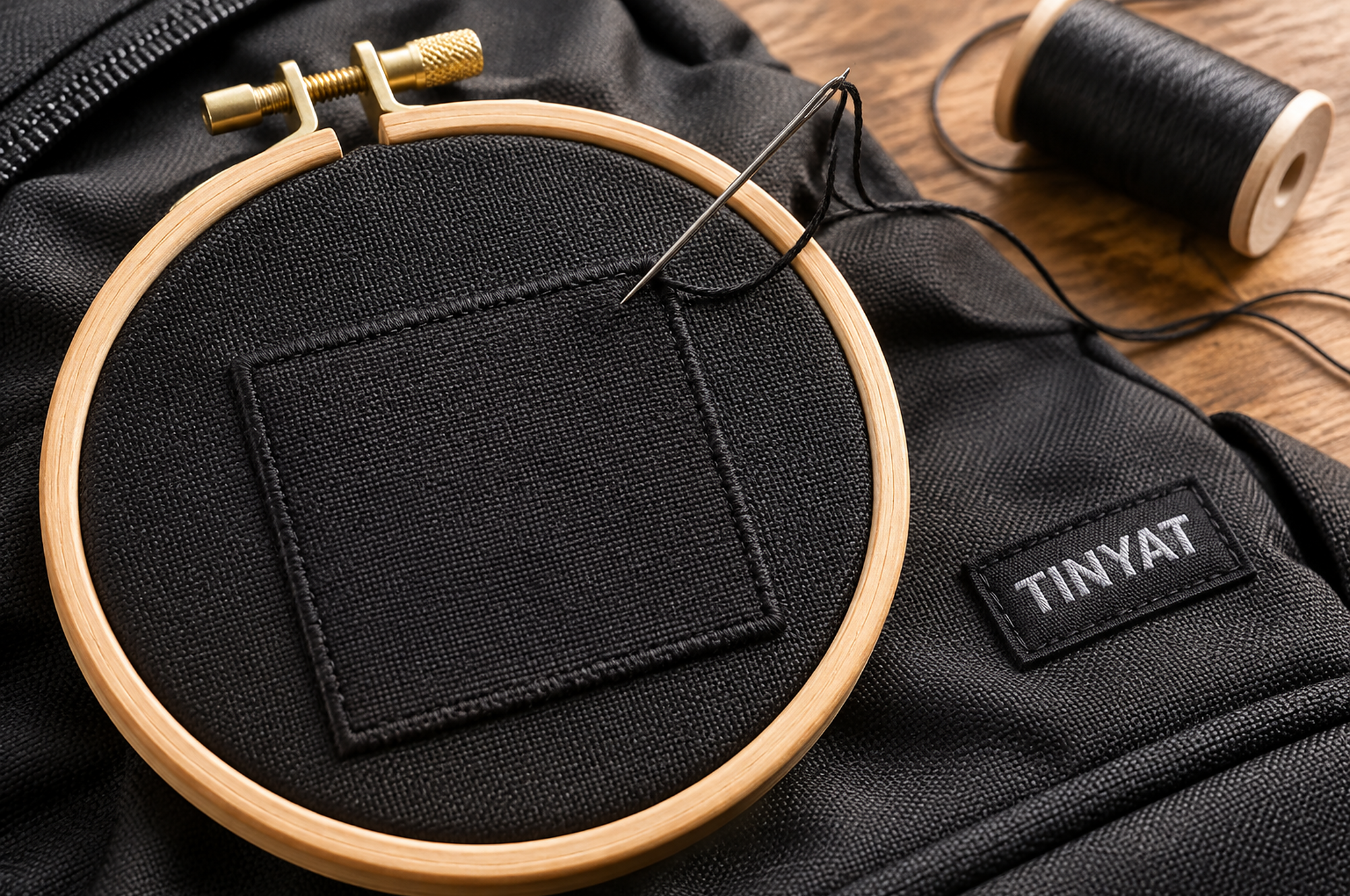
Embroidery: 0.09 to 0.24 USD at 1,000 units, no tooling, 3,000 to 6,000 stitches typical. Fails by thread abrasion on a hand-contact panel, and by puckering above 6,000 stitches on thin shell fabric.
Woven label: 0.05 to 0.09 USD per label, 60 to 90 USD for the loom setup, 2.5 mm border minimum. Fails by edge fraying when the border is narrower.
Silicone print: 0.16 to 0.32 USD, 120 to 180 USD per screen. Fails by lifting at the edge where a flap bends, and needs a primer on coated 600D.
Heat transfer: 0.08 to 0.15 USD, 90 to 140 USD per plate. Fails by telegraphing the weave on textured fabric, and by edge curl after 20 washes.
Metal badge: 0.32 to 0.58 USD, 380 to 550 USD for the mould. Fails by pulling through a single shell layer, and by bending at a panel fold.
Leather patch: 0.22 to 0.45 USD, 90 to 150 USD for a deboss die. Fails by edge abrasion and by dye transfer onto a light lining in humid storage.
Two placement rules come out of that list. Keep any logo at least 12 mm clear of a fold line, because a flap hinge bends through 90 degrees and a rigid element across it will crack. And never put a metal badge on a panel with no stiffener behind it, because a 90 N pull is what a loaded bag experiences when it is grabbed by the front.
What A Custom Laptop Bag With Logo Manufacturer Asks You
Our first six questions on a logo brief are always the same, and the answers decide the method.
Which panel, and is it backed by a board, foam, or a single layer of shell
Does the logo cross a fold, a seam, or a strap root
What contacts that panel: a hand, a desk, a body, or another bag
Artwork size in millimetres, plus the thinnest line weight
Colour requirement, meaning a Pantone match or the nearest thread and film
Volume split by colourway, since tooling amortises across the first order
The volume question is the one buyers answer last and should answer first. A 550 USD badge mould spread over 400 units adds 1.38 USD per bag, which can exceed the entire trim budget on a value program. The same mould over 3,000 units adds 0.18 USD and becomes the cheapest option per unit after the first season.
A Branding Method Comparison
Use these lines to pick a method before the sampling round rather than after it.
Method: embroidery, tooling 0 USD, unit 0.09 to 0.24 USD
Embroidery best panel: flat front panel, board-backed, low hand contact
Method: woven label, tooling 60 to 90 USD, unit 0.05 to 0.09 USD
Woven best panel: small areas under 40 mm wide, and folded edges
Method: silicone print, tooling 120 to 180 USD, unit 0.16 to 0.32 USD
Silicone best panel: rigid front panel, no fold within 15 mm
Method: heat transfer, tooling 90 to 140 USD, unit 0.08 to 0.15 USD
Heat transfer best panel: smooth 600D, fine detail down to 0.3 mm
Method: metal badge, tooling 380 to 550 USD, unit 0.32 to 0.58 USD
Badge best panel: board-backed front panel, 90 N pull test
Method: leather patch, tooling 90 to 150 USD, unit 0.22 to 0.45 USD
Limit: patch on dark leathers can transfer dye to a light lining
Approval: physical strike-off on the production fabric, per colourway
That approval line is where programs lose time. A logo approved from a screen render is not approved, because the film, thread, and metal all read differently against a 600D shell, and a dark colourway hides a defect that a grey one exposes.
Where A Cheap Method Costs More
The honest trade-off in this comparison is that embroidery looks the most economical on the quotation and is not always the cheapest over two years. Thread fuzz on a hand-contact panel reads as wear, and a worn logo drives a replacement in a channel where the brand is the product. We have seen a program move from embroidery to a woven label on the front panel after the first return cycle, and the label cost 0.04 USD less per unit as well as wearing better.
The other limit is colour. A four-colour logo in a 4 mm high woven label loses detail, and a metal badge cannot do a gradient. If the artwork needs either, screen or heat transfer is the only route, and both need a flat, low-contact panel.
What the buyer sees when the artwork goes to the line
From your side, the striking difference appears on the second colourway, not the first. A logo that sat perfectly on a charcoal sample can read 1 mm low on a tan one, because the operator centres on the panel edge by eye. That is why we mark logo position on the pattern with a template and check the first five units of every colourway rather than the first five of the run.
Send The Artwork With The Panel Callout
Send your artwork with the panel named, the contact level stated, and the volume per colourway. We will come back with the method that fits the geometry, the tooling cost, and the unit impact at your order quantity, so you can choose on total cost rather than on the sample photograph.
Contact [email protected] or visit www.tianqinbag.com to request samples, get a factory quote, or start an OEM/ODM project with Quanzhou Tianqin Bags Co., Ltd. Sampling lead time is 7-15 working days. Seventeen years of bag manufacturing in Quanzhou, exports to more than 50 countries, SGS test reports covering REACH, CPSIA and Prop 65 on request.

 Hot News