
 EN



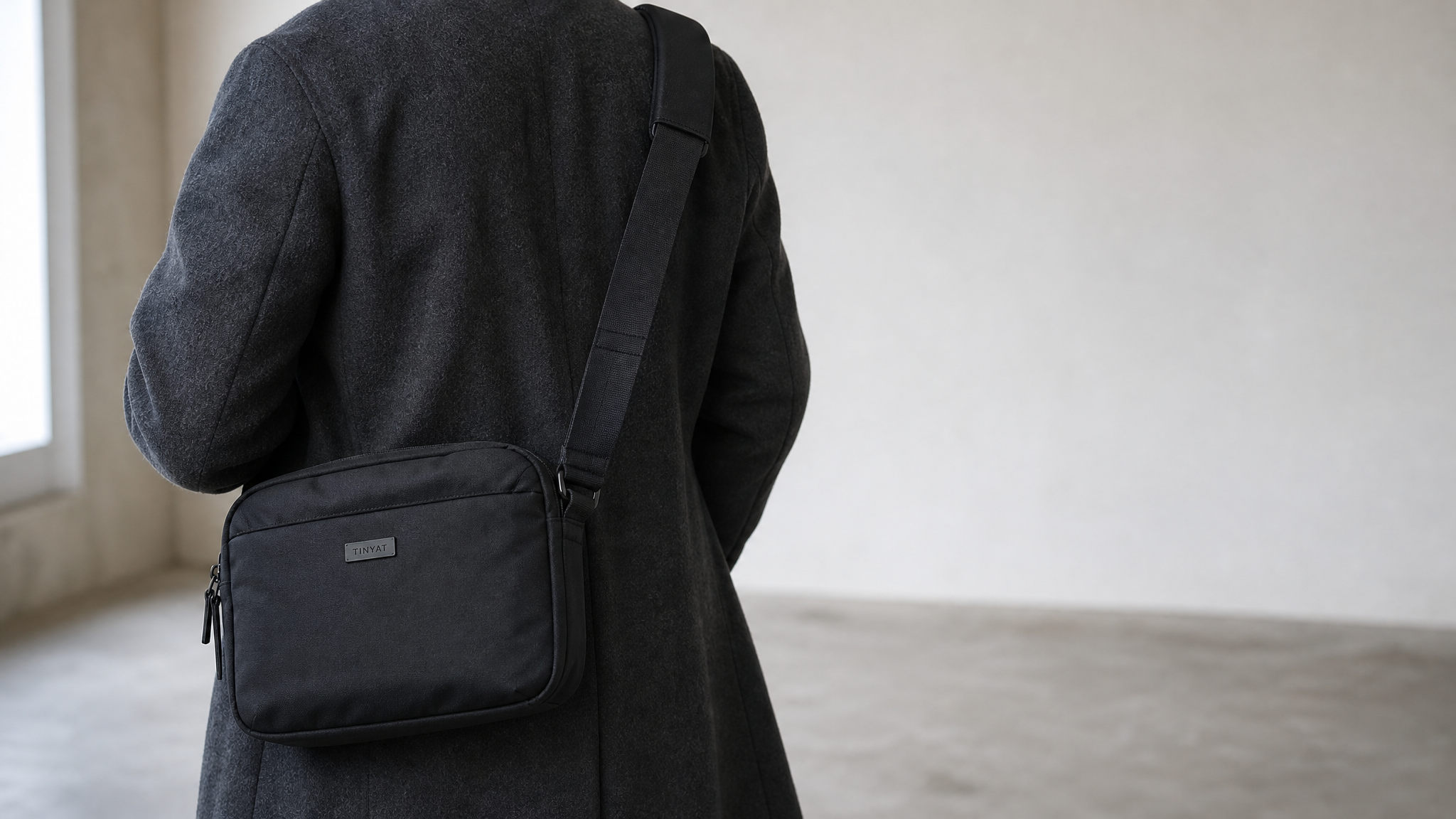
A shoulder bag puts 3 to 4 kg on a strip of webbing about 40 mm wide, resting on one shoulder for a whole journey. Any custom laptop shoulder bag manufacturer is solving an ergonomic problem before a design problem, and it is solved in four places: the pad, the webbing, the adjuster, and the swivel. The budget should go where the pressure actually is.
A Strap Is A Pressure Problem With A Buckle On It
Comfort on a single-shoulder carry is pressure, and pressure is load divided by contact area. The arithmetic is simple enough to run before a sample exists.
A 4 kg bag on two points of contact, if the wearer uses the bag across the chest, is roughly 2 kg per contact. If the pad contacts 45 mm by 180 mm, that is about 81 square cm and roughly 25 g per square cm, which is a light pressure. If the pad is 30 mm by 120 mm, contact is 36 square cm and the pressure is 56 g per square cm, which produces a hot spot within half an hour.
That calculation explains why a wider pad helps even when the foam is unchanged, and why a long thin pad is worse than a shorter wide one. It also explains the most common complaint in this category, which is not weight but a burning point on the shoulder after twenty minutes.
Pad Shape And Load Per Square Centimetre
A pad has four measurable properties, and all four appear on our specification sheet for a shoulder bag program.
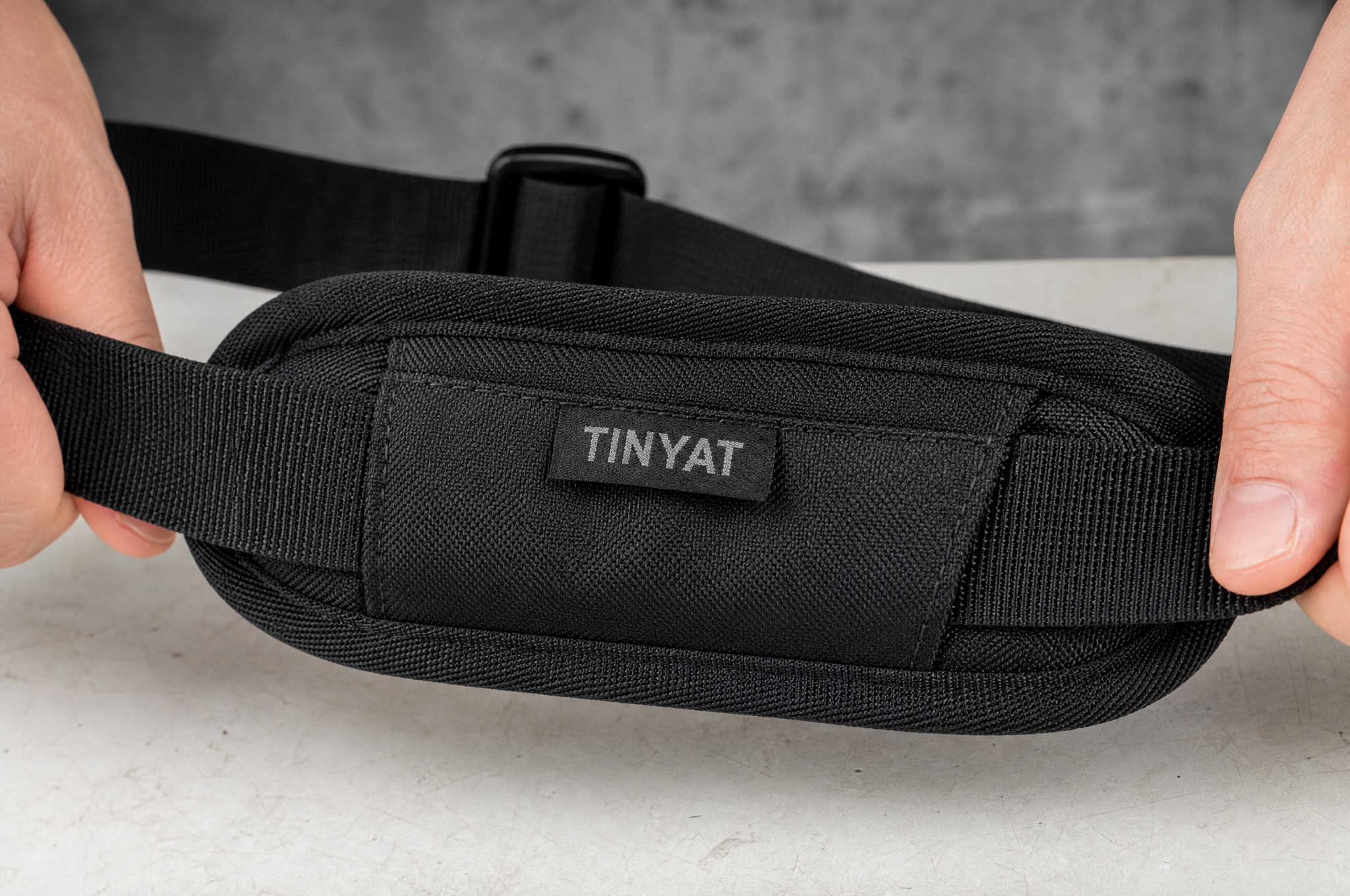
Width: 50 mm on the top surface, tapering to 45 mm at the ends
Length: 220 mm, which covers the shoulder and reaches the collarbone
Foam: 12 mm closed-cell at the centre, 6 mm at the taper
Surface: 3 mm spacer mesh against the body, for moisture rather than padding
The 12 mm centre is thicker than a backpack strap because the contact area is smaller. On a two-shoulder carry, 4 kg is split across two points and 10 mm of foam is sufficient. On one shoulder, the same load arrives through one point and the foam needs to distribute it before the shoulder feels it.
Spacer mesh is the second half of comfort. A closed foam surface against a shirt traps moisture, and a damp patch on a shirt after a commute is a complaint even when the pressure is fine. The mesh adds about 9 g and 0.07 USD per pad.
We measure the result rather than assuming it. On new pad patterns we use pressure film between the shoulder and the pad with a 4 kg load and read where contact saturates. A pattern that shows one concentrated spot and a large untouched area is concentrating load, and the fix is a shape change rather than more foam.
Length Range, Adjusters, And Rotation
Length is where shoulder bags fail most often for reasons that have nothing to do with padding.
Webbing length: 950 to 1,250 mm for an on-shoulder carry, 1,250 to 1,500 mm if the bag can be worn across the body
Adjuster: a metal or heavy acetal slider that holds position under 4 kg and releases when the webbing is lifted
Swivel: a 40 mm metal swivel at the bag end, which lets the bag hang flat instead of rotating
Attachment offset: 30 mm back from the side seam, which changes the hang angle and reduces forward roll
The adjuster matters more than buyers expect. A light acetal slider on 40 mm webbing creeps under load, and the customer retightens the strap every ten minutes. We pull test adjusters at 400 N for 10 seconds and then check for slippage of more than 5 mm under a sustained 3 kg load for an hour, which is the closest bench condition to a walk.
The swivel is the second cheap fix. A strap sewn directly into a seam makes the bag rotate forward on every step, and a rotation above about 20 degrees is uncomfortable. Adding a swivel costs 0.09 USD and stops the bag fighting the hip.
What A Custom Laptop Shoulder Bag Manufacturer Tests
Shoulder bags get a strap-specific test set, because a strap failure is both a comfort complaint and a safety issue.
Pad pressure: 4 kg load on pressure film, no point above 300 g per square cm
Adjuster creep: under 5 mm in one hour at 3 kg
Swivel cycle: 500 rotations under 4 kg, no binding or wear through the plating
Attachment pull: 600 N static at both ends of the strap
Webbing abrasion: 2,000 cycles against a 1680D pad edge, checking for fraying
Swing test: 500 walking cycles, rotation under 20 degrees
Stitch density: 10 stitches per inch on the strap run, 25 mm bar-tack at terminations
The swing test is the one that catches geometry errors. A bag can pass every static test and still swing like a pendulum on a walking wearer, because the attachment points are too close to the ends of the bag or the swivel is missing. We run 500 cycles and film it, and the video is more useful to a buyer than any measurement.
Where ergonomics meets price
A shoulder bag built with a 12 mm shaped pad, spacer mesh, a metal swivel, and a creep-resistant adjuster adds about 0.28 USD and 55 g over a flat 8 mm pad with a plastic slider. Below roughly 5.40 USD FOB at 1,000 units, one of those four items goes, and the first to go is always the swivel.
There is also a limit that no strap design fixes. A single-shoulder carry of 5 kg for an hour is uncomfortable whatever the pad, because the contact area is too small for the load. If a program needs to carry that much, the honest advice is a two-strap bag, and we say so rather than selling a wider pad as a solution.
What the buyer sees after twenty minutes of wear
From your side, a sample feels fine for the first five minutes and tells you nothing. Load it to the weight your customer actually carries, put it on, and walk for twenty minutes. The strap either stays where you put it or it slides toward your neck, and the pad either spreads the load or develops one point that you keep adjusting. Those two observations are the whole ergonomic assessment.
A Strap Ergonomic Sheet
Put these values in the tech pack.
Rated load: 4 kg typical, 5 kg maximum
Pad width: 50 mm top, 45 mm at the taper
Pad length: 220 mm
Pad foam: 12 mm closed-cell at centre, 6 mm at taper
Pad surface: 3 mm spacer mesh against the body
Webbing: 40 mm, 950 to 1,250 mm on-shoulder, 1,250 to 1,500 mm cross-body
Adjuster: metal slider, creep under 5 mm per hour at 3 kg
Swivel: 40 mm metal at the bag end
Attachment: 30 mm back from the side seam, 25 mm bar-tack
Pressure gate: no point above 300 g per square cm at 4 kg
Rotation: under 20 degrees over 500 walking cycles
Verification: twenty minute wear test at rated load, plus pressure film reading
The wear test line is the one to insist on, and it is the only item on the list that cannot be checked on a bench.
Send The Load And The Journey Length
Tell us the weight your customer carries and how long they carry it, and we will return a strap specification with the pad, webbing, adjuster, and swivel costed separately. If the load is beyond what a single shoulder should carry, we will say so and quote a two-strap alternative rather than a heavier pad.
Contact [email protected] or visit www.tianqinbag.com to request samples, get a factory quote, or start an OEM/ODM project with Quanzhou Tianqin Bags Co., Ltd. Sampling lead time is 7-15 working days, and wear tests are run on request before shipment. Seventeen years of bag manufacturing in Quanzhou, exports to more than 50 countries, SGS test reports covering REACH, CPSIA and Prop 65 on request.

 Hot News


