EN



The bag on the pallet can be traced back to a bundle ticket, which traces to a cutting ticket, which traces to a roll of fabric carrying a lot number. A custom laptop bag factory that can follow that chain answers a complaint in a day. One that cannot answers with an estimate. The process is physical, but what makes it controllable is the paper that travels with the goods, and that is what a buyer should examine.
The Bag Carries Its Own History
Every finished bag has a history: which roll, which cutting table, which line, which operator, which inspection. None of it is visible in the bag.
The history is written down in eight handovers, and each handover is a place where information can be lost. Tech pack to pattern. Pattern to marker. Marker to cutting ticket. Cutting ticket to bundle. Bundle to line. Line to inspection. Inspection to packing. Packing to carton and packing list.
A factory with a gap at any of those eight points can still produce a good bag. What it cannot do is tell you why the fourth carton in the shipment was wrong, which matters when a buyer asks and a container is waiting.
From Tech Pack To Pattern
The first handover is the one that decides everything else, and it happens before any fabric is cut.
A tech pack arrives with measurements, construction notes, material calls, and tolerances. The pattern maker turns it into pattern pieces, adds seam allowances, and marks notches, grain lines, and logo positions. Where the tech pack is silent, the pattern maker decides, and those decisions are invisible to the buyer.
That is why we return a pattern summary with the first sample: piece count, seam allowance per seam type, the tolerance on the main dimensions, and a list of the four places where we had to interpret the drawing. Buyers who read that list usually correct one of the four, and correcting it before sampling saves a round.
One number governs the rest. Our cutting tolerance is 2 mm on cut parts, and the pattern is built so that the sewn dimension still lands inside the agreed tolerance when two cut edges meet. A pattern built to exact dimensions with no allowance for take-up produces a bag that measures short on every panel.
Cutting, Bundles, And The Run Card
Cutting is where a design becomes a countable quantity, and the bundle is the unit that the rest of the factory works with.
The cutting ticket states the PO, the colourway, the panel name, and the quantity
The marker lays pieces for the most economical use of the roll, usually 12 to 20 pieces per lay
The bundle holds the cut pieces for a set of bags, normally 30 to 50, tied with a ticket showing PO and quantity
The run card travels with the bundle and records the line, the date, the operator at each operation, and the stitch density checks
The finished bundle is counted against the ticket before inspection, and a shortage is investigated at that point
The run card is the document that makes a factory auditable. When a buyer asks why the stitch density on the second shipment is lighter, the run card either shows a measured value of 8 per inch or it shows nothing, and the second answer is itself information.
We keep run cards on the floor rather than in the office, because a record written up at the end of the week is a summary rather than a measurement. Cards are retained for 12 months, which covers the reorder cycle on most programs.
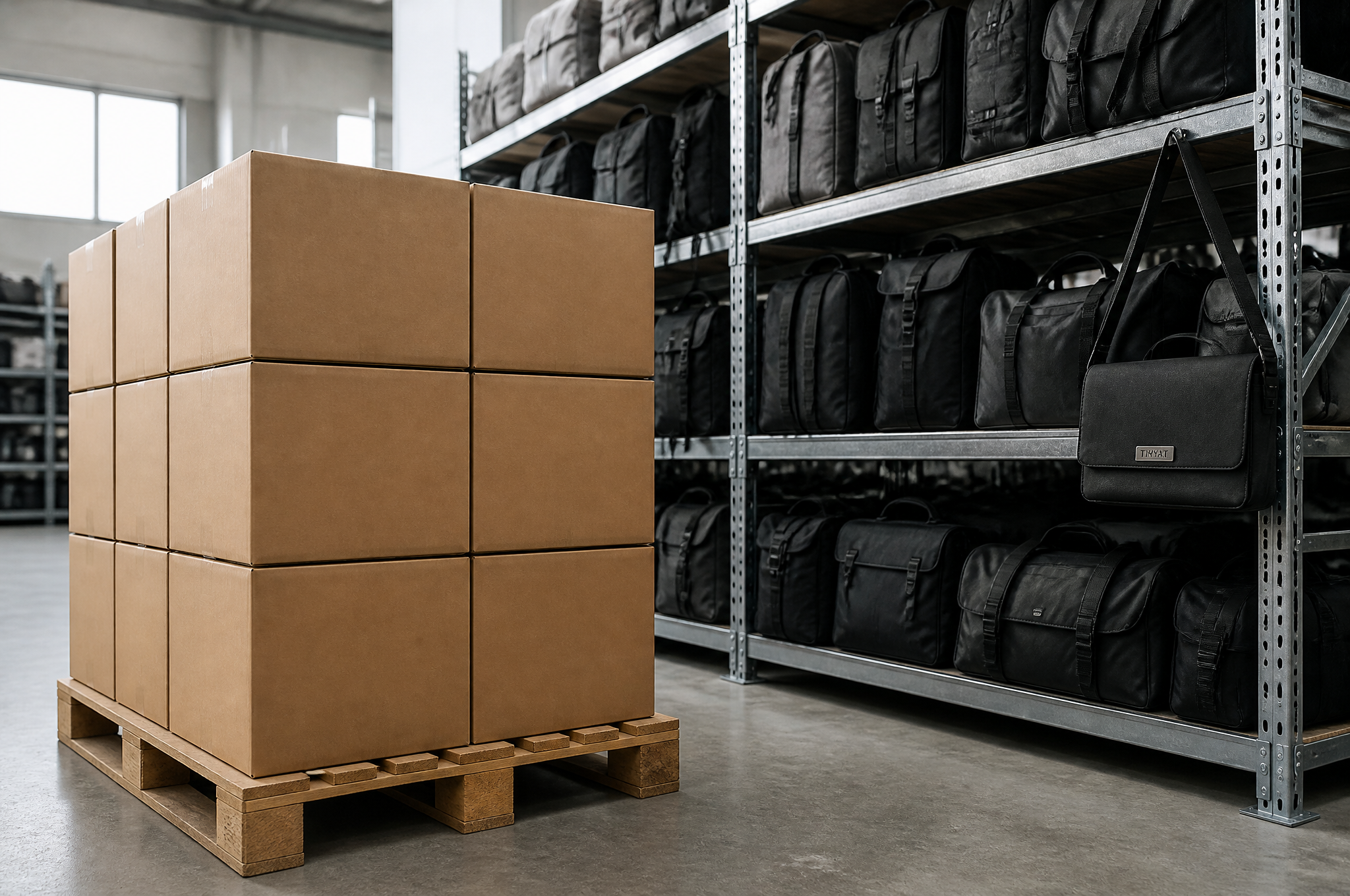
Palletisation is the last handover and the one buyers rarely see. Cartons are counted against the packing list by range rather than one by one, gross weights are compared with the carton specification, and the loaded pallet is photographed before wrapping. A count that does not reconcile stops the shipment on our loading bay rather than in the buyer's warehouse.
What A Custom Laptop Bag Factory Records At Each Handover
The records we hand to a buyer at the end of a program are not the internal documents. They are a smaller set, chosen so that a buyer can reconstruct what happened without reading Chinese production paperwork.
Golden sample: sealed, signed, and dated at approval, with the measurement sheet attached
Cutting summary: rolls used, lot numbers, and the shade approval for each
Inspection report: AQL 2.5 at General Inspection Level II, with the defect classification and a photograph set
Measurement record: three bags measured per 500 units, values listed against the tolerance
Test records: abrasion, seam, zipper, and hardware results where the program called for them
Packing list: carton range, units per carton, gross weight, and the carton marking used
The golden sample line is the one that resolves most disagreements, because it is a physical object rather than a description. If the sealed sample from approval and the bag in the container differ, the conversation is short. If there is no sealed sample, the conversation is about memory.
Where the paper trail stops
Two limits are worth stating. A record shows what was done, not whether the design was right. A factory can produce perfect documentation for a bag that was always going to fail at the seam, and good paperwork will not save it.
The other limit is the mixed bin. Once cartons are opened and stock is combined at a distributor, we can identify the production run but not the individual bag, so any investigation becomes statistical. Buyers who keep purchase orders in separate bins get faster answers from every factory they work with.
What the buyer sees when the paperwork is complete
From your side, the difference shows up when something goes wrong. With a complete set you can look up the defect in the inspection report, match it to the run card, and tell your customer exactly what happened and what changed. Without it, the same situation turns into a negotiation with your own supplier about what "normal" means.
A Traceability Sheet
Ask for these items with the first bulk shipment, not after a problem.
Sealed golden sample: signed and dated by both parties
Pattern summary: piece count, seam allowances, and the four interpreted points
Cutting record: roll lot numbers and shade approval per colourway
Run card extract: line, dates, stitch density checks, operator records
Inspection report: AQL 2.5 at Level II, with defect photos
Measurement record: three bags per 500 units against stated tolerance
Packing list: carton range, units per carton, gross weight
Record retention: 12 months from shipment date
Carton marking: PO number and carton sequence on each box
Claim route: the name of the person who holds these records
That last line is small and practical. A traceability system with no named owner is a filing cabinet.
Ask For The Records Before You Need Them
Send us a tech pack and we will return the pattern summary with the interpreted points listed, and we will show you the run card and inspection report format before you place the order rather than after the first problem. Records are only useful when they already exist at the moment you need them.
Contact [email protected] or visit www.tianqinbag.com to request samples, get a factory quote, or start an OEM/ODM project with Quanzhou Tianqin Bags Co., Ltd. Sampling lead time is 7-15 working days, and the golden sample is sealed at approval. Seventeen years of bag manufacturing in Quanzhou, exports to more than 50 countries, SGS test reports covering REACH, CPSIA and Prop 65 on request.

 Hot News