 ×
×
Most laptop backpacks on the market are marketed as "waterproof" or "water-resistant" without any meaningful specification behind the claim. A buyer who accepts this language without asking follow-up questions is accepting unknown performance — and unknown liability when the product fails.
True waterproofing requires sealed seams, waterproof zippers, and a fabric with a hydrostatic head rating sufficient to resist sustained water pressure. Most laptop backpacks described as "waterproof" are actually water-resistant — they will shed light rain for a short period but will allow water ingress under sustained exposure or pressure. Understanding the difference shapes how you spec the product and how you communicate its capabilities to end users.
The most common water-resistance treatment is Durable Water Repellency (DWR) coating, applied to the outer fabric surface. DWR causes water to bead on the fabric surface rather than absorbing into the fibers. It is effective against light rain and brief moisture exposure but degrades with use, washing, and UV exposure.
Polyurethane (PU) coating is a heavier application — a film laminated to the fabric's inner surface. PU coating provides more robust water resistance than DWR and is measured using the hydrostatic head test (ISO 811). A fabric with a 1,000mm hydrostatic head rating will resist a column of water 1,000mm high for a defined test period. For a laptop backpack, 1,500–2,000mm is a reasonable specification for meaningful rain protection. Below 1,000mm, the protection is largely cosmetic.
Thermoplastic polyurethane (TPU) lamination offers the strongest water resistance short of full waterproofing. TPU-laminated fabrics are commonly used in roll-top laptop backpacks marketed for outdoor and travel use.
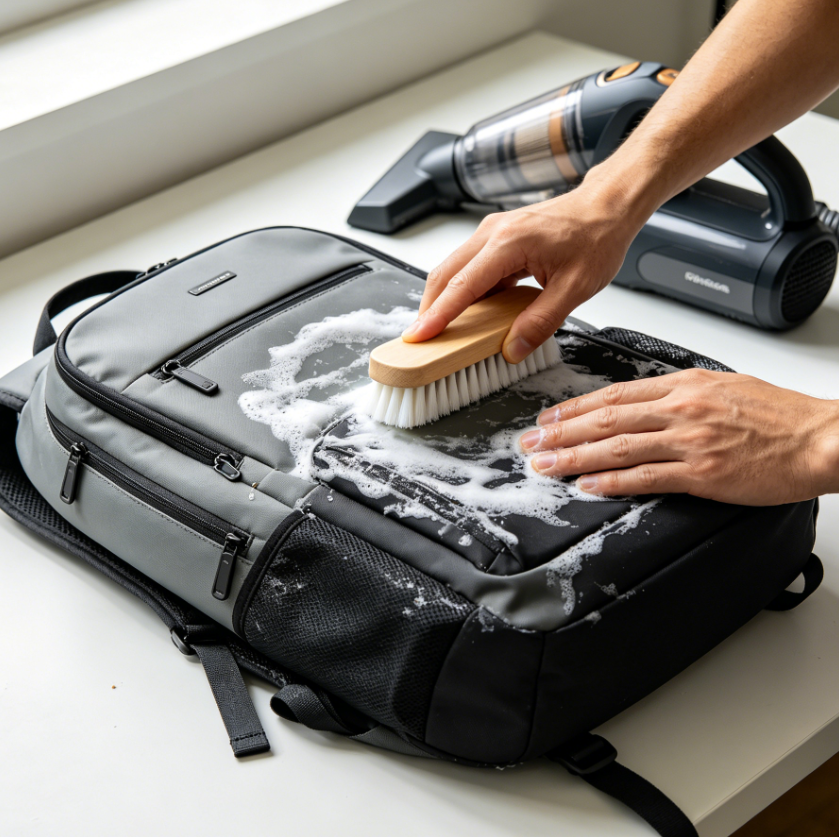
When placing an order for water-resistant laptop backpacks, require the coating type and hydrostatic head rating in the purchase order. "Water-resistant" as a standalone description is not a specification — it is a marketing claim.
Request the fabric mill's test certificate for hydrostatic head rating. This is different from the factory's own quality documentation — it comes from the source of the fabric and is harder to fabricate.
If the bag will be marketed as offering laptop protection from rain, specify sealed seams in the laptop compartment. An uncoated seam on an otherwise water-resistant bag is a guaranteed leak point. Seam sealing adds cost — typically $0.50–1.50 per bag — but is the only way to deliver on a meaningful water-protection claim.
"Waterproof zippers" is a claim that requires verification. Water-resistant zippers (typically rated IPX3 or IPX4) resist spray from defined angles at defined pressures — they are not submersion-proof. Full waterproof zippers (coil zippers with a waterproof membrane) cost significantly more and are rarely used in standard laptop backpack production.
Base panel treatment is frequently omitted in spec sheets. The bottom of a laptop backpack — the surface most likely to be set down in water — is often the least protected part of the bag. Specify TPU or rubberized base material if bottom water ingress is a real use-case concern.
Coating durability claims are difficult to verify without wash testing. Request ISO 4920 spray rating test results after 10 wash cycles to understand how the coating performs after real-world use.
Most laptop backpacks sold to corporate and business buyers do not need full waterproofing — they need reliable rain resistance for commuter and travel use. A 1,500mm hydrostatic head rating, DWR outer coating, and taped seams in the laptop compartment delivers meaningful protection at a cost that does not require a premium price point.
The problem is not the technology. The problem is that buyers who do not specify these properties receive whatever the factory has in stock — which may be a 500mm PU coating with no seam treatment, marketed as "water-resistant" because the factory's sales team knows the term will not be challenged.
 Hot News


 EN
EN